
“`html
Artificial Solar Eclipse Achieved in Space by European Satellites
Table of Contents
In a groundbreaking achievement, the European Space Agency (ESA) has successfully created an artificial solar eclipse in outer space using two specialized satellites. Announced on Monday, June 16, 2025, this innovative experiment provides invaluable data for scientists seeking a deeper understanding of the sun and its dynamic atmosphere.
Proba-3 Mission Creates Artificial Eclipse
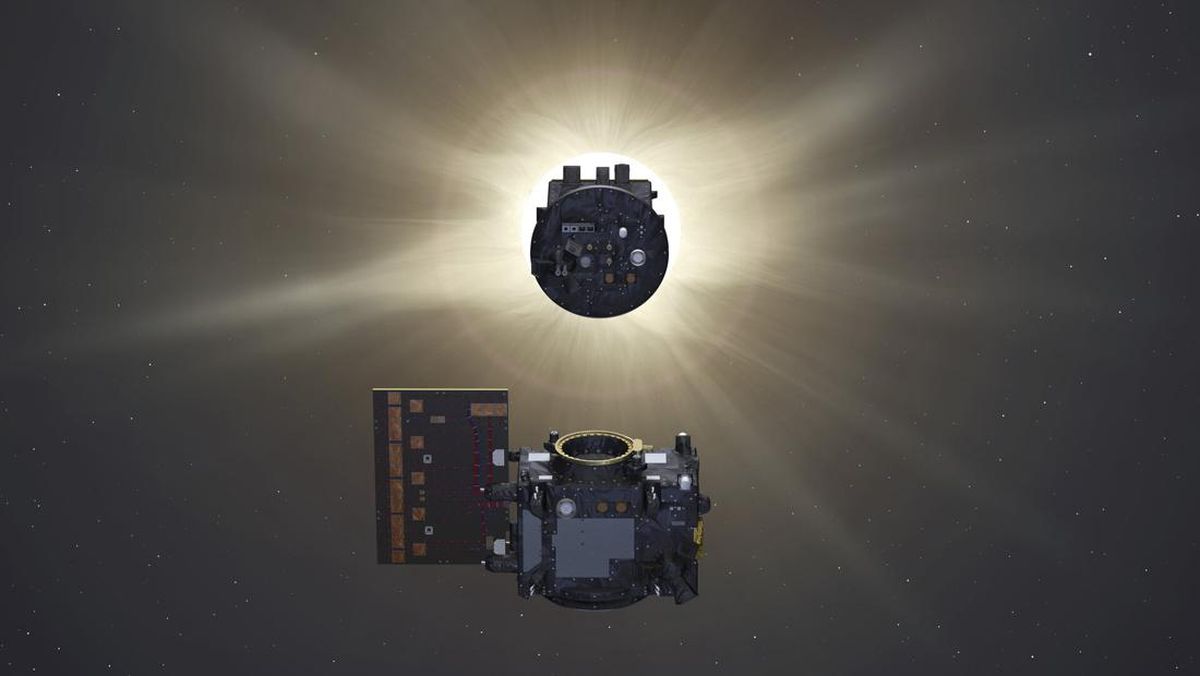
The ESA’s Proba-3 mission involved two satellites, named Coronagraph and occulter, flying in a meticulously controlled formation, maintaining a distance of 130 meters for several hours.This formation effectively created an artificial eclipse,allowing for sustained observation of the sun’s corona. According to ESA, this marks the agency’s first precision space-flight mission and a world first in achieving such controlled shadow play in space.
Did You Know? The Proba-3 mission has successfully created 10 artificial eclipses to date!
scientific Objectives and Benefits
The United States Space Agency (NASA) highlights that the Proba-3 mission will enable scientists to closely examine the sun’s corona, facilitating the study of solar wind and coronal mass ejections. These phenomena have a direct impact on space weather and can affect Earth-based technologies [Source: NOAA space Weather Prediction Center].
dietmar Pilz,Director of Technology,Engineering,and Quality at ESA,expressed his enthusiasm,stating,”It’s fun to see these amazing images validate our technology in what is now the world’s first precision flying mission,” as reported by USA Today.
Pro Tip: Studying the sun’s corona helps us better predict and mitigate the effects of solar storms on our planet.
| Feature | Details |
|---|---|
| Satellites | Coronagraph & Occulter |
| Formation Distance | 130 meters |
| Longest Eclipse Duration | 5 hours |
| Primary Objective | Study the Sun’s Corona |
Instrument Details and Data Processing
During the artificial eclipses, the ASPIICS optical instrument on Coronagraph captures images of the sun’s corona while Occulter effectively blocks the sunlight. The resulting images are then processed by the ASPIICS Science Operations Center at the Belgian Royal Observatory, where a team of scientists creates detailed corona photos based on input from the scientific community.
Jorge Amaya, coordinator of space weather at ESA, emphasized that the current corona photos are incomparable to those from Proba-3, which observes the sun’s corona almost to the edge of the sun’s surface. He noted that this level of detail has previously only been achievable during natural solar eclipses.
ESA further added that the images from the Proba
