
Navigating Complexity: the Swiss Queer Organization Keschet Addresses Rising Tensions and Internal Debates
The current geopolitical climate is creating friction within the queer movement, according to the Swiss association Keschet. Traditionally built on international solidarity and intersectional thinking, the movement is now grappling with internal contradictions, particularly regarding the position of Jewish people within broader struggles for liberation.
Keschet argues that some activists,while eager to stand with the oppressed,are overlooking the reality of contemporary anti-Semitism and the fact that Jewish people are themselves a marginalized group. The organization strives to create space for this complexity, prioritizing dialog over confrontation and facilitating events that bring together Jewish and Palestinian queer perspectives. Their aim is to foster awareness without resorting to moral judgment.
“Many people don’t even know what anti-Semitic images they are reproducing when they adopt certain slogans,” explains Keschet’s board. They point to recent examples, such as the advertisement for a Christopher Street Day event in Basel featuring red Hamas triangles, and a speaker concluding a speech with “There is no love without Intifada.” The board highlights the irony of using “love is love” – a slogan central to the fight for marriage equality – alongside a battle cry of a terrorist organization that targets both jews and LGBTQ+ individuals.
Keschet is also engaged in internal reflection, collaborating with partner organizations in Berlin and Düsseldorf to refine its arguments and address evolving challenges.This process is further informed by the personal histories of its members.
Rolf Stürm, a founding member of Keschet and a veteran of LGBTQ+ activism in Switzerland, shares his own journey of “double coming out.” Growing up in Bern with a secular upbringing – his mother a German Jew who rarely spoke of her persecution, and his father having left the church – Stürm sought early orientation, declaring his lack of religious belief to his first-grade teacher and acknowledging his difference. He found a sense of belonging within the Jewish community at age 14.
Later, after a marriage and divorce, Stürm embraced his homosexuality. Experiences within the gay and lesbian jewish community during a postdoctoral position in Houston further shaped his activism, which he brought back to Switzerland, contributing to the founding of Aids-Hilfe Both Basel, Gay Sport, and Queer Officers. He publicly identified as Jewish while an officer candidate in 1972 and came out as gay as a captain in 1984, even refusing to donate blood in protest of the discriminatory ban on gay men donating due to HIV concerns.
Stürm emphasizes that identities aren’t simply intersecting, but rather forming a union. He advocates for young people to leverage their diverse skills instead of competing for recognition as victims. He stresses the importance of openness and honesty, particularly in combating anti-Semitism. “Queerness means enduring differences,” he concludes. “This also applies when it comes to Jewish identity. It doesn’t require complete unity – just a willingness to listen to one another.”
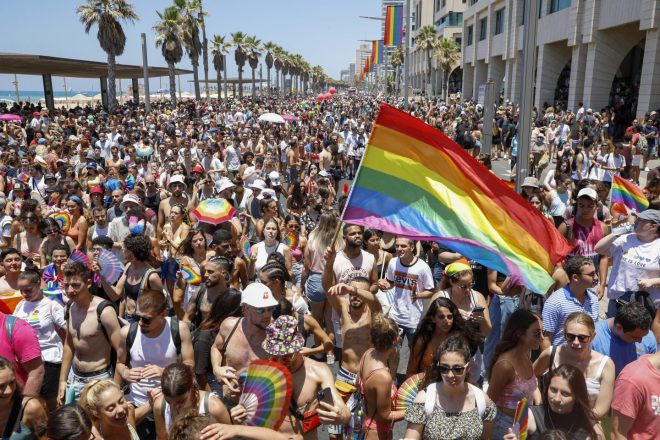
(Image caption from the original article is retained): A Pride Parade in Tel Aviv (archive photo). Foto: picture alliance / ASSOCIATED PRESS
