
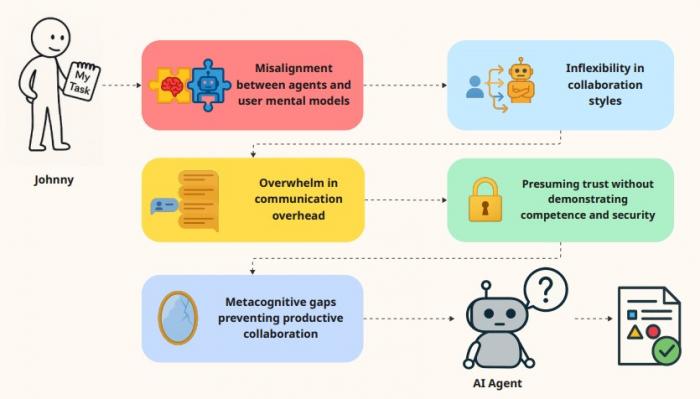
The Challenges of AI Agent Usability: Bridging the gap Between Potential and User Experience
recent research highlights a significant disconnect between the promise of AI agents and the reality of user experience. While the underlying technology demonstrates strong potential – evidenced by high System Usability Scale scores of 70-90 – users are struggling to effectively interact with and trust these agents. A study, titled “Why Johnny Can’t Use Agents: Industry Aspirations vs.User Realities with AI Agent Software” and available on arXiv, identifies five key usability issues hindering widespread adoption.
One major problem is the failure to understand and incorporate user preferences proactively. Participants noted agents didn’t ask clarifying questions about desired outcomes, like bed configurations or preferred views, instead launching directly into task execution. As one participant (P22) pointed out, the agent didn’t inquire about fundamental preferences, operating as if a single path to completion exists.
Secondly, the study revealed a lack of flexibility in collaboration styles. Users felt limited in their ability to control the agent’s behavior. Several participants (like P26) expressed a desire for a “pause button” to regain control during task execution, indicating a need for more granular oversight. There was also a divergence in desired levels of agent autonomy, with some (P16) preferring to handle basic tasks themselves and utilize AI primarily for confirmation.
A third challenge is excessive interaction. Some users found the agent’s output overwhelming, describing it as an “endless eruption” (P18) or “too much information” (P16). However, others (P21 & P23) valued seeing the agent’s reasoning process and the steps taken to achieve a result, demonstrating a clear need for adaptable communication styles.
The research also points to a critical lack of metacognitive ability within the agents. They struggle to recognize their own limitations and knowledge gaps, leading to unproductive loops. One participant (P16) described the agent “spinning” when unable to access necessary information or complete a task.
the study identified a phenomenon dubbed “prompt gambling,” where users feel they are experimenting with instructions rather than engaging in a predictable interaction.This suggests a core usability issue, not a technological one.
The researchers propose six design recommendations to address these challenges: personalization, enhanced metacognitive skills, adaptive interfaces, a clear planning-execution process, guaranteed user control, support for diverse input methods, and precise iterative refinement.
Ultimately, the study suggests that success in the AI agent market will depend on a shift towards user-centered design. Companies must prioritize translating complex AI technology into simple, intuitive, and predictable user experiences.
Key Takeaways for Users:
* Initial Prompting Matters: The first instruction significantly influences the outcome. start with a balanced level of detail and refine your requests iteratively.
* Verify Information: Always double-check information provided by the agent, especially for critical decisions. Question unrealistic outputs (like a $10/day car rental, as noted by P26).
* Treat Agents as Assistants: Approach collaboration with AI agents like working with a management assistant - providing guidance and oversight throughout the process, rather than expecting full automation.
(Original article source: AI Matters – https://aimatters.co.kr/?p=31837)
