
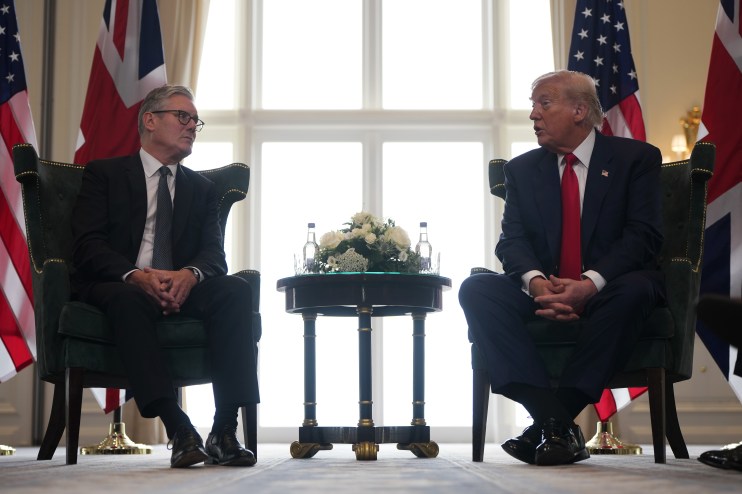
Trump tells Starmer to ‘go get your own oil’
Trump’s directive to Starmer signals a decoupling of UK-US energy security, driving Brent crude above $100 amid Hormuz disruptions. Corporate treasuries must immediately reassess liquidity reserves and supply chain contingency plans against rising geopolitical friction.
Market volatility is no longer abstract. It hits the P&L directly. When the President of the United States tells a key ally to secure their own fuel lines, the implicit guarantee of Western energy stability evaporates. This shift forces CFOs to treat geopolitical risk as a line item rather than a footnote. The Strait of Hormuz blockage is not merely a logistical bottleneck. it is a liquidity event.
The Price of Sovereign Independence
Oil prices jumping above $100 per barrel changes the cost of capital for every energy-intensive sector. Aviation margins, already thin, face immediate compression. Shell CEO Wael Sawan warned of fuel shortages in Europe within weeks, a statement that carries weight given Shell’s exposure to North Sea and global logistics networks. This is not speculation. It is a supply shock confirmed by downstream operators.

Companies relying on just-in-time delivery models face a dual threat: rising input costs and physical inventory stagnation. Treasuries holding significant exposure to sterling-denominated debt may identify hedging costs spiking as currency markets react to the fraying security arrangements between Washington and London. The Financial Times noted restricted intelligence access, suggesting deeper structural cracks than public rhetoric implies.
Energy-intensive sectors including pharmaceuticals, travel and agriculture were set to be heavily affected by disruptions. The shock in manufacturing is spreading from west to east.
— Kallum Pickering, Economist, Peel Hunt
Procurement teams cannot wait for diplomatic resolutions. They need actionable alternatives. Engaging with specialized risk management and insurance brokers becomes critical to mitigate force majeure claims. Standard policies often exclude war-related disruptions in specific zones like the Strait of Hormuz. Without tailored coverage, balance sheets remain exposed to total loss scenarios.
Supply Chain Contagion Vectors
The ripple effect extends beyond fuel. Pharmaceutical supply chains rely on stable air freight for temperature-sensitive compounds. Agriculture depends on fuel for distribution and fertilizers derived from natural gas. When energy costs rise, food inflation follows. Peel Hunt’s analysis highlights this cross-sector contagion, indicating a heightened probability of global recession fears materializing in Q3 earnings.
Three critical areas require immediate executive attention:
- Liquidity Preservation: Companies must stress-test cash flow models against sustained $100+ oil scenarios. Access to corporate finance and advisory services helps restructure debt covenants before breaches occur.
- Logistics Diversification: Reliance on single-route shipping through conflict zones is now untenable. Firms need to map alternative corridors, even at higher marginal costs.
- Regulatory Compliance: Navigating sanctions regimes becomes complex when US and UK foreign policies diverge. Legal teams must audit exposure to conflicting mandates.
Downing Street officials urging Brits to “act as normal” does not hedge a balance sheet. Treasury minister James Murray mentioned government guarantees, but the scope remains undefined. Private enterprise cannot rely on state backstops for operational continuity. The market prices in uncertainty quickly. Delaying strategic pivots costs more than the pivot itself.
Legal Frameworks and Force Majeure
Contract law becomes the frontline defense. Suppliers invoking force majeure due to the Iran war context will test the resilience of procurement agreements. Jurisdiction matters. A contract governed by English law may interpret “war” differently than one under New York jurisdiction, especially given the current diplomatic rift. Corporate counsel must review every long-term supply agreement for ambiguity.
Specialized corporate law and compliance firms are seeing surge demand for contract auditing. The divergence in US and UK security arrangements creates a gray zone for multinational corporations. Operating in this environment requires legal clarity on where sovereignty ends and liability begins. Ignoring this exposes firms to litigation from shareholders if risk mitigation appears negligent.
Market analysts remain confused by Trump’s approach, specifically the consideration of a ground invasion on Kharg Island. Such an escalation would close the Strait indefinitely. Oil exports from Iran, accounting for significant global volume, would cease. The resulting price spike could breach $150 per barrel. This tail risk must be modeled now, not when the headlines break.
Strategic Imperatives for Q2
Leadership teams must move from observation to activation. The window for defensive positioning is closing as fuel shortages loom. Communication with stakeholders needs to be transparent about exposure levels. Investors penalize surprise more than bad news. Disclosing supply chain vulnerabilities in upcoming SEC 10-Q filings or equivalent regulatory reports protects against future liability.
The era of guaranteed Western energy cohesion is paused. Businesses must operate assuming fragmentation. In other words higher costs, redundant supply lines, and rigorous legal oversight. The firms that survive this quarter will be those that treated geopolitical friction as a financial variable rather than a political headline. Secure your supply lines. Audit your contracts. Preserve your cash.
World Today News Directory connects enterprises with the vetted partners needed to navigate this volatility. From legal counsel to logistics strategists, the infrastructure for resilience exists. The cost of inaccessibility is now higher than the cost of engagement.