
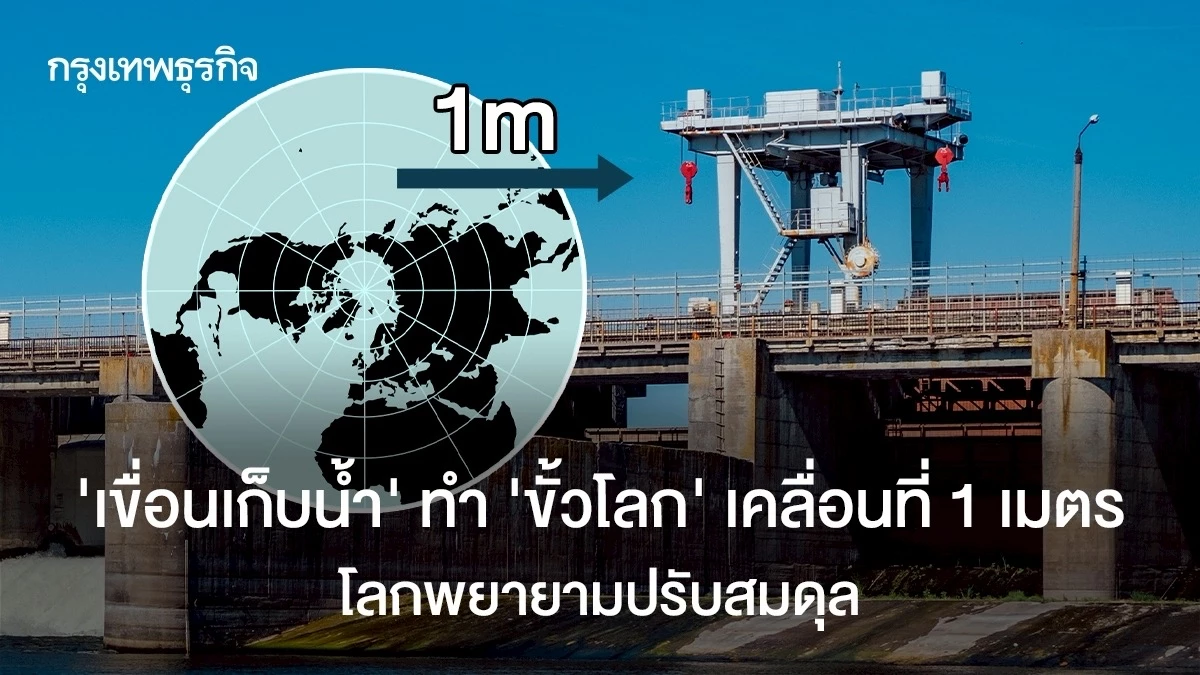
Human Dams Reshape Earth’s Rotation, Shift Poles
Massive Water Reservoirs Alter Planet’s Spin
The planet’s foundational spin is subtly changing, not just from natural shifts but also due to humanity’s immense engineering feats. For over two centuries, the construction of countless dams has fundamentally altered Earth’s rotation, moving the poles by more than a meter.
Engineered Mass Redistribution Alters Global Axis
True Polar Wander, the shifting of Earth’s solid crust relative to its rotational axis, is typically attributed to processes like melting ice sheets. However, groundbreaking research reveals that human dam construction has become a significant driver of this phenomenon. By accumulating vast quantities of water on land, these structures redistribute mass, influencing the planet’s spin.
A study published in Geophysical Research Letters indicates that this mass redistribution began significantly impacting Earth’s rotation around 1835. Initially, dam construction in North America and Europe from the mid-19th to early 20th century played a key role. Later, massive dam projects in Asia and East Africa during the latter half of the 20th century further influenced the polar shift.
Dams’ Influence on Polar Movement Detailed
The core concept is akin to a spinning ball: adding weight to one side causes a slight wobble. On Earth, this translates to the solid crust adjusting its position relative to the rotational axis. As surface mass shifts, the geographic poles consequently move across the planet’s surface.
While natural events like glacial melt are known contributors, researchers led by Natasha Valenic at Harvard University identified dam-induced water storage as another crucial factor. When we keep the water in the dam, not only are we pulling water out of the ocean until the sea level around the world reduces, but we are also distributing mass around the world in different forms. These masses of water from the original ocean were stored in still reservoirs that were distributed on every continent.
Valenic explained.
Analyzing data from 6,862 reservoirs constructed between 1835 and 2011, the team mapped the consequential mass shifts. From 1835 to 1954, dam building concentrated in North America and Europe caused the North Pole to drift approximately 8 inches northward, passing through Russia and parts of Asia.
After 1954, a shift in construction patterns saw larger projects emerge in East Africa and Asia. This led to a change in the direction of polar movement, shifting approximately 22.5 inches towards longitude -117.5 degrees East, crossing the western United States and entering the South Pacific. The variability in this movement is directly linked to the size and location of dams built over different periods.
Centuries of Dams Shift Poles Significantly
Over the study period, the poles experienced a total movement of about 44.6 inches, with the most substantial shifts occurring during the 20th century. This research highlights how modern infrastructure, a product of human ingenuity, now plays a more significant role in shaping Earth’s geological platform than natural processes alone over extended durations.
Water Storage Impact on Sea Levels
While global sea levels are currently rising, the dam construction of the 20th century inadvertently helped to slow this increase. The study’s 6,862 dams were found to have contributed to a reduction of 0.86 inches in global sea levels between 1900 and 2011. Though minor compared to factors like glacial melt, this water retention complicates sea-level calculations.
“The shape of the higher sea level will change. This depends on the position where you build dams and reservoirs. This is another factor that we must consider because these changes may be very large and very significant,” Valenic stated.
The average polar movement attributed to dams was around 0.12 inches per year in the first half of the 20th century. This rate accelerated to 0.37 inches annually in the latter half, a threefold increase reflecting the rapid expansion of dam projects post-1950. Earlier research from 2008 had estimated lower annual polar movements, which this new study’s findings help to reconcile, contributing to a more complete understanding of polar drift budgets.
This research underscores how a widely used tool of civilization, the dam, has actively reshaped global geography. Every dam and spillway is now recognized as a contributor to Earth’s momentum, demonstrating that the water we redirect on land not only alters river systems but also subtly influences planetary rotation by redistributing mass.
