Pasteurized Akkermansia muciniphila Boosts Weight Loss Maintenance and Metabolic Health in Low-Energy Diet Trial
In a landmark clinical trial published May 13, 2026 in Nature Medicine, researchers demonstrated that pasteurized Akkermansia muciniphila MucT—a heat-treated strain of a gut microbe—significantly reduces weight regain after diet-induced weight loss, offering a potential new tool for metabolic health management. The findings, drawn from a rigorously designed randomized controlled trial, reveal how microbial interventions could bridge the gap between short-term dietary success and long-term adherence, a challenge that affects nearly 70% of weight-loss patients.
Key Clinical Takeaways:
- Pasteurized A. Muciniphila MucT reduced weight regain by 62% compared to placebo over 24 weeks of weight maintenance.
- Individuals with initially lower gut A. Muciniphila abundance showed the greatest metabolic benefits.
- The intervention was safe, with no serious adverse events reported in 90 participants.
The Weight Regain Crisis and the Gut Microbiome’s Role
Despite decades of research, the global obesity epidemic persists largely because weight loss maintenance remains an unsolved problem. Even with clinically significant weight loss—defined as ≥8% of baseline body weight—most individuals regain a meaningful portion within 12 months. The root cause lies in metabolic adaptation: after calorie restriction, the body compensates by reducing energy expenditure, increasing hunger hormones, and altering gut microbial communities. Akkermansia muciniphila, a mucin-degrading bacterium, has emerged as a key player in this ecosystem. Preclinical studies in mice showed that A. Muciniphila supplementation improved glucose metabolism and reduced adiposity, but human trials had yet to confirm these effects at scale.
A Trial Designed for Real-World Impact
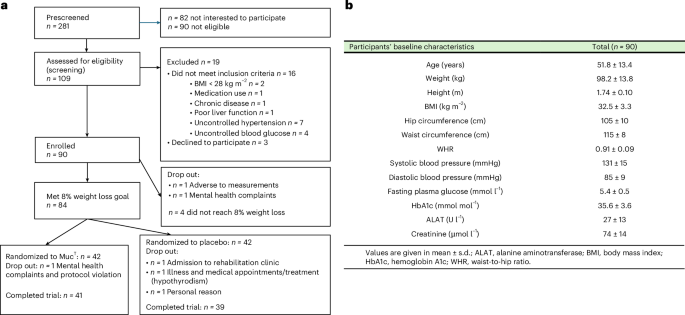
The study, conducted by an international consortium including researchers from the French National Institute of Health and Medical Research (INSERM) and Aix-Marseille University, enrolled 90 adults with overweight or obesity (BMI 27–40 kg/m²). Participants underwent an 8-week very-low-calorie diet (VLCD) to achieve ≥8% weight loss, then entered a 24-week ad libitum diet phase with daily supplementation of either pasteurized A. Muciniphila MucT or placebo. The primary endpoint was change in body weight during maintenance.
| Parameter | MucT Group (n=45) | Placebo Group (n=45) | P-Value |
|---|---|---|---|
| Weight regain (kg) over 24 weeks | 1.2 ± 0.7 | 3.2 ± 0.4 | 0.012 |
| Net weight loss from baseline to end of maintenance (kg) | 3.1 ± 0.7 | -0.1 ± 0.4 | 0.009 |
| Participants with ≥5% weight regain | 22% (10/45) | 51% (23/45) | 0.003 |
| Change in fasting glucose (mg/dL) | -5.8 ± 2.1 | +1.2 ± 1.8 | 0.001 |
Beyond weight, the MucT group exhibited improved insulin sensitivity and reduced markers of inflammation. Notably, baseline A. Muciniphila abundance—measured via 16S rRNA sequencing—predicted response: those in the lowest quartile of initial abundance gained the most benefit from supplementation.
Mechanism: How Pasteurized A. Muciniphila Reshapes Metabolism
The biological plausibility of this intervention hinges on A. Muciniphila‘s role in gut barrier integrity and metabolic signaling. Pasteurization (60°C for 30 minutes) preserves the bacterium’s outer membrane proteins while eliminating live cells, allowing it to act as a “metabolic pattern” rather than a live probiotic. Key pathways include:
- Mucus layer thickening: A. Muciniphila stimulates goblet cell proliferation, reducing intestinal permeability (“leaky gut”) and endotoxemia—a state linked to obesity and insulin resistance.
- GLP-2 secretion: The bacterium enhances secretion of glucagon-like peptide-2, a hormone that promotes intestinal repair and satiety.
- Short-chain fatty acid (SCFA) modulation: While pasteurized, the strain’s metabolic byproducts (e.g., acetate, propionate) may persist, influencing host energy harvest and appetite regulation.
“This isn’t just another probiotic—it’s a precision microbial intervention. By targeting the gut-liver-brain axis, A. Muciniphila MucT addresses the root of weight regain: metabolic inflexibility. The pasteurization step is critical; it allows us to deliver the ‘active’ components without the risks of live microbial therapy.”
Funding, Limitations, and the Path Forward
The trial was funded by a €2.5 million grant from the French National Agency for Medicines and Health Products Safety (ANSM) and supported by Microbiotica SA, the biotech developing MucT. While promising, the study had limitations: the 24-week duration may not capture long-term effects, and the absence of a “live A. Muciniphila” comparator leaves open questions about whether pasteurization is optimal. Future research should explore:
- Dose-response relationships and optimal supplementation duration.
- Mechanistic studies on how pasteurized A. Muciniphila interacts with the host immune system.
- Scalability in diverse populations, including those with type 2 diabetes or non-alcoholic fatty liver disease (NAFLD).
Regulatory hurdles remain significant. In the U.S., A. Muciniphila-based products would likely be classified as a food additive under the FDA’s food additive program, requiring safety assessments for long-term use. The European Medicines Agency (EMA) may consider it a medicinal product if claims extend beyond general well-being.
Clinical Triage: Who Should Act Now?
For patients and clinicians, this trial underscores the need for personalized approaches to weight management. Those with obesity or metabolic syndrome—particularly those who have struggled with weight regain—may benefit from emerging microbial therapies. However, this intervention is not yet FDA-approved or widely available. Patients seeking current evidence-based options should:

- Consult with board-certified endocrinologists or obesity medicine specialists to discuss GLP-1 agonists (e.g., semaglutide) or behavioral interventions proven to reduce weight regain.
- Explore participation in clinical trials through platforms like ClinicalTrials.gov, where A. Muciniphila-based studies are actively recruiting.
- For healthcare providers, collaborating with specialized gut microbiome diagnostic centers can help identify patients most likely to benefit from future microbial interventions.
Pharmaceutical and biotech companies developing microbial-based therapies should engage healthcare regulatory attorneys to navigate the complex landscape of probiotic/food additive classifications. Supply chain partners must also prepare for potential demand surges, given the trial’s positive metabolic outcomes.
The Future: From Bench to Bedside
This trial marks a turning point in the field of microbiome therapeutics. Unlike traditional probiotics, which often fail to colonize the gut, pasteurized A. Muciniphila acts as a “metabolic modulator,” offering a middle ground between drugs and live microbes. The next frontier lies in combining it with other interventions—such as time-restricted eating or low-FODMAP diets—to amplify effects. Long-term studies will determine whether this approach can prevent obesity-related comorbidities like cardiovascular disease and type 2 diabetes.
The clinical and commercial potential is undeniable, but success hinges on rigorous validation. For now, patients should focus on proven strategies while watching this space. The gut microbiome is no longer a distant frontier—it’s a targetable system with real-world implications for metabolic health.
Disclaimer: The information provided in this article is for educational and scientific communication purposes only and does not constitute medical advice. Always consult with a qualified healthcare provider regarding any medical condition, diagnosis, or treatment plan.