
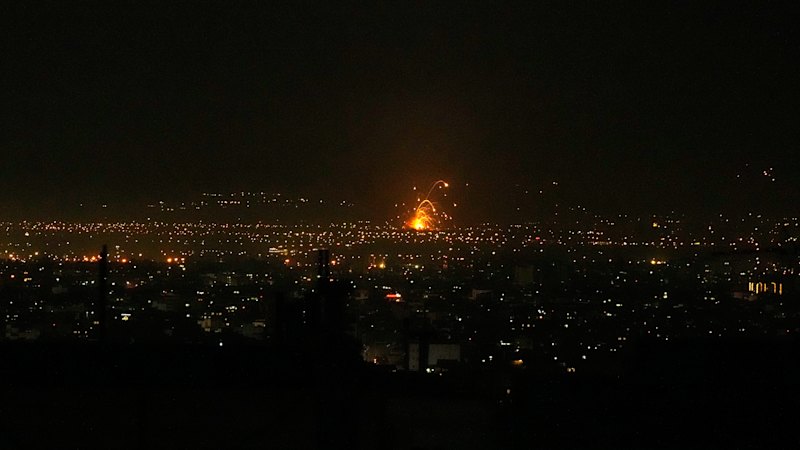
Oil prices surged to a four-year high Monday as the conflict between the United States, Israel, and Iran escalated following the killing of Supreme Leader Ali Khamenei, pitching the Middle East and the global economy into deep uncertainty. Brent Crude rose 13 percent to above $82 a barrel, whereas West Texas Intermediate hovered around $72.
Iranian authorities reported attacking three oil tankers in the Strait of Hormuz, a critical transit point for global energy supplies. The waterway is essential for oil shipments from the Persian Gulf to major markets including China, India, and Japan. Iran, despite producing approximately 3.3 million barrels of oil per day – roughly 3 percent of global output – exerts significant influence over energy markets due to its strategic location, according to reports.
President Donald Trump stated that U.S. Forces had destroyed nine Iranian naval ships and indicated that combat operations would continue until all objectives were met. He told Fox News Sunday that 48 Iranian leaders had been killed in the strikes, describing the operation as a resounding success. Trump asserted the attacks aimed to prevent Iran from acquiring a nuclear weapon, contain its missile program, and eliminate threats to the United States and its allies. U.S. Central Command reported having targeted over 1,000 Iranian targets since the campaign began.
In an interview with the Atlantic, Trump revealed he had agreed to a conversation with Iranian leadership, while a separate interview with the Daily Mail suggested the military campaign could last another four weeks. He has not yet articulated long-term goals for Iran, raising concerns about a potential power vacuum and its regional consequences.
The first U.S. Casualties have been reported, and with the Strait of Hormuz effectively closed and cities like Dubai, Abu Dhabi, and Doha facing bombardment, the risks associated with Trump’s decision to launch the attacks are becoming increasingly apparent. A Reuters/Ipsos poll on Sunday indicated that only about one in four Americans approve of the operation. Prolonged closure of the Strait of Hormuz – handling approximately 20 percent of the world’s oil supply – could significantly impact U.S. Consumers and potentially influence the upcoming midterm elections.
The Israeli military announced late Sunday that its air force had achieved aerial superiority over Tehran, conducting strikes targeting intelligence, security, and military command centers across the capital. An Israeli official, speaking anonymously, stated Israel’s focus is to destabilize the Iranian government and encourage popular uprising.
Global air travel has been severely disrupted, with major Middle Eastern airports, including Dubai – the world’s busiest international hub – closed, marking one of the largest aviation interruptions in recent years.
In Iran, President Masoud Pezeshkian announced that a leadership council, comprising himself, the judiciary head, and a member of the powerful Guardians Council, had temporarily assumed the duties of the Supreme Leader. Oman’s foreign ministry reported that Iranian Foreign Minister Abbas Araqchi expressed Tehran’s openness to de-escalation efforts.
The long-term prospects for Iran’s leadership remain unclear following the death of 86-year-old Khamenei, who had held power since 1989. Russian President Vladimir Putin condemned Khamenei’s death as a “cynical murder,” and China’s Foreign Minister Wang Yi described it as a “blatant killing.” Israel, which has long advocated for action against Iran, claimed responsibility for Khamenei’s death and showed no intention of halting its attacks.
Israeli military spokesperson Lieutenant Colonel Nadav Shoshani stated, “We have the capabilities and the targets to keep going on for as long as necessary.” Trump warned that the U.S. Would respond with unprecedented force if Iran retaliated.
However, Iran launched renewed missile barrages across the region. Air raid sirens sounded in Israel late Sunday, including in Tel Aviv, as projectiles were observed in the night sky. Israel’s ambulance service reported nine deaths in Beit Shemesh, the United Arab Emirates reported three deaths from Iranian attacks, and Kuwait reported one fatality.
Trump, via social media, claimed the U.S. Military had destroyed nine Iranian warships and was targeting the remainder. Britain, France, and Germany stated their readiness to defend their interests in the region following what they termed “indiscriminate and disproportionate” missile attacks by Iran, potentially including missile and drone strikes against the source of the attacks.
British Prime Minister Keir Starmer announced the UK had accepted a U.S. Request to utilize British bases for defensive strikes against Iranian missiles in storage or launch sites. He stated, “Our partners in the Gulf have asked us to do more to defend them, and it is my duty to protect British lives.”
Inside Iran, reactions to Khamenei’s death were mixed. While some mourned, others celebrated, revealing deep divisions within the country. Footage showed mourners gathering in Tehran, while videos posted on social media depicted celebrations, including the toppling of a statue in Dehloran and dancing in the streets of Karaj and Izeh.
Khamenei, who had led Iran for 36 years, was killed while working in his office during Saturday’s attack. State media reported his daughter, grandchild, daughter-in-law, and son-in-law also perished. Two U.S. Sources and a U.S. Official indicated that Israel and the U.S. Timed the attack to coincide with a meeting Khamenei was holding with top aides.
Experts suggest that while Khamenei’s death and those of other Iranian leaders represent a significant blow, they do not necessarily signal the end of Iran’s clerical rule or the influence of the Revolutionary Guards.
Protests erupted among Shi’ites in neighboring Pakistan, where police clashed with demonstrators who breached the outer wall of the U.S. Consulate in Karachi, resulting in nine deaths. In Iraq, police used tear gas and stun grenades to disperse hundreds of protesters gathered outside the Green Zone in Baghdad, where the U.S. Embassy is located.
