
Astronomers Discover Oldest Black Hole, Peering Back to the Dawn of the Universe
Table of Contents
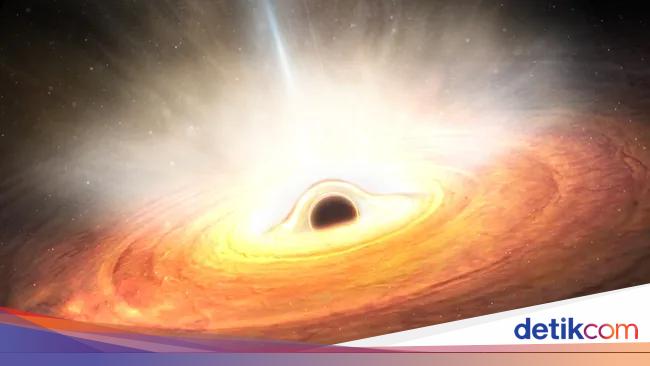
Jakarta - in a groundbreaking finding, astronomers have identified the most distant and oldest black hole known to date.This colossal object is believed to have formed a mere 500 million years after the Big Bang, offering a unique window into the universe’s formative years.
Unveiling a Cosmic Relic
the black hole resides at the heart of the galaxy Capers-LRD-Z9, estimated to have formed approximately 13.3 billion years ago. This timing places its origin within the first few percent of the universe’s 13.8 billion-year history, as established by the prevailing Big Bang theory [[1]]. The Big Bang theory posits that the universe originated from an incredibly dense and hot state, rapidly expanding outwards.
Observing such distant objects is akin to looking back in time, as light takes billions of years to reach us.”When we observe a very, very far object, the light needs billions of years to reach us. So, in reality, we see these objects as they where in the early universe,” explained Anthony Taylor, a researcher at the University of Texas at Austin, who spearheaded the international research team.
A Giant Among Giants
This newly discovered black hole is exceptionally large, boasting a mass 300 million times that of our sun. To put this into perspective, its mass is roughly equivalent to half the mass of all the stars within the Milky Way galaxy, and ten times greater than the supermassive black hole at our galaxy’s center.
Scientists utilized the James Webb Space Telescope to identify this black hole candidate. While previous observations hinted at the possibility of more distant black holes, this discovery marks the oldest one definitively confirmed.
Did You Know? The James Webb Space Telescope’s advanced infrared capabilities are crucial for detecting light from these incredibly distant objects, as the expansion of the universe stretches light waves towards the red end of the spectrum-a phenomenon known as redshift.
The Enigmatic capers-LRD-Z9 Galaxy
The galaxy hosting this ancient black hole is itself a subject of intense interest. Classified as a “small red dot” galaxy, it emits primarily red wavelengths of light and exhibits an unexpectedly high brightness and density.Studying Capers-LRD-Z9 could unlock clues about the formation of these unique galaxies and the origins of their distinctive red hue.
Furthermore, understanding how this black hole grew to such immense proportions so early in the universe’s evolution presents a significant challenge to current cosmological models.
Key Data: The Oldest Black hole
| Characteristic | Value |
|---|---|
| Galaxy | Capers-LRD-Z9 |
| Age (estimated) | 13.3 billion years |
| Distance from Earth | Approximately 13.3 billion light-years |
| Black Hole Mass | 300 million times the mass of the Sun |
| Observation Tool | NASA’s James Webb Space Telescope |
Pro Tip: The study of supermassive black holes in the early universe helps astronomers test and refine theories about galaxy formation and the co-evolution of black holes and their host galaxies.
What role did these early black holes play in shaping the structure of the universe as we know it? And how can studying Capers-LRD-Z9 refine our understanding of the universe’s earliest epochs?
Looking Ahead: The Future of Black Hole Research
The discovery of this ancient black hole represents a pivotal moment in astrophysics. Future research will focus on identifying and characterizing more of these early black holes, refining our understanding of their formation mechanisms, and their impact on the surrounding cosmic environment. The James Webb Space Telescope is poised to play a central role in these endeavors, providing unprecedented observational capabilities.
Frequently Asked Questions About the Oldest Black Hole
- What is a black hole? A region of spacetime exhibiting such strong gravitational effects that nothing, not even particles and electromagnetic radiation, can escape from inside it.
- How did astronomers find this black hole? They used the James Webb Space Telescope to identify a candidate and then confirmed its distance and age through detailed analysis of its light.
- Why is this discovery crucial? It provides a glimpse into the early universe and helps us understand how black holes and galaxies evolved.
- What is the Big Bang theory? The prevailing cosmological model for the universe, stating it expanded from an extremely dense and hot state approximately 13.8 billion years ago.
- What are “small red dot” galaxies? These are galaxies that emit primarily red wavelengths of light, are very dense, and exhibit unexpected brightness.
We hope this article has sparked your curiosity about the mysteries of the universe! Please share this exciting discovery with your friends and colleagues, and join the conversation in the comments below. Don’t forget to subscribe to World Today News for more breaking science news and insightful analysis.
