
Animal Study Reveals Interplay Between Sleep, Growth Hormone, and brain Arousal
A new study published in the journal Cell on May 2025 details a newly mapped neural circuit linking sleep, growth hormone release, and brain arousal in mice. Researchers at the University of California, Berkeley, are hopeful this finding will pave the way for novel therapies targeting sleep quality and growth hormone imbalances.
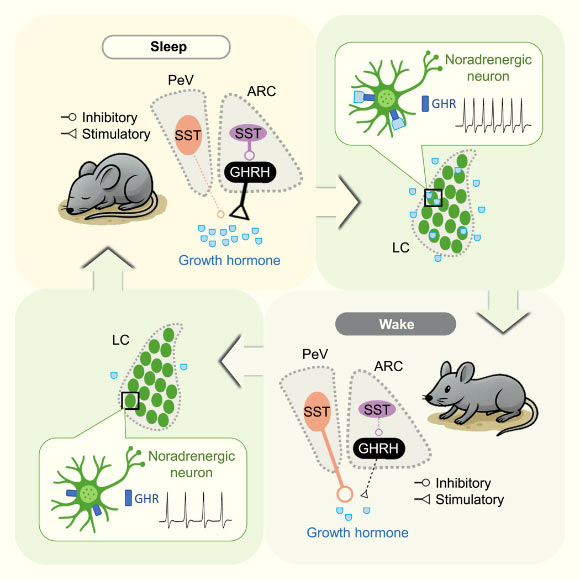
The research focuses on the neurons responsible for orchestrating growth hormone release during the sleep-wake cycle: growth hormone releasing hormone (GHRH) neurons and two types of somatostatin neurons, located deep within the hypothalamus. The team,led by Dr. Xinlu Ding and Dr. Daniel Silverman, aimed to provide “a basic circuit to work on in the future to develop different treatments.”
The study revealed that growth hormone,once released,increases activity in neurons within the locus coeruleus – a brainstem area crucial for arousal,attention,cognition,and novelty seeking. Dysregulation of these locus coeruleus neurons has been linked to various psychiatric and neurological disorders.
Researchers utilized electrodes implanted in the brains of mice, combined with optogenetic stimulation of hypothalamic neurons, to map the circuit. Mice, with their frequent short sleep cycles, provided ample opportunities to observe growth hormone fluctuations during sleep-wake transitions.The team discovered that the two hormones controlling growth hormone release – GHRH (promoting release) and somatostatin (inhibiting release) – function differently depending on the sleep stage. During REM sleep, both somatostatin and GHRH surge to boost growth hormone.However, during non-REM sleep, somatostatin decreases while GHRH only moderately increases to achieve the same effect.
Growth hormone release, the study found, regulates locus coeruleus activity as a feedback mechanism, creating a “homeostatic yin-yang effect.” Growth hormone gradually accumulates during sleep to stimulate the locus coeruleus and promote wakefulness. Interestingly, the researchers also found that overstimulation of the locus coeruleus can paradoxically induce sleepiness.
“This suggests that sleep and growth hormone form a tightly balanced system: too little sleep reduces growth hormone release, and too much growth hormone can in turn push the brain toward wakefulness,” explained Dr. Silverman. He further emphasized,”Sleep drives growth hormone release,and growth hormone feeds back to regulate wakefulness,and this balance is essential for growth,repair and metabolic health.”
The researchers believe that targeting this circuit could offer a “novel handle to try to dial back the excitability of the locus coeruleus,which hasn’t been talked about before.” Dr. Ding added that growth hormone may offer cognitive benefits, potentially enhancing arousal levels upon waking, along with its known roles in muscle and bone building and fat reduction.
The study, formally titled “Neuroendocrine circuit for sleep-dependent growth hormone release” (Xinlu Ding et al. 2025. Cell 188 (18): 4968-4979; doi: 10.1016/j.cell.2025.05.039), suggests potential for future hormonal therapies and even experimental gene therapies targeting specific cell types within this newly understood circuit.
