
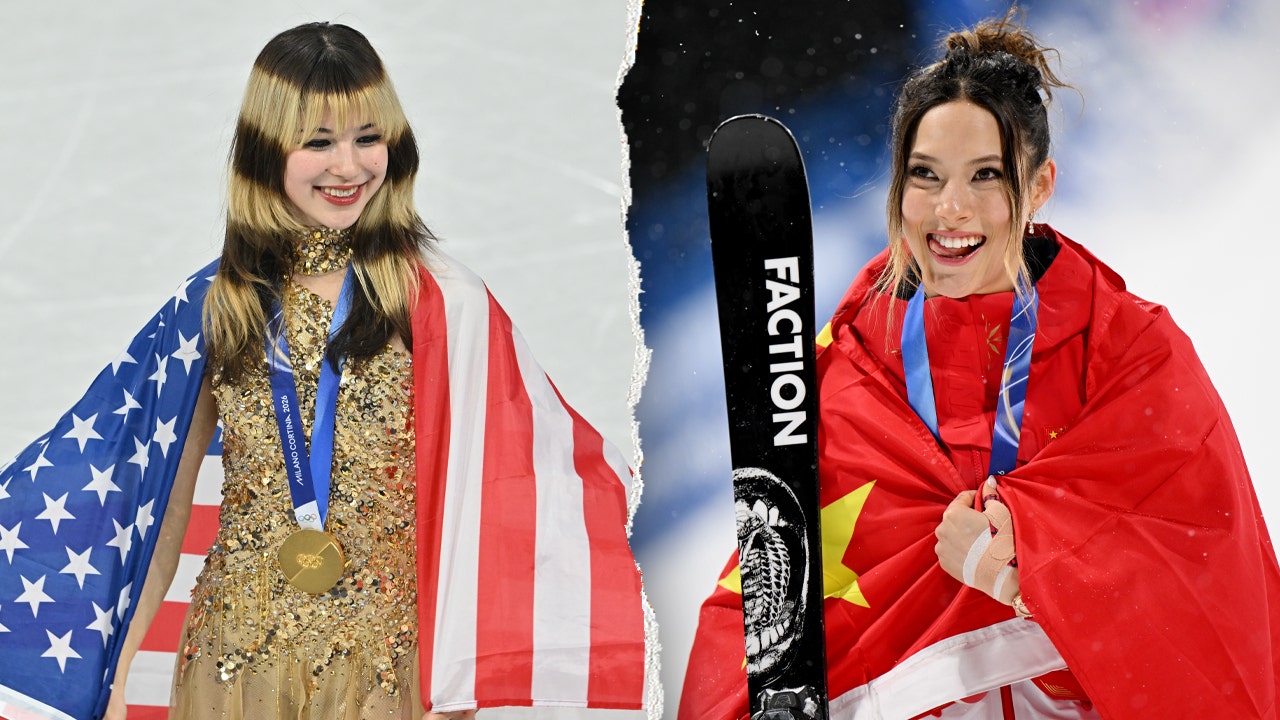
Milan, Italy – Alysa Liu’s historic gold medal in women’s figure skating at the 2026 Winter Olympics has ignited a complex debate surrounding national identity and athletic allegiance, drawing stark comparisons to Eileen Gu, the American-born freestyle skier competing for China. Liu’s victory on Thursday, and the story of her father’s escape from China following the Tiananmen Square protests, quickly circulated on social media, framing her success as a triumph of American values.
The contrast with Gu, who chose to represent China in 2019 despite being raised in California, has been amplified by political commentators and online users. Barstool Sports founder Dave Portnoy succinctly captured the sentiment with a post on X stating, “Alysa Liu > Eileen Gu. The triumph of America over China!” This sentiment reflects a broader narrative that positions the two athletes as symbols of diverging paths and loyalties.
Both Liu and Gu share a common origin: they were each born to single parents who left China. Arthur Liu, Alysa’s father, was present during the Tiananmen Square protests in 1989. He later faced interrogation by Chinese authorities for his involvement and ultimately fled to California, risking imprisonment to secure his family’s freedom. He recounted to USA Today his refusal to name fellow student protestors, fearing repercussions and choosing to take full responsibility. Alysa Liu has spoken of her father’s bravery and persistence, acknowledging the sacrifices he made.
Eileen Gu’s mother, Yan Gu, immigrated to the United States in the 1980s to pursue advanced studies at Stanford University. While details about Gu’s father remain scarce, she was raised as an only child by her mother in San Francisco. The differing paths of their families highlight the varied experiences of Chinese Americans and the choices they make regarding national identity.
While both athletes excelled in their respective sports from a young age, their decisions regarding international representation diverged significantly. Gu’s decision to compete for China came as part of a broader initiative by the Chinese government, dubbed the “Chinese naturalization project,” aimed at recruiting athletes with Chinese heritage to bolster its Olympic performance, particularly in the lead-up to the 2022 Beijing Winter Olympics. Gu’s switch was formalized in 2019, after competing for the U.S. In a Freestyle Ski World Cup event.
Gu has develop into one of the highest-paid Winter Olympic athletes, earning an estimated $23 million in 2025 through endorsements with Chinese and Western companies, including the Bank of China. Recent reports indicate that Gu and fellow American-born figure skater Zhu Yi received a combined $6.6 million from the Beijing Municipal Sports Bureau in 2025, and nearly $14 million over the past three years, for their efforts in qualifying for the Milan Winter Olympics.
The Liu family, however, remained steadfast in their commitment to Team USA. According to The Economist, Arthur Liu was “not open to persuasion” regarding a potential switch to representing China. This loyalty has not come without risk. Prior to the 2022 Beijing Games, Liu and her father were allegedly targeted by a Chinese spying operation, with an individual impersonating a USOPC official attempting to obtain their passport information. The FBI intervened, providing security assurances and investigating the incident, which Alysa Liu described as “a little bit freaky and exciting.”
Gu has faced criticism for her silence on China’s human rights record, particularly regarding the treatment of Uyghurs in Xinjiang. When questioned by Time Magazine, Gu stated she hadn’t “done the research” and deemed it “irresponsible” to act as a mouthpiece for any agenda. In contrast, Liu’s family has been directly impacted by the Chinese government’s actions.
Liu temporarily retired from competitive skating after the 2022 Beijing Olympics, citing trauma related to the spying incident and the intense pressure surrounding the Games. She returned to the sport in 2024, culminating in her gold medal victory this week. She has even expressed interest in a film adaptation of her life story, emphasizing the importance of highlighting her father’s experiences.
All eyes are now on Eileen Gu as she prepares to compete in the women’s freestyle skiing halfpipe final on Sunday, following a postponement due to severe weather conditions. The event will be the culmination of a Games marked by intense scrutiny and politically charged comparisons to Alysa Liu. Gu’s performance will unfold against a backdrop of ongoing debate and criticism, leaving her legacy and the implications of her choice to compete for China open to interpretation.
