AfDB and EBRD Outline Deeper Partnership for SMEs, Energy and Domestic Capital
The African Development Bank Group and the European Bank for Reconstruction and Development outlined a deeper partnership on November 24 in Abidjan, a day after the EBRD opened its country office there, to combine AfDB’s government ties with EBRD’s private-sector model for SME financing, energy projects and domestic capital mobilisation.
AfDB President Sidi Ould Tah and EBRD President Odile Renaud-Basso opened the Africa Small and Medium Enterprise Business Day at the Noom Hotel, attended by about 200 financial leaders, investors and executives, the EBRD reported.
WAEMU Commission Abdoulaye Diop and Côte d’Ivoire’s Minister of Commerce, Industry and Crafts Kalil Konaté also addressed the gathering, which focused on practical barriers such as working-capital gaps, guarantee access, weak accounting and the “missing middle” — mid-sized firms too large for small-business schemes yet not structured enough for mainstream financiers.
EnterpRise Africa targets high-growth SMEs
The two banks are jointly developing EnterpRise Africa, a project for fast-growing SMEs ready to scale but unable to find credit matched to their growth trajectories, the EBRD reported. It comprises a private credit fund and an advisory platform to strengthen management, governance and capital-raising ability.
Nine countries are under consideration: Benin, Côte d’Ivoire, Ghana, Kenya, Nigeria and Senegal, where both banks operate, plus Burkina Faso, Burundi and the Democratic of Congo — three Transition States where AfDB would operate alone. Italy is considering a contribution through its Ministry of Economy and Finance.
“A fast-growing African SME with a strong growth project should not have to knock on two doors or wait on two timetables,” said Ould Tah. “If our teams work together from the start, the result will be that the company will get a single answer and faster.”
Banks co-finance Dandara solar project in Egypt
Energy offers another complementarity. In Egypt, the banks co-finance the Dandara solar project, combining 500 megawatts of solar capacity with 100 megawatt-hours of battery storage under a 25-year supply contract with aluminium producer Egyptalum, the EBRD reported.

“Dandara is a strong example of what our institutions can achieve by combining their respective strengths,” said Renaud-Basso. “As our shared footprint grows, so do the opportunities to work together to mobilise investment and deliver greater impact.”
Mobilising African savings is a shared priority. The continent needs about $400 billion annually for development while holding roughly $4 trillion in domestic savings across pension funds, insurers and sovereign wealth funds, the EBRD reported. A morning panel brought together AfDB, EBRD, the West African Development Bank, the Regional Securities Exchange, NSIA Group and Côte d’Ivoire’s National Social Security Fund to discuss channelling those resources.
Local-currency lending, which shields businesses from exchange risk, illustrates the cooperation. EBRD supported the development of Morocco’s MONIA benchmark in 2020, and AfDB recently issued its first Moroccan dirham bond indexed to MONIA, extending its use into longer-term instruments, the EBRD reported.
Fireside talks affirm complementary roles
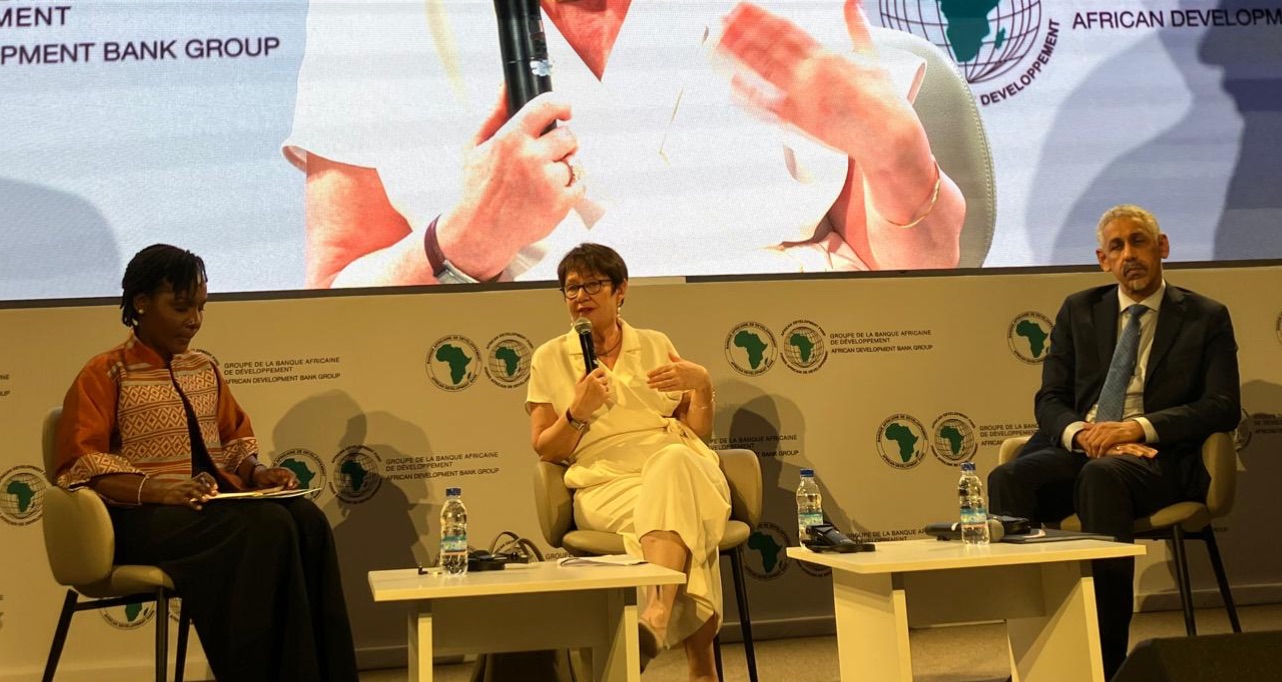
In an afternoon fireside conversation at AfDB headquarters in Abidjan, with EBRD staff joining online, the two presidents set out how their institutions complement each other, the EBRD reported.
SME Business Day targets practical barriers
The morning programme of the Africa Small and Medium Enterprise Business Day centred on concrete obstacles that stall smaller firms, the EBRD reported. Discussions highlighted working-capital gaps when an SME must finance production before payment, the need for reliable accounts to unlock guarantees, and the importance of market access alongside tailored advisory support.
Particular attention fell on mid-sized companies that sit between small-business schemes and mainstream financing, the EBRD reported. Participants also examined SMEs’ access to regional and international markets and their integration into the supply chains of large industrial groups.
Action Plan and donor interest shape EnterpRise Africa
The initiative has already drawn donor interest, with Italy considering a contribution through its Ministry of Economy and Finance.
The European Bank for Reconstruction and Development (EBRD) brings a private-sector financing model built on direct equity, debt and risk-sharing instruments for companies, complementing the AfDB’s sovereign-focused toolkit. The EBRD reported that its EnterpRise Africa platform, under joint development since the November 2024 Abidjan launch, will deploy a private credit fund alongside an advisory facility to strengthen management, governance and capital-raising capacity for high-growth SMEs across nine countries, including three Transition States where only AfDB operates.
This structure targets the “missing middle” — mid-sized firms too large for small-business schemes yet not structured enough for mainstream financiers — by offering growth capital matched to company trajectories rather than project-by-project lending.
Beyond SME finance, the EBRD contributes local-currency and capital-markets expertise developed in its countries of operations.
Partnership track record
The institutions signed a cooperation framework in May 2021 and began a staff exchange in 2023. Since 2024 alone, they have co-financed projects representing around €1.25 billion in combined financing, with further opportunities under development, the EBRD reported.