
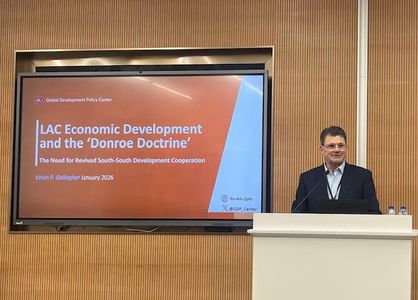
Boston University Global Development Policy Center Director Kevin P. Gallagher participated in the 11th annual U.S.-China Global Economic Order (GEO) Dialogue in China in January, addressing leading scholars and policy advisors on China’s evolving role in the international financial system and potential impacts on Latin America.
The track two dialogue, co-chaired by the Center for Strategic and International Studies and the Peterson Institute for International Economics in the U.S., and the Shanghai Institute for International Studies and the CASS Institute for World Economics and Politics in China, brought together former officials and experts to discuss challenges in trade, finance, and international financial institutions. The group also met with CEOs of U.S. Companies operating in China and toured a Chinese artificial intelligence firm.
Gallagher presented his new book, China and the Global Economic Order, at the Shanghai Institute for International Studies, arguing that China has achieved objectives in global economic governance that other nations at similar income levels have not. He suggested that this success may have provoked a reaction from the United States, according to a Boston University report. Participants from the Chinese side reportedly expressed surprise at the balanced analysis offered by a U.S.-based research institution.
The book, published by Cambridge University Press, traces China’s engagement with the Bretton Woods Institutions (BWIs) – the International Monetary Fund (IMF) and the World Bank – from its re-entry in 1980 through 2025. The analysis highlights China’s exercise of “two-way countervailing power,” operating both within and outside the BWIs to push for changes, resulting in reforms and a gradual transformation of the global order, while also generating counter-reactions, particularly from the United States.
Gallagher also spoke at the New Development Bank, led by the BRICS nations (Brazil, Russia, India, China, and South Africa), on the potential impacts of the new U.S. National Security Strategy on Latin American economies. He cautioned that the strategy’s focus on security could hinder economic development in the region, particularly as the U.S. Increasingly views resources like oil, gas, minerals, and ports as strategic assets to be developed primarily by U.S. Investors. Gallagher reportedly drew on historical examples to suggest strategies for Latin American countries to leverage U.S. Interest to their advantage.
Gallagher currently serves as the lead expert on Multilateral Development Bank Reform to the Brazilian Presidency of the G20 and is a member of the Task Force on Climate, Development and the International Monetary Fund, as well as co-chair of the Debt Relief for a Green and Inclusive Recovery Project. He is the author or co-author of eight books, including The Case for a New Bretton Woods (2021) and The China Triangle: Latin America’s China Boom and the Fate of the Washington Consensus (2016).
