
As the United States navigates a complex geopolitical landscape, its focus on controlling Arctic Greenland reveals a broader strategic shift. Simultaneously, a potential weakening of U.S. influence in Antarctica raises concerns about a power vacuum, possibly opening the door for rivals like China to expand their presence on the southernmost continent. While Washington’s interest in Greenland appears deliberate, the diminishing U.S. role in Antarctica seems, at least initially, unintentional – a outcome of cuts to crucial scientific funding.
The Shifting Landscape of Antarctic Research and Influence
The implications of reduced U.S. investment in Antarctic research are significant. According to Professor Ted Scambos,a glaciologist at the University of Colorado and a veteran of U.S. Antarctic research, proposed cuts to climate-related research – a cornerstone of Antarctic study – are “catastrophic.” This isn’t simply about scientific advancement; research serves as a key mechanism for nations to maintain their influence in the region.the antarctic Treaty System, established in 1959, prohibits military activities and mineral exploitation, making scientific presence the primary means of asserting a nation’s stake in the continent [Antarctic Treaty System].
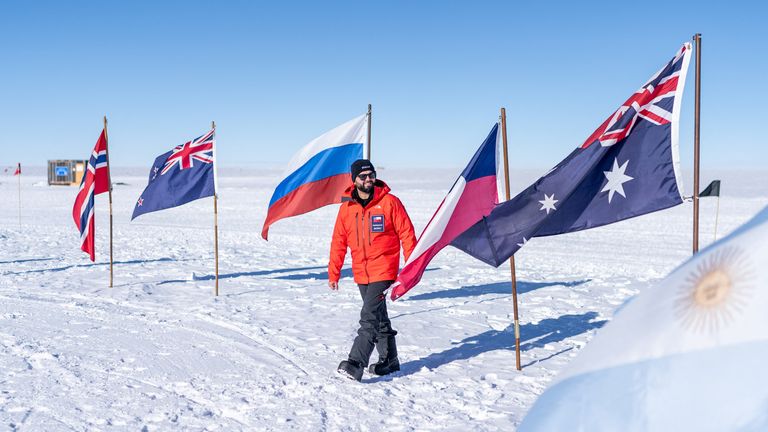
Historically, several nations – including the UK, Argentina, Australia, Chile, France, New zealand, and Norway – laid claim to portions of Antarctica. However, the 1959 treaty placed these claims “in abeyance,” effectively suspending them while allowing for peaceful scientific exploration. Maintaining a robust scientific presence, thus, is crucial for countries wishing to preserve their potential future claims or, at the very least, exert influence over the continent’s governance.
The United kingdom, for example, actively maintains a presence through its research bases at Rothera on the West Antarctic Peninsula and Halley VI further inland. These bases are strategically positioned within the boundaries of the UK’s territorial claim, extending from the coast to the South Pole. As Professor Dame Jane Francis,director of the British Antarctic survey,explains,“The Antarctic treaty says that Antarctica is a continent for peace and science.We are contributing to the treaty by doing world-class science, but also by having a UK presence in Antarctica.” The £200 million research icebreaker, RRS Sir David Attenborough, further solidifies the UK’s commitment and capability in the region.
The United States’ Diminished Capacity and China’s Rising Ambition
For decades, the United States has been a dominant force in Antarctic research, with its South Pole Station standing as one of the largest and best-funded facilities on the continent. Strategically located at the convergence of all territorial claims, the station has been central to U.S. influence. However, recent policy decisions have dramatically altered this position. Cuts initiated during the Trump administration,coupled with the non-renewal of a lease for its only dedicated Antarctic icebreaker,have left the U.S. significantly hampered in its ability to conduct research and maintain a consistent presence. The situation has become so dire that the U.S. has been forced to lease an icebreaker from Ukraine to continue operations.
This shift in capacity is not going unnoticed. Professor Francis notes a clear “change in the leadership and the balance of power.” This creates opportunities for other nations, most notably China, to expand their influence. China’s Antarctic research agency, CHINARE, has rapidly increased its footprint on the continent, now operating five research bases, with another planned. In 2024,China commissioned a new icebreaking vessel,Xuelong 2,joining its existing icebreaker to support its expanding Antarctic program. This investment demonstrates a clear long-term commitment to the region.
Beyond Scientific Research: geopolitical Implications
While all signatories to the Antarctic Treaty are ostensibly focused on scientific research, concerns are growing about potential ulterior motives. China and Russia, in particular, have exhibited behaviors that suggest broader strategic interests. China has resisted international efforts to increase protection for fisheries in the Southern Ocean, raising concerns about potential resource exploitation. In 2020,Russia announced the finding of a massive oil reserve beneath the Antarctic seabed,though it maintains the survey work was purely scientific.
Professor Scambos emphasizes that all nations involved in Antarctic research are mindful of the continent’s future. “Countries that have signed the Antarctic Treaty,are there to do scientific research,” he says,“But they have an eye on…any sort of future for Antarctica. Be it to maintain the treaty or to rethink the treaty in terms of exploitation.”
Despite these concerns, the unique characteristics of Antarctica – its remoteness, harsh climate, and year-round ice cover – currently limit the scope for large-scale exploitation. However, as the continent warms and its ice sheets melt, driven by climate change, access to resources and strategic positioning may become increasingly attractive. The potential for a re-evaluation of the Antarctic Treaty, particularly in light of the Trump administration’s willingness to challenge international norms regarding Greenland, cannot be dismissed.
Key Takeaways
- The U.S. is facing a decline in its Antarctic research capacity due to funding cuts and logistical challenges.
- China is rapidly expanding its presence in Antarctica, investing heavily in research infrastructure and icebreaking capabilities.
- The Antarctic Treaty System, while currently holding firm, could be challenged as the continent becomes more accessible due to climate change.
- Maintaining a scientific presence is crucial for nations seeking to exert influence in Antarctica.
- The situation in Antarctica mirrors a broader geopolitical competition for influence in the polar regions.
The future of Antarctica remains uncertain. The continent’s fate will depend on the continued commitment to international cooperation, the prioritization of scientific research, and the willingness of global powers to uphold the principles of the Antarctic Treaty. As the world watches,the delicate balance of power in this remote and vital region hangs in the balance.
