
Scientists Propose Universe Expansion Explanation Without Dark Energy
Bremen, Germany - October 15, 2025 – An international research team, including experts from Germany’s Center for Applied Space Technology and Microgravity (ZARM) at the University of Bremen and Romania’s Transylvanian University of Brașov, has presented a new model possibly explaining the accelerating expansion of the universe without invoking the concept of dark energy. The findings, published in the Journal of Cosmology and Astroparticle Physics (10(2025): 050), challenge mainstream cosmological understanding.
Currently, the expansion of the universe is described using general relativity and the Friedmann equations. The observed acceleration prompted scientists to introduce dark energy as a component of these equations to align with observational data.Though, some researchers remain dissatisfied with this approach.
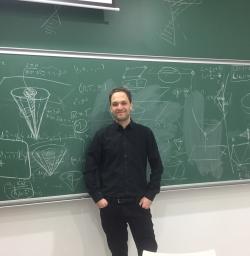
Christian Pfeifer of ZARM and his colleagues utilized an extension of general relativity based on the Finsler gravity model. This model offers a more accurate representation of gravitational forces in gases by employing a more generalized geometry of spacetime.
Calculations applying the Finsler extension to the Friedmann equations revealed that the equations inherently predict the accelerating expansion of the universe in a vacuum - eliminating the need for dark energy.
“This is an exciting hint that we may be able to explain the observed behavior of the universe based on the generalized geometry of spacetime without the need for dark energy,” stated Pfeifer, as reported by ZARM. He suggests this new geometrical concept could be pivotal to a deeper understanding of physics and the universe.
Further facts is available at https://www.zarm.uni-bremen.de/en/news-list/news-display/new-attempt-to-explain-the-accelerated-expansion-of-the-universe.
