
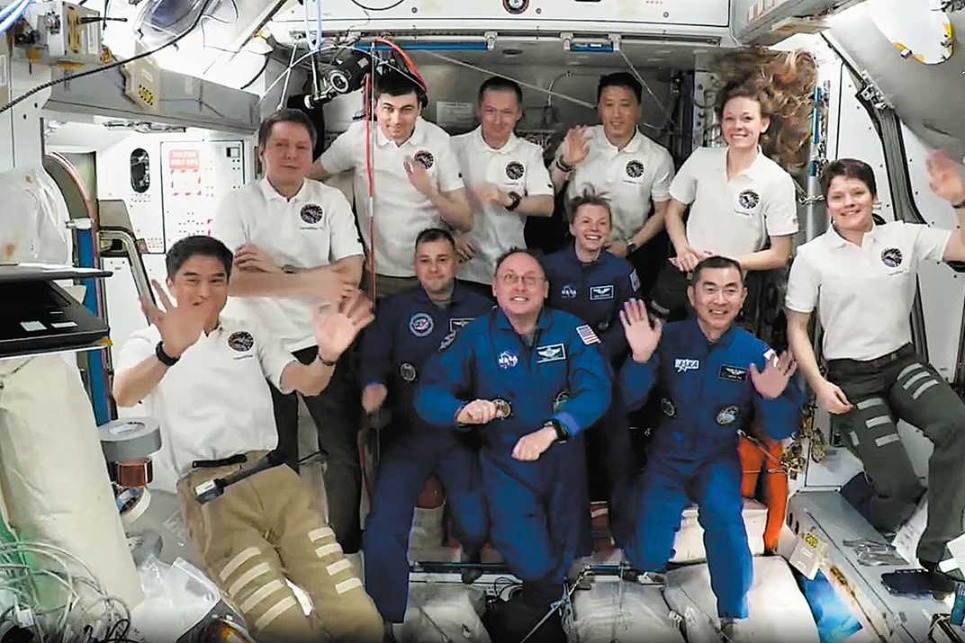
New Crew Arrives at International Space Station
SpaceX Delivers International Astronauts for Six-Month Mission
A new team of astronauts has successfully reached the International Space Station, marking a significant moment for space exploration. The four-person crew, comprising specialists from the United States, Russia, and Japan, completed their journey aboard a SpaceX capsule.
International Team Joins Orbiting Laboratory
The newly arrived astronauts include NASA’s Zena Cardman and Mike Fincke, Japan’s Kimiya Yui, and Russia’s Oleg Platonov. They will reside aboard the orbiting outpost for at least six months, taking over duties from the previous crew who have been conducting research since March. The departing astronauts are expected to return to Earth as early as Wednesday.
Upon docking, Mike Fincke expressed his excitement, radioing, Hello, space station!
as the capsule connected with the station high above the South Pacific.
Crew Assignments and Mission Adjustments
The deployment of this crew saw several shifts in planned missions. Zena Cardman and another astronaut were reassigned from a previous SpaceX flight last year to accommodate NASA’s Butch Wilmore and Suni Williams, whose stay on the station extended significantly. Both Mike Fincke and Kimiya Yui were originally training for a Boeing Starliner mission, but due to Starliner’s ongoing technical issues until 2026, they transitioned to the SpaceX program.
Oleg Platonov‘s inclusion followed a previous reassignment from a Soyuz launch lineup a couple of years ago due to an undisclosed health reason. Their arrival temporarily increases the total population on the International Space Station to eleven individuals.
Scientific Pursuits in Orbit
During their time aboard the station, the astronauts will engage in a variety of scientific investigations and technology demonstrations. Their work includes simulating lunar landings and exploring strategies for vision protection. They will also conduct vital studies aimed at improving human health and performance in the challenging environment of space.
Further research objectives include examining plant cell division and the impact of microgravity on viruses that target bacteria. The crew will also perform experiments focused on increasing the yield of human stem cells and on-demand nutrient generation, as detailed by NASA.
The ISS is currently scheduled for decommissioning after 2030, with plans for a controlled de-orbit into the Pacific Ocean’s Point Nemo, often referred to as a spacecraft graveyard.
This mission highlights the ongoing international collaboration in space. For context, as of 2023, there have been over 270 individuals who have visited the International Space Station, representing 22 different countries (NASA).
