
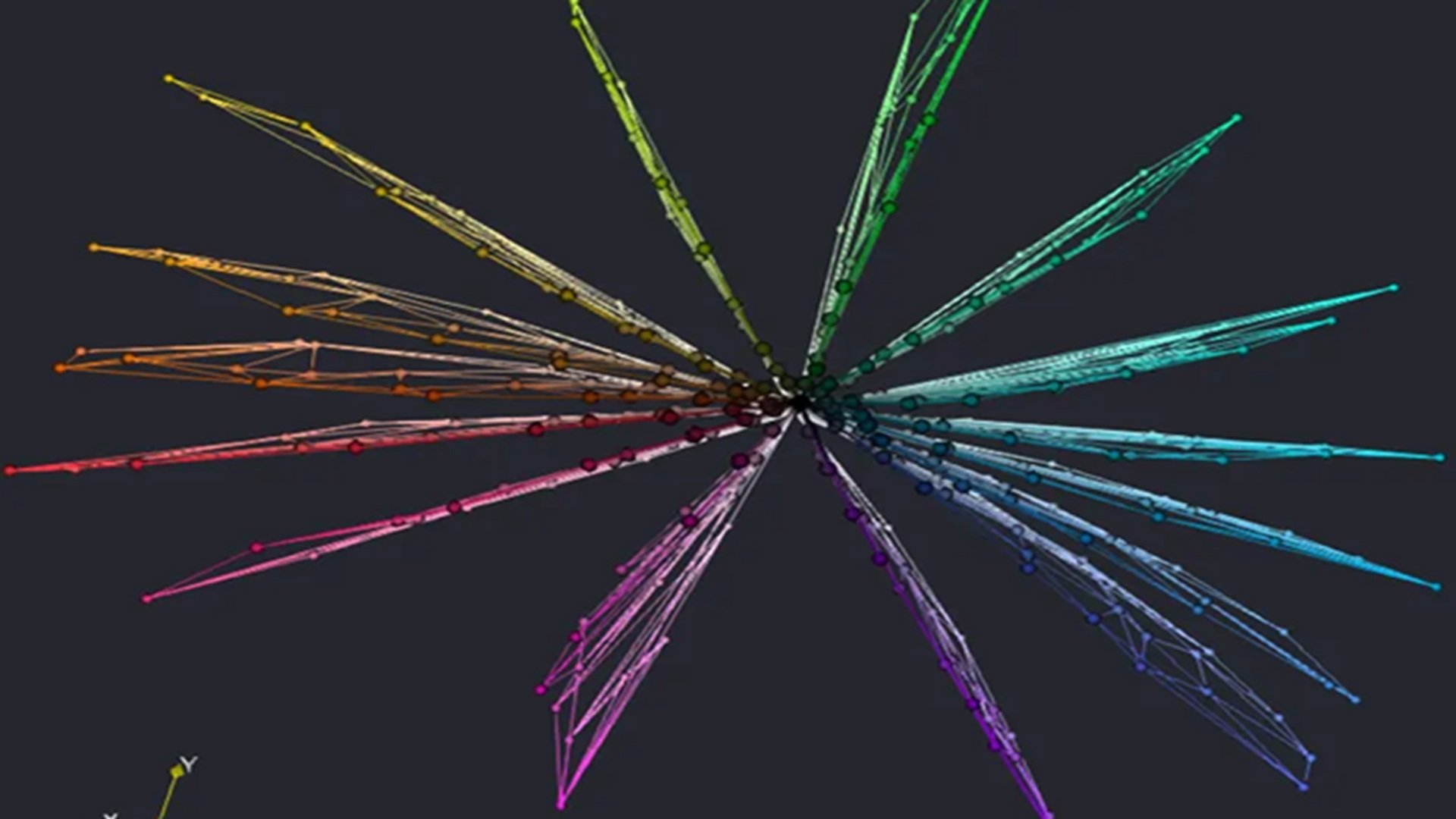
A century-traditional theoretical framework for understanding human color perception, initially sketched out by physicist Erwin Schrödinger, has been mathematically completed by a team of researchers at Los Alamos National Laboratory (LANL). The breakthrough, announced February 23, 2026, resolves a long-standing flaw in Schrödinger’s model and promises to refine visualization tools across scientific disciplines.
Schrödinger, known for his work in quantum mechanics, proposed in the 1920s that human color perception could be mapped as a three-dimensional geometric shape, determined by the response of cone cells in the retina. His work defined hue, saturation, and lightness, but lacked a crucial mathematical element.
Roxana Bujack, PhD, a computer scientist at LANL, led the team that applied advanced geometry to finalize Schrödinger’s theory. Their research demonstrates that these core qualities of color aren’t shaped by cultural or learned experiences, but are inherent to the structure of human vision. “What we conclude is that these color qualities don’t emerge from additional external constructs such as cultural or learned experiences but reflect the intrinsic properties of the color metric itself,” Bujack stated.
Human color vision relies on trichromacy – the presence of three types of cone cells (red, green, and blue) that detect different wavelengths of light. In the 19th century, Bernhard Riemann posited that the perceptual spaces created by these cone cells were not linear, but curved. Schrödinger built upon this foundation, but his model remained incomplete.
The LANL team identified the “neutral axis” – the line representing shades of gray from black to white – as the primary missing component. Schrödinger’s definitions relied on the positioning of colors relative to this axis, yet he never mathematically defined it. By defining this axis, the researchers repaired the flaw in Schrödinger’s model.
The team’s work extended beyond simply defining the neutral axis. They also corrected for the Bezold-Brücke effect, a phenomenon where increasing brightness can subtly shift perceived hue. This was achieved by utilizing the shortest path, rather than a straight line, within their geometric model of color perception. They addressed the phenomenon of diminishing returns in color perception, again by employing the shortest path in a non-Riemannian space.
The findings, presented at the Eurographics Conference on Visualization, build upon a project that previously delivered a study published in the Proceedings of the National Academy of Sciences in 2022. The current research has been published in Computer Graphics Forum, the official journal of the Eurographics Association.
According to LANL, understanding color perception is a critical component of visualization science, with implications for image processing, computer graphics, and a range of other applications. The team has not yet announced plans for further research, but the completed model is expected to inform the development of more accurate and reliable visualization tools.
