
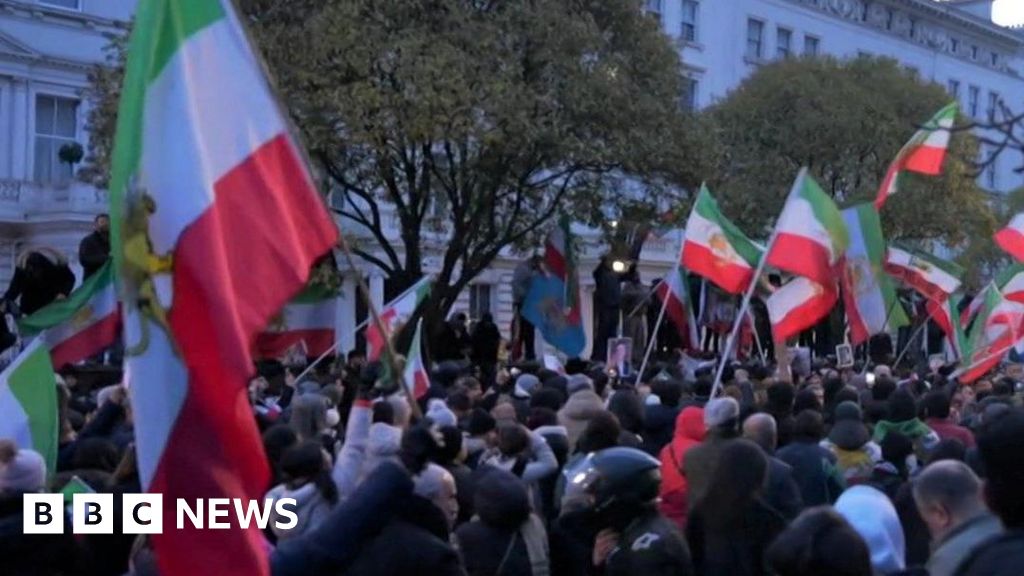
Global Protests Erupt as Iran Faces Mounting Internal Unrest
London, UK – Demonstrations have spread worldwide as protests continue to rage within Iran, sparked by economic grievances and escalating into widespread calls for regime change. A dramatic scene unfolded in london on Saturday as a protester scaled the balcony of the Iranian embassy, tearing down the national flag in a powerful symbol of defiance. This act of protest occurred as hundreds gathered outside the embassy in West London, chanting anti-government slogans and waving flags.
Escalating protests and Government Response
The current wave of protests began on December 28th, initially focusing on economic hardship. However, they have quickly broadened into a nationwide movement challenging the authority of the Islamic Republic. Reports from human rights groups indicate at least 50 protesters have been killed [[1]], though the actual number is feared to be substantially higher due to restricted access for international observers and an ongoing internet blackout within the country.
Iran’s Supreme Leader, Ayatollah Ali Khamenei, has condemned the protesters as “troublemakers,” accusing them of being influenced by external forces, specifically the United States. This rhetoric reflects a familiar pattern of the Iranian government attributing dissent to foreign interference.
International Response and Condemnation
the international community is increasingly voicing its concern over the escalating violence and suppression of dissent in Iran. A joint statement released by the leaders of the United Kingdom, Germany, and France strongly condemned the killing of protesters and called on Iranian authorities to respect freedom of expression and peaceful assembly. [[1]] This unified stance highlights the growing international pressure on the iranian regime.
The Metropolitan Police in London responded to the protests by deploying additional officers to maintain order and prevent disruption. two individuals were arrested on Saturday evening – one for aggravated trespass and assault on an emergency worker, and another for aggravated trespass. Police confirmed they are seeking a third individual in connection with the incident. Despite the arrests, the protest continued peacefully under police supervision.
The Call for Regime Change and Potential Alternatives
The protests are fueled by a deep-seated dissatisfaction with the current political and economic situation in Iran.Many demonstrators are calling for an end to the Islamic Republic and, surprisingly, the restoration of the monarchy. This has lead to increased attention on Reza Pahlavi, the exiled son of Iran’s last Shah, mohammad Reza Shah Pahlavi, who was overthrown in the 1979 revolution. Demonstrators in Iran and abroad are holding up his image, signaling a desire for a return to a pre-revolutionary system.
However, the path forward for Iran is far from clear. [[1]] Several potential alternatives to the current regime exist, both within and outside the country, each representing a distinct political ideology. these range from secular democratic movements to various factions within the existing religious establishment seeking reform. The challenge lies in uniting these disparate groups and forging a cohesive vision for a post-Islamic Republic Iran.
Recent Israeli Strikes and Regional Implications
Adding another layer of complexity to the situation, recent reports indicate a series of Israeli strikes targeting Iranian nuclear facilities and military infrastructure. [[3]] These strikes, which reportedly killed several high-ranking Iranian generals, represent a important escalation of tensions in the region. While israel has not officially claimed responsibility, the attacks are widely believed to be a direct response to iran’s nuclear program and its support for regional proxies.
The combination of internal unrest and external pressure creates a volatile environment in Iran and the wider Middle East. The potential for miscalculation and further escalation is high, raising concerns about a broader regional conflict.
Information Blackout and the Role of Social Media
The Iranian government has imposed a severe internet blackout in an attempt to suppress information and control the narrative surrounding the protests. This has made it extremely difficult for international news organizations to report from within the country. Consequently, social media platforms have become a crucial source of information, allowing protesters to share videos, images, and accounts of events on the ground. However, even this access is limited, and the authenticity of information circulating online must be carefully verified.
Looking Ahead
The protests in Iran represent a pivotal moment in the country’s history. Whether they will lead to meaningful change remains to be seen. The regime’s response will be critical in determining the outcome. Continued repression could further fuel the unrest, while a willingness to engage in dialog and address the legitimate grievances of the Iranian people could pave the way for a more peaceful and stable future. The international community will continue to watch closely, and its response will undoubtedly play a role in shaping the events to come.
