Performance Evaluation and Benchmarking of EVLF-FM Medical Vision-Language Foundation Model
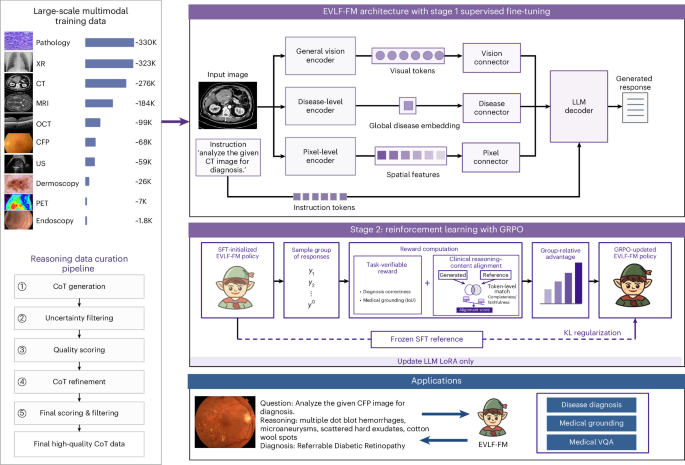
Researchers published details of a new multimodal vision-language foundation model called EVLF-FM, designed to unify broad diagnostic capability with fine-grain explainability, nature.com reported.
- EVLF-FM was tested on more than 1.3 million samples across 23 global datasets spanning eleven imaging modalities and six clinical specialties.
- The architecture incorporates both supervised and visual reinforcement fine-tuning to provide step-by-step reasoning that aligns outputs with visual evidence.
Development and Scope of EVLF-FM
The research team assembled over 1.3 million total samples from 23 global datasets covering eleven imaging modalities across dermatology, hepatology, ophthalmology, pathology, pulmonology, and radiology.
External validation for the model utilized 8,884 independent test samples drawn from 10 additional datasets across five imaging modalities. The model is built to assist clinicians with multi-disease diagnosis and visual question answering, featuring pixel-level visual grounding and reasoning capabilities.
Researchers Benchmark EVLF-FM Against Generalist and Specialist Models
To evaluate diagnostic performance, researchers benchmarked EVLF-FM against four generalist vision-language models including LLaVA version 1.5 13B, Qwen2.5-VL 7B, LLava-Med V1.5 7B, and InternVL 8B. They also compared it against six specialist foundation models and eight specialist deep learning models.
EVLF-FM Maintains High Accuracy in Visual Question Answering
Visual question answering tasks test a model’s ability to integrate visual and textual information to generate accurate responses. Using datasets such as VQA-RAD, SLAKE, and Path-VQA, researchers evaluated EVLF-FM against specialized models including RadFM, LLaVA-Med, Med-Flamingo, MedDr, and InternVL 8B. EVLF-FM maintained closed-label accuracy around 90% across all three datasets and achieved open recall exceeding 80% on VQA-RAD and SLAKE.
In medical visual grounding assessments across nine modalities—including MRI, pathology slides, X-rays, computed tomography, optical coherence tomography, color fundus photography, ultrasound, dermatoscopy, and endoscopy—EVLF-FM surpassed baseline models. Averaged across modalities, EVLF-FM achieved an accuracy at a 10% intersection over union threshold of 0.946, at 30% of 0.902, at 50% of 0.842, and a mean intersection over union of 0.741.
Few-Shot Examples Improve Diagnostic Performance in External Testing
External evaluation examined the zero-shot and few-shot capabilities of EVLF-FM using external datasets. In zero-shot testing, the model achieved high accuracy on the DRCR-CFP dataset, with the zero-shot configuration achieving the highest accuracy (0.952). However, the article does not specify additional datasets or metrics in this context.
Incorporating few-shot examples—ranging from 8-shot to 64-shot configurations—improved diagnostic performance across most external tasks. However, increased example counts did not uniformly improve results across every dataset, as demonstrated by the DRCR-CFP benchmark where the zero-shot configuration achieved higher accuracy than higher shot counts.
The integration of supervised and visual reinforcement fine-tuning allows the model to produce step-by-step reasoning outputs that align directly with underlying visual evidence, supporting potential real-world clinical deployment where transparent decision-making is required.
Disclaimer: The information provided in this article is for educational and scientific communication purposes only and does not constitute medical advice. Always consult with a qualified healthcare provider regarding any medical condition, diagnosis, or treatment plan.