
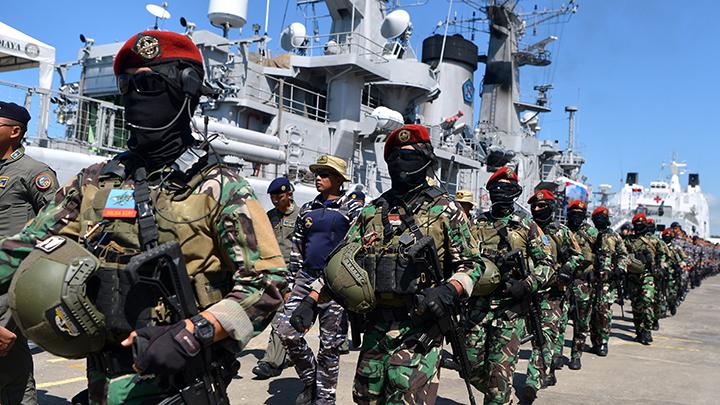
Indonesia Balances Defense Amidst Global Arms Surge
While Indonesia’s defense budget has seen a nominal increase, it’s struggling to keep pace with the accelerating global arms race, raising questions about the nation’s commitment to military modernization and regional security.
Modest Budget Increases
Indonesia’s defense budget reached US$8.8 billion in 2023 and is projected to hit US$10.6 billion in 2025. However, defense spending as a percentage of GDP remains relatively unchanged, rising from 0.7 percent in 2023 to just 0.77 percent in 2025. This lags behind the 1.85 percent average of other U.S. allies in East and Southeast Asia.
Indonesia’s GDP also grew, from Rp 20.9 quadrillion (US$1.37 trillion) in 2023 to Rp 24.2 quadrillion (US$1.49 trillion) in 2025. Experts suggest that the nominal defense budget increase is a response to overall economic expansion rather than a strategic prioritization of defense.
Resource Allocation Concerns
Even with plans to increase defense spending to 1.5 percent of GDP, commitment to modernization is uncertain. In the proposed 2025 defense budget, 51 percent is allocated to personnel and management, with only 40 percent for modernization and procurement.
The recently passed National Armed Forces Law expands the military’s role to include non-military operations like food security. This broadened scope could strain resources, potentially hindering Indonesia’s ability to promote regional stability. As of June 2024, Indonesia had over 395,000 active military personnel (Statista).
Procurement Strategy
Indonesia’s procurement of fighter aircraft such as the French Rafale and Turkish Kaan, along with potential acquisitions of Chinese J-10s and Russian SU-35s, reflect efforts to address equipment shortfalls after the Minimum Essential Forces (MEF) program failed to meet its 2024 targets.
Rather than focusing on advanced systems or interoperability, Indonesia prioritizes market availability and avoiding reliance on single suppliers. Political considerations appear to outweigh strategic military factors.
External Pressure
During the Shangri-La Dialogue, then U.S. Secretary of Defense **Pete Hegseth** urged Indo-Pacific partners to increase military spending to counter China’s growing influence. He cited China’s actions in the South China Sea and Taiwan Strait as destabilizing forces. The **Donald Trump** administration has even suggested a target of 5 percent of GDP for Asian defense spending.
Regional Trends
Across Asia, defense spending is rising. East Asia saw a 7.8 percent increase in military expenditure in 2024, the largest since 2009. Japan increased its defense budget by 21 percent, reaching 1.4 percent of GDP, while Singapore allocated 2.8 percent. Still, most Asian countries remain below the spending levels advocated by the U.S., the world’s leading arms exporter.
Global Context
Global military spending reached US$2.718 trillion in 2024, the highest since the Cold War. The Stockholm International Peace Research Institute (SIPRI) reports that over 100 countries are prioritizing defense at the expense of economic and social development.
This increase is happening amidst global economic uncertainty. **Donald Trump’s** proposed reciprocal tariff policy, with a 10 percent tariff on all countries, has triggered retaliatory measures, disrupting global supply chains and hindering economic growth. The World Bank projects global growth at just 2.3 percent in 2025, the slowest pace outside of a recession since 2008.
Geopolitical Risks
Geopolitical risks are a major driver, with conflicts like Russia-Ukraine, Israel-Hamas, Israel-Iran, and India-Pakistan highlighting military capability gaps and the need for greater self-reliance. At a recent NATO summit, European countries agreed to raise defense spending to 5 percent of national income by 2035 to meet **Trump’s** demands and bolster their security.
Indonesia faces its own geopolitical risks, including overlapping claims with China in the South China Sea. Escalation in the Taiwan Strait or on the Korean Peninsula would directly impact the country.
Indonesia’s defense modernization efforts, while underway, are insufficient to address security threats or meet U.S. expectations for increased spending. Thus, Indonesia’s current military modernization does not align with the global arms race.
