
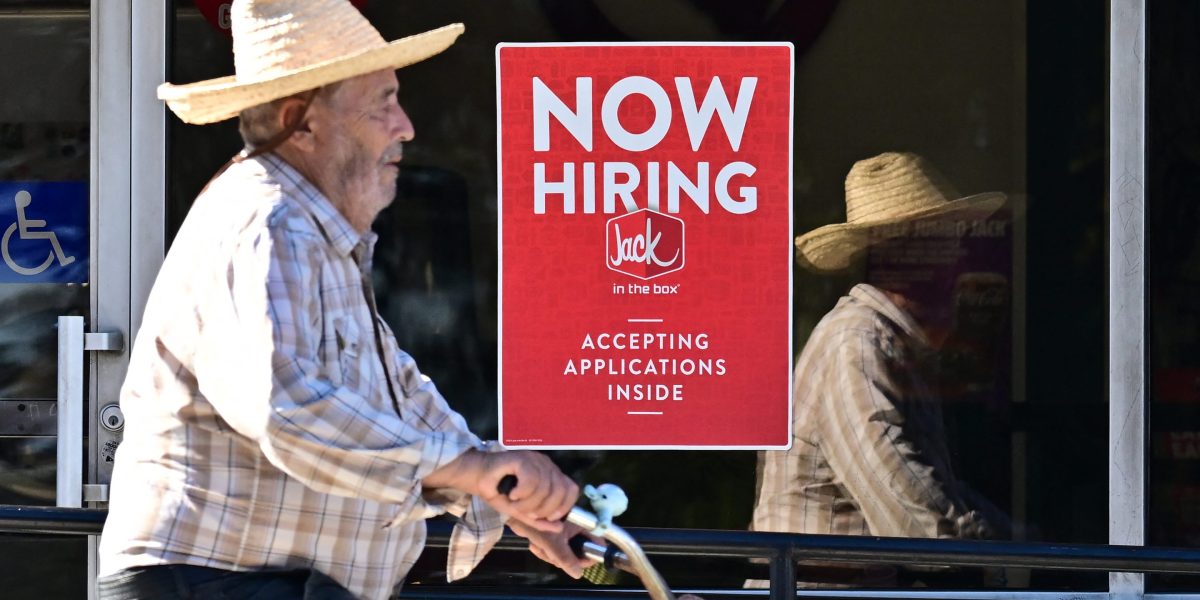
Hiring just hit a level not seen since the economy was shut down during COVID, top economist says
The U.S. Labor market has contracted to a hiring rate of 3.1%, the lowest level since the April 2020 pandemic shutdown, signaling a severe liquidity freeze in human capital. With job openings plummeting to 6.9 million and the quits rate stagnating at 1.9%, employers are entering a defensive posture. This stagnation, compounded by rising energy costs from the ongoing Iran conflict, forces corporations to pivot from organic growth to strategic consolidation and automation.
The Bureau of Labor Statistics released the Job Openings and Labor Turnover Survey (JOLTS) data this Tuesday, and the numbers are flashing red for organic expansion. We are witnessing a “locked-out” market. The hiring rate has collapsed to levels unseen since the global economy physically shuttered four years ago, yet unemployment remains stubbornly near 4%. This divergence suggests a structural break in the labor pipeline rather than a simple cyclical downturn.
Heather Long, chief economist at Navy Federal Credit Union, characterized the environment as “brutal,” noting that the 3.1% hiring rate underscores how little movement is occurring in the workforce. The comparison to 2020 is jarring due to the fact that the mechanics are entirely different. Four years ago, businesses were closed by mandate. Today, balance sheets are open, but the checkbook for fresh headcount is shut tight.
The Liquidity Trap in Human Capital
Nicole Bachaud, a labor economist at ZipRecruiter, describes this as a market where new entrants are effectively barred from the pipeline. The data reveals a dual stagnation: stalled hiring and delayed retirements. Older workers are not exiting the workforce at the expected rate, blocking the natural churn that usually creates openings for junior talent. This creates a bottleneck that ripples through wage growth and productivity metrics.

While lousy weather in February accounted for some volatility in construction and hospitality sectors, Skanda Amarnath of Employ America points to a more insidious trend: reduced immigration is draining dynamism from the system. Less population growth means less churn. When fewer people switch jobs, the aggregate hiring number drops, even if individual companies remain solvent.
The hospitality and construction sectors, traditionally the safety nets for displaced workers, are showing deceleration. This is a critical warning sign. If the entry-level rungs of the economic ladder are being removed, the broader consumption engine risks stalling. Companies are no longer hiring to grow; they are hiring only to replace essential losses.
Geopolitical Volatility and the Stagflation Bind
The JOLTS data reflects the labor market prior to the full impact of the U.S.-Israeli campaign against Iran, which has upended global energy markets. With Brent crude hovering above $115 and the Strait of Hormuz effectively closed, the cost of doing business is skyrocketing. Bachaud warns that surging gas prices will hit transportation and manufacturing margins, likely pulling back hiring activity further in the March data.
This creates a potential stagflation bind for the Federal Reserve. Inflation is running a full percentage point above the central bank’s core target, trending upward even before the war exacerbated supply chains. The Fed faces a dilemma: tightening policy to curb inflation could crush an already fragile labor market, while loosening policy risks igniting hyperinflation via energy costs.
Long flagged the war as a potential “final straw” for corporate budgets. We are moving from a no-hiring equilibrium to a potential firing phase. Companies may begin shedding headcount to make their budgets perform as energy costs eat into EBITDA. The April jobs report, due in May, could serve as the first major warning sign of this transition.
- Operational Rigidity: With hiring frozen, companies cannot scale operations organically. This forces a reliance on enterprise automation solutions to maintain output without adding headcount.
- Cost Arbitrage: As domestic labor costs remain sticky while revenue growth stalls, firms are seeking global payroll and compliance experts to shift roles to lower-cost jurisdictions legally.
- Defensive Consolidation: Instead of hiring talent, cash-rich incumbents are acquiring smaller competitors to absorb their workforce. This drives demand for M&A advisory firms specializing in talent-acquisition buyouts.
The Institutional View: Capital Allocation Shifts
The market is reacting to this labor freeze by reallocating capital away from growth stocks and toward value and defense. Institutional investors are pricing in a lower terminal value for companies reliant on rapid headcount expansion.
“We are seeing a fundamental decoupling of revenue growth from headcount growth. The companies winning in this environment aren’t the ones hiring the most; they are the ones leveraging AI to do more with less. If you are a mid-cap firm relying on linear hiring for linear growth, your valuation multiple is about to compress.”
— Marcus Thorne, Chief Investment Officer, Apex Global Macro Fund
Thorne’s assessment aligns with the broader market sentiment. The “locked-out” market favors incumbents with high cash reserves who can weather the energy shock. For the rest, the path forward requires aggressive cost restructuring.
The March jobs report, due Friday, will offer the next read on whether this stagnation is turning into contraction. Economists caution against drawing a direct line from JOLTS to payrolls immediately, but the broader picture is hard to ignore. If Friday delivers another weak number, early demand issues are back in the picture. Layering the Iran war on top of that creates a nerve-wracking scenario for Q2 earnings.
Strategic Imperatives for the Next Quarter
For corporate leaders, the message is clear: organic hiring is off the table. The focus must shift to efficiency and retention. The “Great Resignation” has been replaced by the “Great Stagnation.” Employees are staying put not out of loyalty, but out of fear. This reduces turnover costs but also reduces innovation.
Businesses must now navigate a landscape where labor is scarce, expensive, and immobile. The solution lies not in traditional recruitment, but in structural optimization. Whether through strategic HR consulting to maximize current workforce utility or legal counsel to navigate complex cross-border employment laws, the B2B service sector is poised to absorb the demand that traditional hiring cannot meet.
The window for reactive management has closed. As we move into the second quarter of 2026, the divergence between companies that can automate and those that cannot will define the market. For executives seeking to navigate this volatility, the World Today News Directory offers a curated list of vetted partners capable of executing these defensive strategies. The era of effortless hiring is over; the era of strategic precision has begun.