
Global Economic Outlook: Unexpected Strength Amidst Trade Headwinds
Table of Contents
New York, NY – August 20, 2025 – Recent economic indicators suggest the world’s major economies are demonstrating unexpected strength, defying earlier predictions of a slowdown.Despite ongoing trade tensions and tariff uncertainties, the United States, China, and Japan are all showing signs of robust activity, bolstering global market sentiment and driving stock gains.
United States: Retail Sales Surge Despite Tariff Concerns
American retail sales experienced a broad-based increase in July, rising 0.5% month-over-month, following a revised 0.9% gain in June [1]. This growth pushed shopping figures to record levels, with nine of thirteen retail subcategories contributing to the positive trend. Notably,automobile purchases increased by 1.7% month-over-month, and furniture sales rose by 1.4%. Even excluding automobiles and gasoline, sales still climbed 0.2% month-over-month.
However, analysts caution that a significant portion of this surge may be attributable to “tariff frontrunning,” as businesses and consumers rushed to purchase goods before the implementation of new tariffs.Industry reports indicate automakers are already factoring these increased costs into 2026 pricing models. Economists anticipate a potential pullback in sales as stockpiled inventory is depleted and tariffs take full effect.
Its important to note that retail sales figures do not account for inflation or the majority of service expenditures, which comprise 66.0% of total consumer spending [2]. The Personal Consumption Expenditures report, scheduled for release at the end of August, will provide a more comprehensive view of consumer behaviour.
Industrial production experienced a slight dip of 0.1% in July [3], but this is considered normal monthly fluctuation. Manufacturing, the largest component of industrial production, remained flat but at its highest level since the post-pandemic recovery of 2022.While not breathtaking, this stability is better than many anticipated given earlier fears of supply chain disruptions.
Did You Know? Industrial production only accounts for 16.2% of overall GDP, meaning its fluctuations have a limited impact on the broader economy [4].
China: Growth Persists Despite Cooling retail Sales
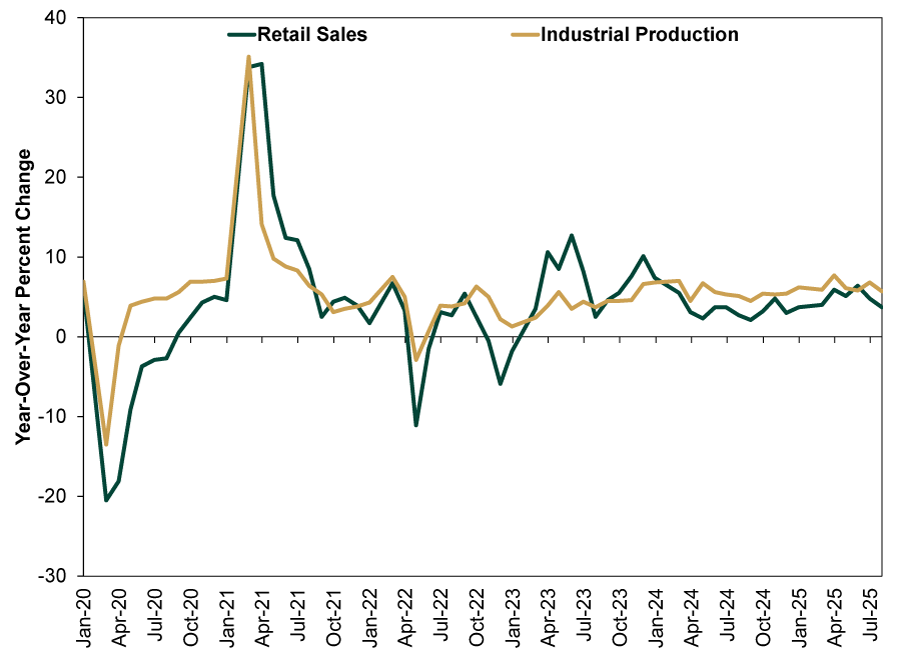
China’s retail sales also increased in July, up 3.7% year-over-year, adjusted for inflation [5]. However, this figure fell short of expectations and slowed from June’s 4.8% year-over-year growth. Month-over-month, sales declined by 0.1%, marking the second consecutive monthly contraction. Despite this slowdown,the Chinese government has implemented a series of measures to stimulate the economy,including targeted loan subsidies for consumption and business services,as well as expanded subsidies for childcare,eldercare,and consumer goods trade-ins.
Despite these challenges, the MSCI China Index has risen 28.0% year-to-date, reaching levels not seen as 2021, signaling renewed investor confidence. As the world’s second-largest economy, accounting for 16.9% of global GDP, China continues to be a significant contributor to global growth [8].
Japan: Q2 GDP Exceeds expectations
Japan’s second-quarter GDP expanded by 1.0% annualized (0.3% quarter-over-quarter), more than doubling initial forecasts of 0.4% annualized growth [9]. This positive result is attributed to a combination of factors, including a more favorable US-Japan trade deal that limited tariff increases to 15% and robust domestic demand.
Private sector demand components all showed growth: household spending increased by 0.5% annualized,residential investment by 3.2%, and business investment by 5.5%, accelerating from the 3.9% growth seen in the first quarter. Exports also surged by 8.4% annualized, driven in part by tariff frontrunning and a broader increase in capital expenditures.
Pro Tip: Keep a close watch on Japanese loan growth and the yield curve, as these are leading indicators of business investment and economic health.
Japanese stocks have also reached record highs, surpassing thier early 1990s peak and breaking out of a year-long flat stretch. This positive momentum suggests that Japan is weathering the storm of global economic uncertainty.
Key Economic Data Summary
| Country | Indicator | July/Q2 2025 data |
|---|---|---|
| United States | Retail Sales (m/m) | 0.5% |
| United States | Industrial Production (m/m) | -0.1% |
| China | Retail Sales (y/y) | 3.7% |
| China | Industrial production (y/y) | 5.7% |
| Japan | GDP (annualized) | 1.0% |
While tariffs and economic uncertainties remain, the latest data suggest that the global economy is proving more resilient than previously anticipated. With sentiment still cautious, there is potential for further positive surprises and continued stock market gains.What impact will ongoing geopolitical events have on these economic trends? And how will central banks respond to these evolving conditions?
The global economic landscape is constantly shifting, influenced by factors such as technological innovation, geopolitical events, and demographic trends. understanding these underlying forces is crucial for investors and policymakers alike. The resilience observed in the US, China, and Japan highlights the interconnectedness of the global economy and the importance of international cooperation. Looking ahead,monitoring key indicators such as inflation,employment,and consumer spending will be essential for assessing the health of the global economy.
Frequently Asked Questions
- What is “tariff frontrunning”? Tariff frontrunning refers to businesses and consumers accelerating purchases before new tariffs are implemented to avoid higher costs.
- How do tariffs impact global economic growth? Tariffs can disrupt supply chains, increase costs for businesses and consumers, and ultimately slow down economic growth.
- What is the significance of the MSCI China Index? The MSCI China Index is a key benchmark for tracking the performance of Chinese stocks and is often used as an indicator of investor sentiment towards the Chinese economy.
- Why is Japan’s business investment important? Increased business investment signals confidence in the economy and can lead to job creation and higher productivity.
- What factors are driving the recent strength in global stock markets? Positive economic data, easing inflation, and expectations of future interest rate cuts are all contributing to the recent rally in stock markets.
We hope you found this analysis insightful. Share this article with your network, leave a comment below, or subscribe to our newsletter for more in-depth coverage of global economic trends.
