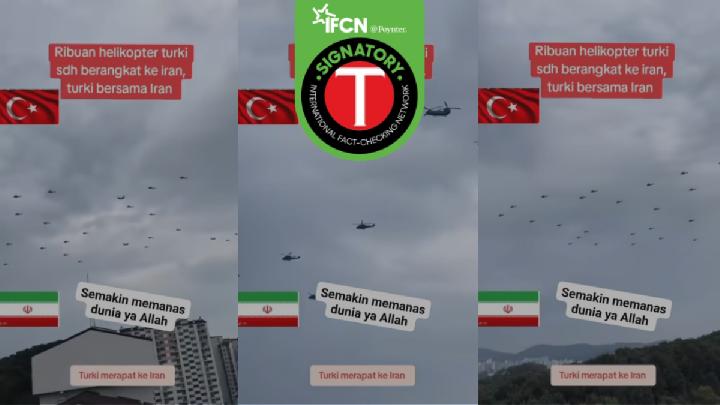
Fact Check: Viral Video of Turkish Helicopters Heading to Iran Is False
Viral claims of Turkish helicopters deploying to Iran are false. The footage actually depicts a South Korean military air show rehearsal for the 77th Armed Forces Day in Seoul, October 2024. This disinformation caused brief geopolitical tension and market instability before being debunked by international fact-checkers on April 6, 2026.
The speed of a lie is now faster than the speed of diplomacy. In the current digital climate, a fifteen-second clip uploaded to TikTok or Facebook can trigger a chain reaction that reaches the trading floors of Istanbul and the war rooms of Washington before a single official can verify the facts.
This isn’t just about a mislabeled video. It’s about the systemic vulnerability of our global information ecosystem.
The Anatomy of a Digital Deception
The video in question, which surfaced on TikTok and Facebook, purported to show thousands of Turkish helicopters departing for Iran to strengthen defense cooperation. The imagery was convincing: dozens of helicopters flying in tight formation over mountains and urban landscapes. To the untrained eye, it looked like a massive mobilization of NATO-standard hardware moving toward a regional flashpoint.

The reality is far less cinematic. The footage was captured in Seoul, South Korea, on September 11, 2024, during a dress rehearsal for the 77th Armed Forces Day commemoration. The aerial display, which took place on October 1, 2024, featured a formation of 76 helicopters. This specific sequence was broadcast live by Yoo Yong-won TV, appearing between the 10:46 and 12:39 marks of their coverage.
The deception relied on three specific levers:
- Visual Ambiguity: The mountainous terrain in the video was presented as the Iranian border, though it was actually the outskirts of Seoul.
- Algorithmic Velocity: The content was pushed through high-engagement platforms like TikTok, where emotional triggers—such as the fear of regional war—drive shares.
- Contextual Vacuum: By stripping the original South Korean captions and replacing them with claims of Turkish-Iranian cooperation, the creators exploited the existing geopolitical tension in the Middle East.
When the line between a grainy clip and a global market dip is only a few seconds, the financial stakes turn into astronomical. This specific incident of disinformation didn’t just confuse social media users; it rattled currency traders eyeing the Turkish lira and forced oil markets to recalculate risk premiums for Persian Gulf shipping insurance.
For businesses operating in these volatile corridors, the ability to distinguish signal from noise is no longer a luxury—it is a survival mechanism. Many firms are now integrating specialized risk management consultants to build early-warning systems against such “information shocks.”
“The ‘weaponization of ambiguity’ is the new frontier of conflict.”
Alexandra Hartman of Archyde highlights a terrifying reality: the goal of these campaigns isn’t always to start a war, but to observe the reaction. By simulating a military movement between a NATO member like Turkey and the Islamic Republic of Iran, bad actors can stress-test how quickly markets react and how slowly governments respond.
A Pattern of Strategic Misinformation
This helicopter hoax is not an isolated event. It is part of a broader trend of “recycled” footage used to simulate current crises. Recently, another viral video claimed to show a US Air Force pilot from a downed F-15E Strike Eagle being taken into custody in Iran. That video was also debunked; the footage actually appeared online in February, a full month before the US and Israel launched attacks on Iran on February 28.
Similarly, a previous campaign used 2012 US military drill footage to falsely claim Turkey was conducting a search operation for Iranian President Ebrahim Raisi. These patterns reveal a playbook: locate high-quality military footage from an unrelated time or place, overlay a high-stakes caption, and release it during a window of peak geopolitical anxiety.
The fallout from these lies often lingers long after the “False” label is applied. For investors and corporate leaders, the sudden volatility can lead to catastrophic decision-making. This is why we are seeing a surge in demand for financial advisors who specialize in geopolitical hedging to protect assets from algorithmic panic.
The Macro-Economic Ripple Effect
The intersection of military disinformation and high-frequency trading creates a dangerous feedback loop. When an algorithm detects a surge in keywords like “Turkish helicopters” and “Iran,” it can trigger automated sell-offs. This creates a “flash crash” effect that doesn’t require a single human to believe the lie—only for the machine to detect the trend.
This volatility affects more than just stock tickers. It impacts local infrastructure and municipal stability. In regions where these tensions are felt most acutely, the fear of escalation can lead to sudden capital flight, affecting everything from local construction projects to municipal bond ratings.
Navigating the legal aftermath of such disinformation—especially when it leads to financial loss or defamation—is a logistical minefield. Companies are increasingly turning to legal professionals to navigate the complex intersection of international digital law and corporate liability.
To understand the scale of the actors involved, one must look at the entities being manipulated. The relationship between NATO and the Republic of Korea—both key security partners of the United States—is being weaponized to create confusion. By blending the military aesthetics of one ally (South Korea) with the political identity of another (Turkey), the architects of these videos create a “hallucination” of reality that is difficult for the average user to parse.
For those seeking the truth, the only defense is a return to primary sources. Verifying footage through the Republic of Korea Government portals or cross-referencing with the Associated Press can stop the spread of a lie before it hits the balance sheet.
Truth now arrives too late to stop the damage, but it is the only thing that can repair it. As we move further into an era of synthetic media and strategic ambiguity, the distance between a TikTok video and a regional crisis will only shrink. The question is no longer whether we will be targeted by disinformation, but whether we have the professional infrastructure in place to survive it.
When the next “breaking” video hits your feed, remember that the most dangerous weapon in modern warfare isn’t a helicopter—it’s a caption. Finding verified professionals through the World Today News Directory is the first step in ensuring your business and your perspective remain grounded in fact.