
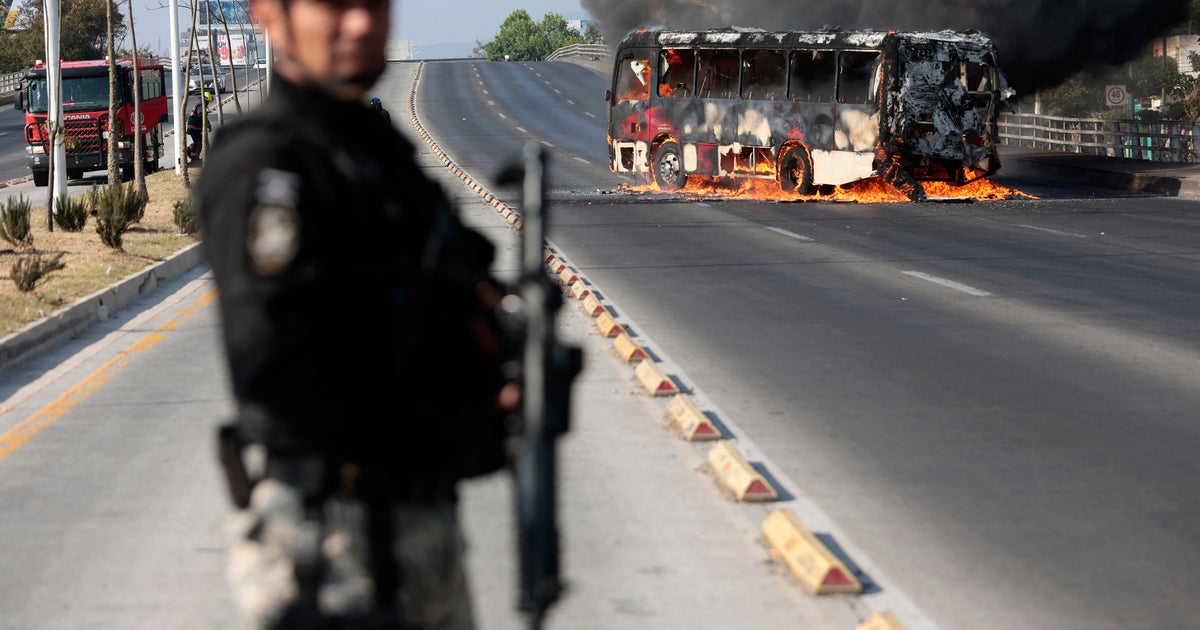
The leader of the Jalisco New Generation Cartel (CJNG), Nemesio Rubén Oseguera Cervantes, known as “El Mencho,” was killed in a military operation in western Mexico on Sunday, February 22, 2026, Mexican authorities confirmed. The operation, conducted in the town of Tapalpa, Jalisco, resulted in a firefight that left several cartel members and military personnel wounded and dead and triggered widespread violence and disruption across the region.
According to a statement from the Mexican Ministry of Defense, Oseguera Cervantes was wounded during the raid and died while being transported to Mexico City. Four individuals were killed at the scene, and three others, including Oseguera Cervantes, succumbed to their injuries later. Two suspects were arrested, and authorities seized armored vehicles, rocket launchers, and other weaponry. Three members of the armed forces were also wounded during the confrontation.
The death of “El Mencho,” considered one of the most powerful and ruthless drug kingpins in Mexico, prompted an immediate and violent response from the cartel. Reports indicate that CJNG members blocked roads with burning vehicles in Jalisco and neighboring states, a tactic frequently employed to hinder military operations. Videos circulating on social media showed plumes of smoke rising over Puerto Vallarta, a major tourist destination in Jalisco, and scenes of panic at the city’s airport.
In Guadalajara, Jalisco’s capital and Mexico’s second-largest city, burning vehicles obstructed roadways. Similar disruptions were reported in Reynosa, a border city in Tamaulipas, where cartel members blocked access to the airport, impacting travel for both Mexican and American citizens. While international bridges remained open, key routes leading to them were impassable.
Jalisco Governor Pablo Lemus Navarro activated a “code red” protocol, declaring a state of emergency and suspending public transportation throughout the state. He urged residents to remain in their homes until the situation stabilized.
The U.S. State Department issued a security alert advising American citizens in several Mexican states – including Jalisco, Tamaulipas, Michoacán, Guerrero, and Nuevo León – to shelter in place. Air Canada temporarily suspended operations at the Puerto Vallarta Airport, citing an ongoing security situation. Southwest and Alaska Airlines canceled flights to and from Puerto Vallarta, and Delta Air Lines issued travel waivers for customers with flights to or from both Puerto Vallarta and Guadalajara.
U.S. Deputy Secretary of State Christopher Landau hailed the cartel leader’s death as “a great development for Mexico, the US, Latin America, and the world,” stating on X, “The good guys are stronger than the bad guys.”
The CJNG, founded around 2007 by Oseguera Cervantes and Érick Valencia Salazar, known as “El 85,” has rapidly grown to become one of Mexico’s most powerful criminal organizations. Valencia Salazar was apprehended by U.S. Authorities in February 2025. The cartel is notorious for its aggressive tactics, including attacks on the military, the use of drones and explosives, and its significant role in trafficking fentanyl into the United States. The U.S. Drug Enforcement Administration (DEA) considers the CJNG to be as powerful as the Sinaloa Cartel, with a presence in all 50 U.S. States.
Oseguera Cervantes had been subject to multiple indictments in the U.S. District Court for the District of Columbia since 2017, and the U.S. State Department had offered a reward of up to $15 million for information leading to his arrest. In February 2025, the Trump administration designated the CJNG as a foreign terrorist organization, citing its involvement in drug trafficking, extortion, migrant smuggling, and weapons trade.
As of Sunday evening, Jalisco remained under heightened security, and the full extent of the cartel’s response to “El Mencho’s” death remained unclear.
