
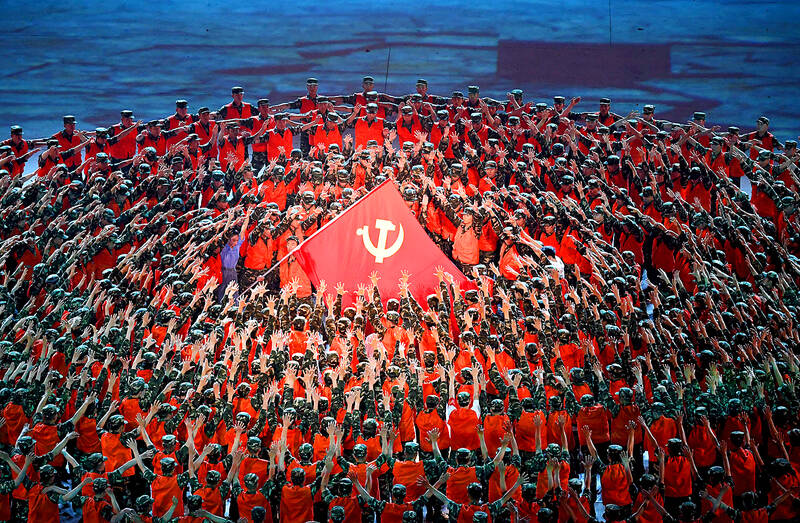
china's growing influence, with the US House Select Committee on China and the International Parliamentary Alliance on China (IPAC) issuing a joint statement. " />
Democracies Unite to Counter China’s influence
WASHINGTON – May 17,2024 – In a notable move,global democracies are joining forces to address the escalating challenge posed by China.A joint statement released by the US House select Committee on China and the Inter-Parliamentary Alliance on China (IPAC) highlights the need for solidarity in the face of authoritarianism.The discussions focused on critical issues, including supporting Taiwan, trade dynamics, and security concerns, showcasing the collective resolve to protect shared values and counter the influence of the Chinese Communist Party. For more, read on.
Global Democracies Unite to Counter China’s Growing influence
A United Front Against Authoritarianism
In a joint statement, the US House Select Committee on China and the Inter-Parliamentary Alliance of China (IPAC) have issued a stark warning: divisions among global democracies are not an option in the face of what they describe as a generational challenge
posed by China. This declaration followed a roundtable discussion focusing on critical issues, including unwavering support for Taiwan.
The statement emphasized the necessity of solidarity:
In the face of rising authoritarianism, division among democracies is not an option. We are committed to deepening our coordination across the Atlantic and beyond – to protect our shared values, strengthen collective resilience and ensure the free world stands united in defending a peaceful, rules-based international order.
The Inter-Parliamentary Alliance on China (IPAC): A Global Network
Founded in 2020, IPAC is an international coalition of lawmakers dedicated to addressing the challenges presented by China’s expanding influence. The alliance includes legislators from over 200 countries, encompassing Taiwan, the US, Japan, Australia, India, and various European nations. This diverse membership underscores the global concern surrounding China’s actions.
Key Discussion Points: Aggression, Trade, and Taiwan
delegates convened at the US Congress in Washington to address pressing matters such as authoritarian aggression, global trade dynamics, security concerns, and the importance of supporting Taiwan.The statement highlighted Taiwan as a beacon of democracy and critical partner of the US.
Leadership Voices: Moolenaar and Paternotte
Representative john Moolenaar,chairman of the committee and an IPAC cochair,alongside Representative Raja Krishnamoorthi,the committee’s ranking member and an IPAC member,spearheaded the IPAC discussions. Moolenaar emphasized the CCP’s strategy to exploit divisions:
The Chinese Communist Party [CCP] is working overtime to divide democracies and exploit the gaps between us. by coming together across the Atlantic, we are strengthening our shared resolve to defend democratic values, protect our institutions and ensure that free nations – not authoritarian regimes – set the rules of the road for the 21st century.
Representative John Moolenaar, US House Select Committee on China
Dutch Member of parliament Jan Paternotte, also an IPAC cochair, echoed this sentiment, stressing the importance of unity:
Authoritarian aggression thrives when democracies are divided. This joint commitment shows that transatlantic lawmakers are united in defending freedom and resisting CCP influence.
Jan Paternotte, Dutch Member of Parliament and IPAC Cochair
Countering China’s Global Ambitions
The committee and IPAC jointly affirmed their dedication to enhancing cooperation among democracies to counteract China’s efforts to reshape the global order according to its own terms. They outlined the CCP’s multifaceted approach:
The CCP is conducting a coordinated campaign to undermine democratic institutions, pressure open societies, and coerce economies through foreign interference, strategic investment and military aggression.
Specific concerns include China’s actions in the Taiwan Strait and the broader Indo-Pacific region, its support for Russia’s aggression in ukraine, and its attempts to subvert international organizations. These actions, according to the statement, reflect a intentional effort to chip away at the norms that have underpinned global stability for decades.
The Call for Solidarity
The overarching message is clear: democracies worldwide must strengthen their solidarity to effectively confront the challenges posed by Beijing.This united front is essential to preserving a free and open international order.
