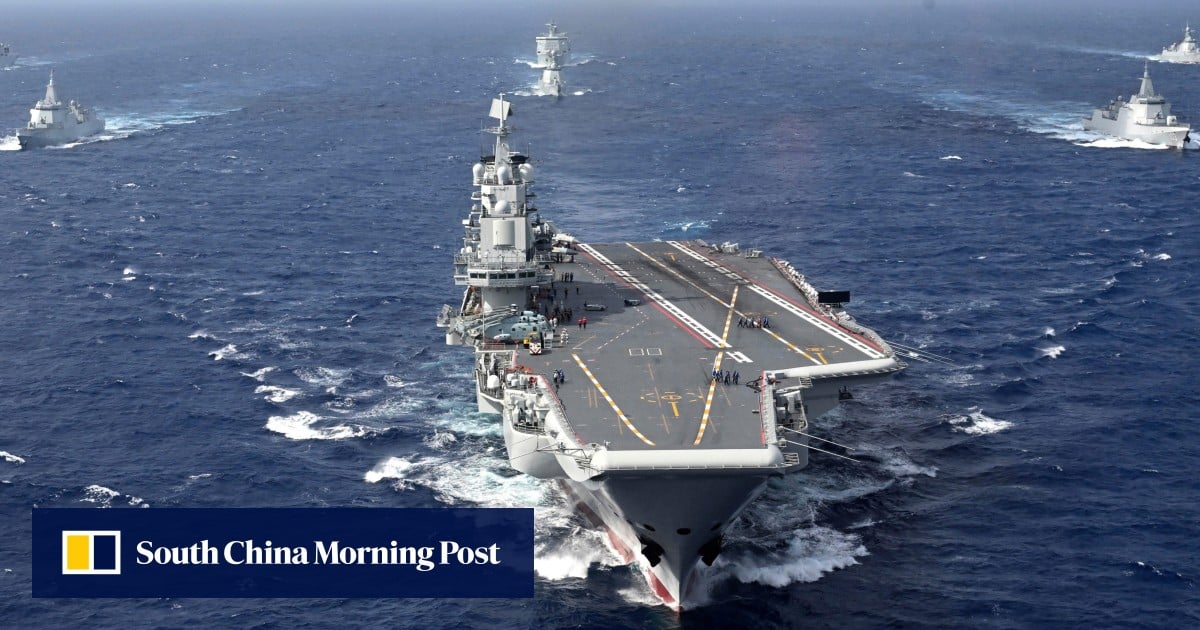
China Navy Drill Highlights as Liaoning Carrier Joins 14 Vessels Amid US-Philippines Balikatan 2026 Exercises
On April 25, 2026, China conducted a major naval exercise featuring the aircraft carrier Liaoning and 14 other large vessels in the South China Sea, coinciding with the commencement of the annual Balikatan military exercises between the United States and the Philippines, heightening regional tensions and testing maritime security protocols amid competing territorial claims and strategic posturing over critical sea lanes.
The timing of China’s drill—launched as U.S. And Philippine forces began joint amphibious landings, live-fire exercises and humanitarian assistance training on Luzon—underscores a deliberate signal of presence in waters both nations consider vital to their sovereignty. The South China Sea, through which over $3 trillion in annual trade passes, remains a flashpoint where overlapping claims by China, the Philippines, Vietnam, Malaysia, Brunei, and Taiwan have repeatedly brought naval and air forces into close proximity, increasing the risk of miscalculation.
Historical Context: From Incidents to Institutionalized Drills
This is not the first time such parallel exercises have occurred. In 2023, a similar convergence prompted the Philippine Department of National Defense to file a formal protest after Chinese vessels conducted maneuvers near Thitu Island, a feature occupied by Philippine forces and home to a small civilian community. That year, the Balikatan exercises included decontamination drills for chemical, biological, radiological, and nuclear threats—a reflection of evolving security concerns beyond traditional military scenarios.
China’s naval activity in the region has steadily increased since 2010, with the Liaoning—China’s first operational aircraft carrier, commissioned in 2012—becoming a recurring presence in annual patrols that often skirt the edges of claimed exclusive economic zones. Analysts at the Lowy Institute note that these deployments serve dual purposes: signaling capability and gathering intelligence on foreign military movements during exercises like Balikatan.
On-the-Ground Impact: Coastal Communities and Maritime Commerce
For coastal provinces in the Philippines—particularly Pangasinan, Zambales, and Palawan—where fishing communities rely on access to traditional grounds now intermittently patrolled by foreign vessels, the presence of large naval flotillas disrupts livelihoods and raises safety concerns. In 2024, the Bureau of Fisheries and Aquatic Resources reported a 12% decline in reported catch volumes in zones near Scarborough Shoal, attributing part of the drop to fisherfolk avoiding areas due to perceived naval activity.
“When warships appear where we’ve fished for generations, it’s not just about territory—it’s about whether we can feed our families,” said Rosario Delgado, a third-generation fisherwoman from Bolinao, Pangasinan, whose cooperative has lobbied for clearer communication channels between maritime authorities and local barangays during foreign exercises.
“Transparency and advance notice aren’t courtesies—they’re necessities for coastal communities living on the front lines of geopolitical posturing.”
— Rosario Delgado, Fisherfolk Leader, Bolinao, Pangasinan
Beyond fisheries, the disruption extends to maritime logistics. The Port of Manila, which handles over 60% of the Philippines’ international cargo, relies on unimpeded passage through the South China Sea for routes to Hong Kong, Singapore, and Kaohsiung. Any perception of increased risk—even without direct interference—can lead to higher insurance premiums and rerouting costs, affecting everything from electronics exports to agricultural shipments.
Expert Perspective: Legal Frameworks and Enforcement Gaps
Under the United Nations Convention on the Law of the Sea (UNCLOS), to which both China and the Philippines are signatories, naval exercises are permitted in exclusive economic zones (EEZs) so long as they do not threaten the peace, excellent order, or security of the coastal state. However, interpretations diverge: Beijing views such activities as permissible under freedom of navigation, while Manila argues that large-scale drills near its EEZ constitute a challenge to its sovereign rights.
“The real issue isn’t whether these maneuvers are technically legal—it’s whether they’re conducted in a way that respects the rights and safety of others,” said Atty. Karen Santiago, professor of international law at the University of the Philippines College of Law. “When carrier groups operate without prior notice or coordination, it erodes trust and increases the chance of dangerous incidents, even if no one intends conflict.”
“Confidence-building measures—like pre-notification of exercises or establishing direct military-to-military hotlines—exist for a reason. Their absence here is telling.”
— Atty. Karen Santiago, UP College of Law
These legal ambiguities underscore the necessitate for accessible expertise. Businesses reliant on shipping, fisheries, or offshore energy exploration in the region increasingly turn to specialized counsel to navigate uncertainty. Firms seeking guidance on maritime law compliance, risk assessment, or diplomatic engagement often consult international maritime attorneys who understand the nuances of UNCLOS implementation and regional dispute resolution mechanisms.
Economic Ripple Effects: Supply Chains and Insurance Markets
The South China Sea’s role in global supply chains means that any escalation in perceived risk reverberates far beyond the immediate vicinity. In 2023, Lloyd’s of London noted a 7% increase in war risk premiums for vessels transiting the area during periods of heightened naval activity—a cost ultimately borne by importers and exporters worldwide. For Philippine exporters of semiconductors and agricultural goods, even marginal increases in transit costs can affect competitiveness in markets like Japan and the Netherlands.
This dynamic creates demand for services that help businesses anticipate and mitigate geopolitical risk. Logistics firms and manufacturers now routinely engage geopolitical risk analysts to model scenarios, adjust routing strategies, and secure appropriate insurance coverage—turning abstract naval movements into tangible operational decisions.
Diplomatic Channels and Local Resilience
While national governments manage high-level diplomacy, local governments and civil society often bear the brunt of uncertainty. In response, some coastal municipalities have strengthened local disaster preparedness not just for typhoons but for potential maritime incidents. After a 2022 near-miss between a Philippine patrol boat and a Chinese vessel near Reed Bank, the municipal government of Puerto Prinsesa, Palawan, upgraded its coastal surveillance systems and conducted joint drills with the Philippine Coast Guard focused on search-and-rescue scenarios involving civilian vessels.
Such initiatives highlight the value of municipal resilience planners and coastal safety coordinators who work to ensure that communities are not passive observers but active participants in maritime safety—equipped with training, communication tools, and clear protocols when naval activity increases nearby.
The Broader Pattern: Signaling, Sovereignty, and the Search for Stability
China’s naval drill during Balikatan 2026 fits a broader pattern of using military exercises as signaling tools—demonstrating capability, testing responses, and asserting presence without crossing into overt conflict. For the Philippines and its allies, these moments reinforce the importance of alliance cohesion, transparent communication, and investment in maritime domain awareness.
Yet beneath the geopolitical calculus lies a simpler truth: the people who live and work along these shores are not pawns in a great-power game. Their livelihoods, safety, and sense of stability depend on predictability—on knowing when to cast a net, when to send a shipment, and when to trust that the waters they depend on won’t suddenly become a stage for maneuvers they had no say in.
As the region navigates this era of strategic competition, the need for reliable, localized expertise has never been greater. Whether it’s a fisherman seeking clarity on access rights, a logistics manager assessing route risks, or a municipal official preparing emergency plans, the World Today News Directory connects communities and businesses with verified professionals who understand the intersection of global events and local reality—helping turn uncertainty into informed action.