
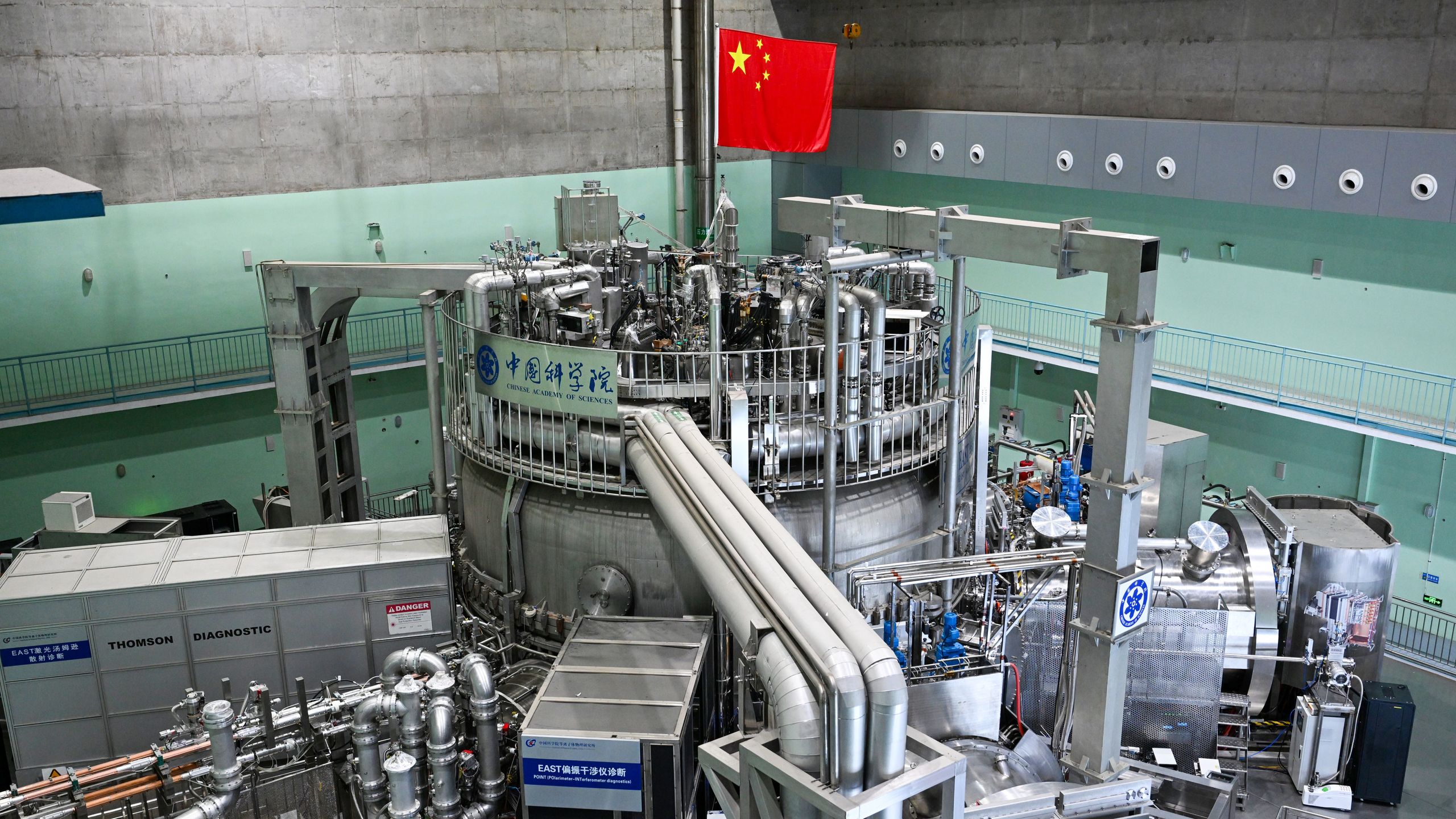
China’s ‘Artificial Sun’ Achieves Breakthrough, Paving teh Way for Clean Energy Future
January 10, 2026 – In a landmark achievement for clean energy research, China’s Experimental Advanced Superconducting Tokamak (EAST), often dubbed the “artificial sun,” has successfully surpassed a critical limit in nuclear fusion technology. By maintaining a stable plasma state at densities previously considered unattainable, this breakthrough brings humanity one step closer to realizing the promise of near-limitless, enduring energy.
Understanding Nuclear Fusion: The Power of the Stars
Nuclear fusion, the process that powers the sun and stars, holds immense potential as a clean energy source. Unlike conventional nuclear fission, which splits atoms, fusion combines them, releasing vast amounts of energy with minimal long-lived radioactive waste [1]. This process requires incredibly high temperatures and pressures to overcome the natural repulsion between positively charged atoms.
To achieve fusion on Earth, scientists utilize devices like tokamaks – donut-shaped reactors that use powerful magnetic fields to confine and control superheated plasma, the fourth state of matter [1]. However, sustaining a stable plasma at the necessary conditions has proven to be a important scientific and engineering challenge.
The Greenwald Limit and EAST’s Recent Success
A major obstacle in fusion research has been the “Greenwald Limit,” a density threshold beyond which plasma becomes unstable, disrupting the fusion reaction.Higher plasma densities are desirable because they increase the frequency of fusion events, reducing the energy required to initiate and sustain the process. However, exceeding the Greenwald Limit traditionally led to plasma disruptions and reactor instability.
Recently, the EAST reactor, operated by the Chinese Academy of Sciences, demonstrated a remarkable achievement: maintaining a stable plasma at densities 1.3 to 1.65 times beyond the Greenwald Limit [1].This was accomplished by carefully controlling the initial fuel gas pressure and the electron cyclotron resonance heating – the frequency at which electrons in the plasma absorb microwaves – during the reactor’s startup phase.
“The findings suggest a practical and scalable pathway for extending density limits in tokamaks and next-generation burning plasma fusion devices,” explained Professor Ping Zhu of the University of Science and Technology in China,a co-lead author of the study [1].
Beyond the Limit: The “Density-Free Regime”
The EAST experiment didn’t just break the Greenwald Limit; it ventured into previously unexplored territory.Researchers were able to heat the plasma to a state known as the “density-free regime,” were the plasma remained stable even as its density increased. This breakthrough is rooted in the theory of “plasma-wall self organization” (PWSO) [1], which posits that a carefully balanced interaction between the plasma and the reactor walls can create a stable, high-density environment.
This isn’t an isolated success. In 2022, the DIII-D National Fusion Facility in San Diego, USA, also surpassed the Greenwald Limit [1], and in 2024, researchers at the University of Wisconsin–Madison achieved a stable plasma at ten times the Greenwald Limit [1]. These parallel advancements demonstrate a growing global momentum in fusion research.
The Path Forward: ITER and the Future of fusion energy
While these achievements are significant, it’s crucial to remember that nuclear fusion is still an experimental technology. Current reactors consume more energy than they produce, and sustained, self-sustaining fusion – known as ignition – remains elusive. However, the progress made at facilities like EAST is informing the design and operation of larger, more enterprising projects.
A prime example is the International thermonuclear Experimental Reactor (ITER) [1], a collaborative effort involving dozens of countries, including China and the united States. Located in France, ITER is the world’s largest tokamak, designed to demonstrate the feasibility of sustained fusion reactions. While not intended to generate electricity directly, ITER will provide invaluable data and experience for future fusion power plants.Full-scale fusion reactions at ITER are anticipated to begin in 2039 [1].
why Fusion Matters: A Long-Term Solution
Despite the challenges, the potential benefits of nuclear fusion are enormous. Fusion offers a pathway to a clean, sustainable, and virtually limitless energy source, without the production of long-lived radioactive waste or greenhouse gas emissions [1].
While fusion is unlikely to solve the immediate climate crisis, it represents a crucial long-term investment in a secure and sustainable energy future. The recent breakthroughs at EAST and other facilities around the world offer a renewed sense of optimism that this ambitious goal is within reach. Continued research, international collaboration, and sustained investment will be essential to unlock the full potential of fusion energy and usher in a new era of clean power.
