
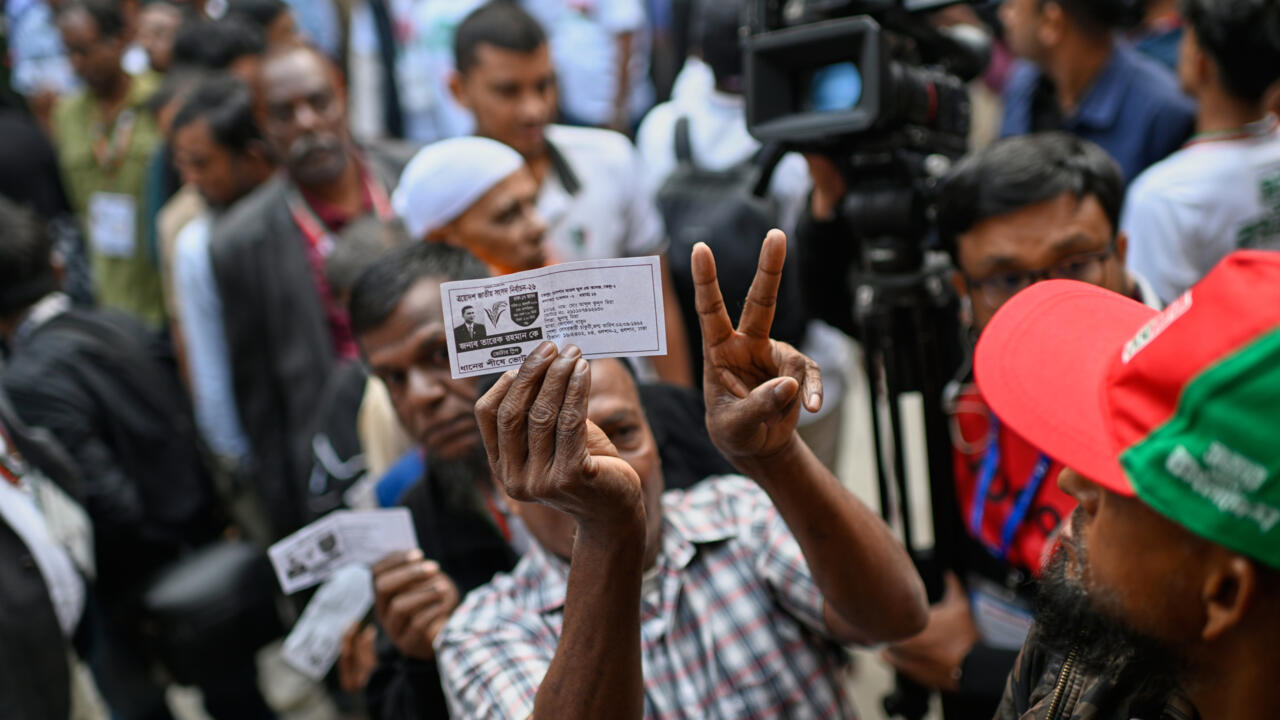
Dhaka, Bangladesh – Bangladeshis lined up to vote Thursday in a landmark election, the first since a mass uprising ended the 15-year rule of former Prime Minister Sheikh Hasina. The election pits the Bangladesh Nationalist Party (BNP), led by Tarique Rahman, against a challenge from the country’s largest Islamist party, Jamaat-e-Islami, led by Shafiqur Rahman.
Queues stretched outside polling stations in the capital, Dhaka, as voting opened in the South Asian nation of 170 million people. More than 300,000 soldiers and police have been deployed nationwide to maintain order, amid warnings from UN experts of “growing intolerance, threats and attacks” and a “tsunami of disinformation” targeting young voters. “I voted in 1991 and today after many years, I cast my vote here,” said Nur Alam Shamim, 50, at the New Model Degree College in Dhaka-10 constituency. Shithi Goswami, 21, a student at Dhaka City College, said she hoped the election would usher in “something positive” after years of political turmoil.
Rahman, 60, is seeking to restore the BNP to power, but faces a strong challenge from Jamaat-e-Islami. If victorious, Shafiqur Rahman, 67, could become the first Islamist leader to head the constitutionally secular nation. Opinion polls suggest a close race, with the BNP holding a slight lead.
Interim leader Muhammad Yunus, the Nobel Peace Prize laureate who has overseen the transition since Hasina’s ouster in August 2024, addressed the nation before the vote, stating the election would “determine the future direction of the country, the character of its democracy, its durability, and the fate of the next generation.” Yunus’s administration has barred Hasina’s Awami League from contesting the polls, and has championed a charter for democratic reform aimed at preventing a return to one-party rule.
Voters are also participating in a referendum on proposals including prime ministerial term limits, a new upper house of parliament, stronger presidential powers, and greater judicial independence. The 127 million eligible voters will elect 300 lawmakers directly, with an additional 50 seats reserved for women, chosen from party lists. Counting will begin after polls close at 4:30 pm local time (1030 GMT), and will include the referendum ballots.
The election follows a period of political unrest, with police records indicating five people killed and over 600 injured in clashes during the campaign period. Sheikh Hasina, 78, was sentenced to death in absentia in November 2025 for crimes against humanity related to a crackdown on protests during her final months in power and remains in hiding in India. The government has sought her extradition, but India has not responded to previous requests.
The next government will inherit a struggling economy, the world’s second-largest garment exporter, and will need to navigate delicate relations with neighboring India. Rahman has pledged to restore security and stability, acknowledging the immense economic challenges facing the country. “The economy has been destroyed,” he told AFP. “There are a huge number of unemployed. We need to create businesses for these young people to have jobs.”
Jamaat-e-Islami, campaigning on a platform of justice and anti-corruption, sees its strongest opportunity in decades. “We desire to build a country of unity with everyone on board,” said Jamaat leader Rahman in his closing campaign speech. “It will be a country where nobody gets the driving seat because of their family background.” Around 10 percent of Bangladesh’s population is non-Muslim, primarily Hindu.
In his final address, Yunus urged citizens to honor the “sacrifice” of the 2024 uprising and prioritize the “national interest above personal and party” agendas. “Victory is part of democracy; defeat is also an inevitable part,” he said. “Please dedicate yourselves to building a new, just, and inclusive Bangladesh.”
