
APOE ε4 Gene Linked to Universal Proteomic Signature Across Neurodegenerative diseases
Table of Contents
- APOE ε4 Gene Linked to Universal Proteomic Signature Across Neurodegenerative diseases
- Brain, Blood, and CSF Show Shared Molecular Patterns
- Unexpected Biomarker Finding Challenges Current Understanding
- Gene-Disease Interactions and Lifestyle Factors Explored
- conclusions: APOE ε4 as a Systemic Immune Modulator
- Understanding APOE ε4 and Neurodegeneration
- Frequently Asked Questions About APOE ε4 and Neurodegeneration
- What is the primary finding regarding APOE ε4 carriers?
- How does APOE ε4 influence biological processes?
- What was the unexpected finding about neurofilament light (NEFL)?
- Does APOE ε4 directly cause neurodegeneration?
- How does this research reframe the role of APOE ε4?
- What are the implications for future research?
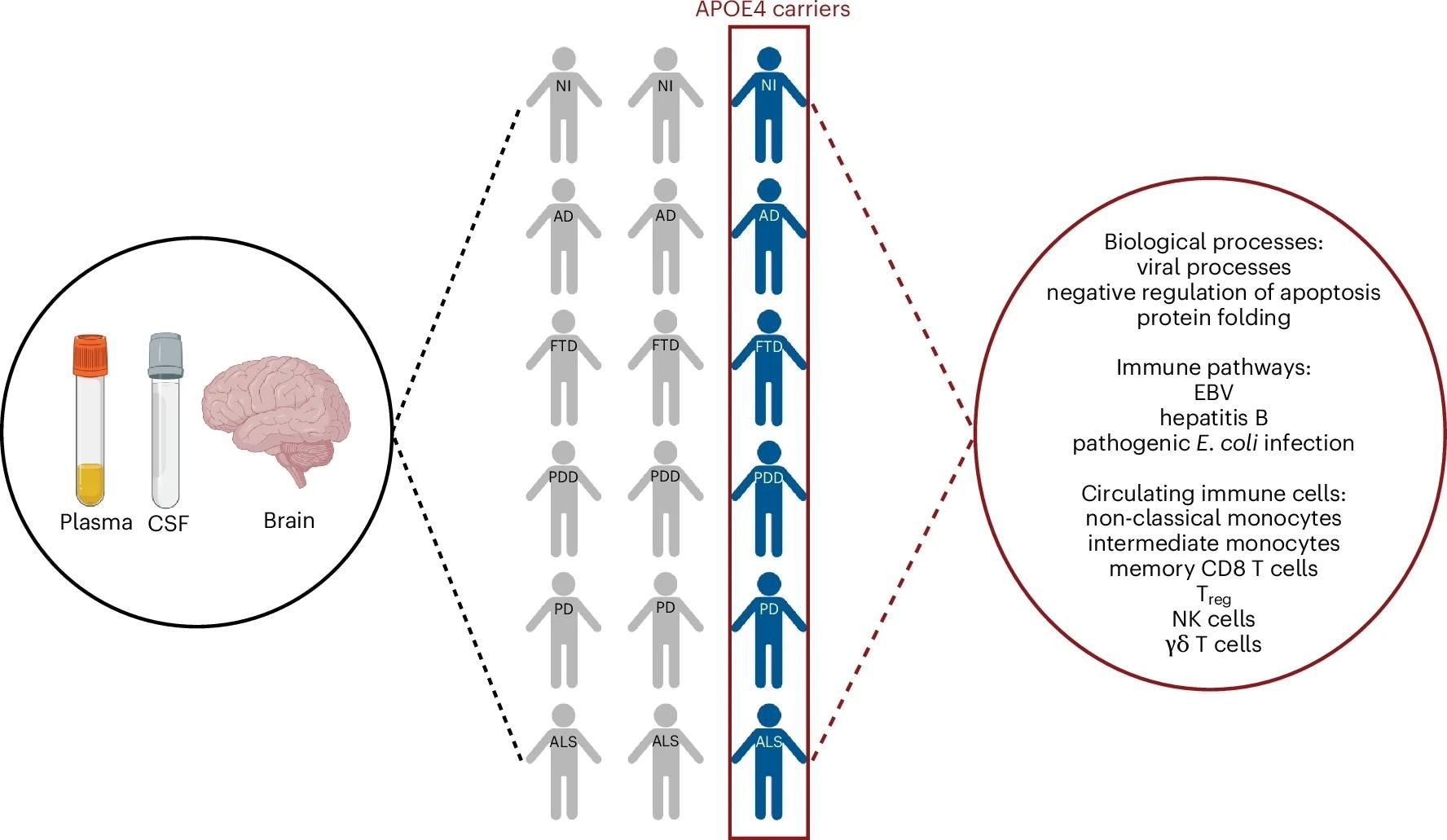
New research reveals a consistent molecular fingerprint in carriers of the APOE ε4 gene, impacting the brain, cerebrospinal fluid, and plasma, irrespective of specific neurodegenerative conditions.
Published recently, a study identified a shared proteomic signature in the dorsolateral prefrontal cortex (dlPFC) of individuals carrying the APOE ε4 gene, a finding consistent across various neurodegenerative diseases.
Functional analysis highlighted that key biological processes-viral processes, apoptosis, and protein folding-were considerably enriched in the dlPFC of APOE ε4 carriers. these same processes were previously identified in plasma and cerebrospinal fluid (CSF) samples.
Moreover, four prominent immune pathways found in plasma and CSF-hepatitis B, Epstein-Barr virus (EBV), Escherichia coli infection, and viral carcinogenesis-were also significantly enriched in APOE ε4 carriers, independent of their specific disease diagnosis.
Crucially, this brain signature persisted nonetheless of the presence of hallmark neurodegenerative pathologies such as amyloid-beta, tau, TDP-43, and alpha-synuclein. This suggests that the APOE ε4 gene’s influence is a basic vulnerability rather than a direct consequence of protein aggregation.
Unexpected Biomarker Finding Challenges Current Understanding
In a surprising development, the study observed that plasma neurofilament light (NEFL) levels, a widely recognized biomarker for neurodegeneration, were consistently lower in APOE ε4 carriers. This finding contrasts with some previous research.
The authors suggest this discrepancy raises questions about NEFL’s reliability as a standalone biomarker,positing that its levels might be influenced by APOE ε4-related metabolic factors or altered clearance across the blood-brain barrier.
Gene-Disease Interactions and Lifestyle Factors Explored
A correlation network analysis examined the relationships between APOE ε4 proteins and clinical, demographic, and lifestyle factors in patients with Parkinson’s disease dementia (PDD), Parkinson’s disease (PD), Alzheimer’s disease (AD), and non-impaired APOE ε4 carriers.
The study identified disease-specific associations with APOE. In AD, APOE was linked to race and sex; in PD, it correlated with diabetes; in non-impaired controls, it was associated with age, hypertension, and body mass index; and in PDD, it related to chronic obstructive pulmonary disease and resting heart rate.
Though,the researchers caution that due to the cross-sectional nature of the study,causality cannot be inferred,as these clinical factors might be outcomes of the neurodegenerative disease rather than its causes.
conclusions: APOE ε4 as a Systemic Immune Modulator
The research concludes that APOE ε4 carriers exhibit a distinct proteomic signature across plasma, CSF, and brain tissue, irrespective of their specific neurodegenerative disease. This signature is linked to an increase in circulating immune cells and pro-inflammatory immune dysregulation.
A proposed mechanism suggests that overactive peripheral immune cells may interact with and compromise the blood-brain barrier, thereby promoting neuroinflammation.Proteins within this signature showed unique correlations with clinical, demographic, and lifestyle factors in a manner specific to each neurodegenerative disease.
These findings indicate that APOE ε4 confers a systemic biological vulnerability that is necessary but not sufficient for neurodegeneration, emphasizing the importance of considering gene-environment interactions.
Limitations acknowledged by the authors include the absence of validated biomarkers for all clinical diagnoses and the lack of direct measurements for routine inflammatory markers like C-reactive protein,which are recommended for future investigations.
The study reframes APOE ε4 as a broad immune modulator, moving beyond its role as an AD-specific risk gene. This viewpoint offers a foundation for developing early intervention strategies and precision biomarkers across a spectrum of neurodegenerative diseases.
The authors advocate for a conceptual shift in the field, moving from merely identifying genetic risk loci to functionally characterizing established variants, and establishing a clear path for future research into these complex biological interactions.
Understanding APOE ε4 and Neurodegeneration
The apolipoprotein E (APOE) gene plays a crucial role in lipid transport and metabolism in the brain. The ε4 allele (APOE ε4) is the strongest genetic risk factor for late-onset Alzheimer’s disease and is also associated with an increased risk for other neurodegenerative conditions.
Neuroinflammation, a chronic inflammatory response in the brain, is increasingly recognized as a significant contributor to the pathogenesis of neurodegenerative diseases. The blood-brain barrier (BBB) acts as a critical interface, regulating the passage of substances between the bloodstream and the brain.
Biomarkers, such as neurofilament light (NEFL), are measurable indicators of biological states or conditions. NEFL is a protein released into the bloodstream and CSF when nerve cells are damaged, making it a sensitive marker of neuroaxonal injury.
Previous research has often focused on APOE ε4’s specific role in Alzheimer’s disease. However, this recent study broadens the understanding by demonstrating its systemic effects across multiple neurodegenerative diseases, highlighting a potential common pathway involving immune dysregulation.
Frequently Asked Questions About APOE ε4 and Neurodegeneration
What is the primary finding regarding APOE ε4 carriers?
APOE ε4 carriers share a consistent proteomic signature across the brain, CSF, and plasma, regardless of the specific neurodegenerative disease they may have.
How does APOE ε4 influence biological processes?
The APOE ε4 gene is associated with enriched viral processes,apoptosis,and protein folding,as well as specific immune pathways,suggesting a role in immune modulation.
What was the unexpected finding about neurofilament light (NEFL)?
Plasma NEFL levels were found to be lower in APOE ε4 carriers, challenging its role as a standalone biomarker and suggesting potential APOE ε4-related influences on its levels.
Does APOE ε4 directly cause neurodegeneration?
The study suggests APOE ε4 confers a systemic vulnerability that is essential but insufficient for neurodegeneration, implying that other factors, including gene-environment interactions, are also critical.
How does this research reframe the role of APOE ε4?
The findings suggest APOE ε4 should be viewed as a pleiotropic immune modulator rather than solely an Alzheimer’s disease-specific risk gene.
What are the implications for future research?
The study calls for a focus on the functional characterization of genetic variants like APOE ε4 and the development of precision biomarkers and early intervention strategies across neurodegenerative diseases.
