AI Smartphone Thermal Tool Predicts Diabetic Foot Ulcer Healing at First Visit
A single smartphone thermal image, taken at a patient’s first clinic visit, can flag which diabetes-related foot ulcers are unlikely to heal — weeks before today’s four-week standard catches them. An Australian team’s AI tool, THERMUL, showed moderate accuracy in a study published November 8, 2026, in the Journal of Diabetes Science and Technology.
- A smartphone-based AI platform called THERMUL predicted healing outcomes for diabetes-related foot ulcers from one thermal image captured at the initial assessment, according to a study in the Journal of Diabetes Science and Technology.
- The model correctly classified 5 of 7 unseen ulcers in a preliminary feasibility check, predicting one healed ulcer would not heal and one unhealed ulcer would heal.
- Researchers at RMIT University, the University of Melbourne and Bolton Clarke say the tool could bring specialist-level decision support to rural and remote clinics.
Why four weeks is too long to wait
The standard of care for judging whether a diabetes-related foot ulcer is on a chronic trajectory is blunt: clinicians look for less than a 50% reduction in wound area after four weeks of standard treatment.
That benchmark, described in the study, means a reliable signal of delayed healing arrives a full month after the first visit — a month in which infection can deepen, perfusion can deteriorate, and the window for targeted intervention narrows.
The stakes are considerable. Diabetes affects more than 500 million people globally, and about a third will develop a foot ulcer during their lifetime. Ulcers that fail to heal can progress to infection, hospitalization and amputation. In Australia alone, diabetes-related foot disease costs an estimated $875 million every year, according to Professor Elif Ekinci, head of the University of Melbourne’s Department of Medicine.
How THERMUL reads heat inside the wound
Thermal imaging is not new to wound assessment, but earlier approaches compared the affected foot with the opposite foot — a comparison that breaks down when ambient temperature, humidity or airflow shift, or when both feet are affected, which is common in diabetes. THERMUL, developed at RMIT University under Professor Dinesh Kumar, takes a different route.
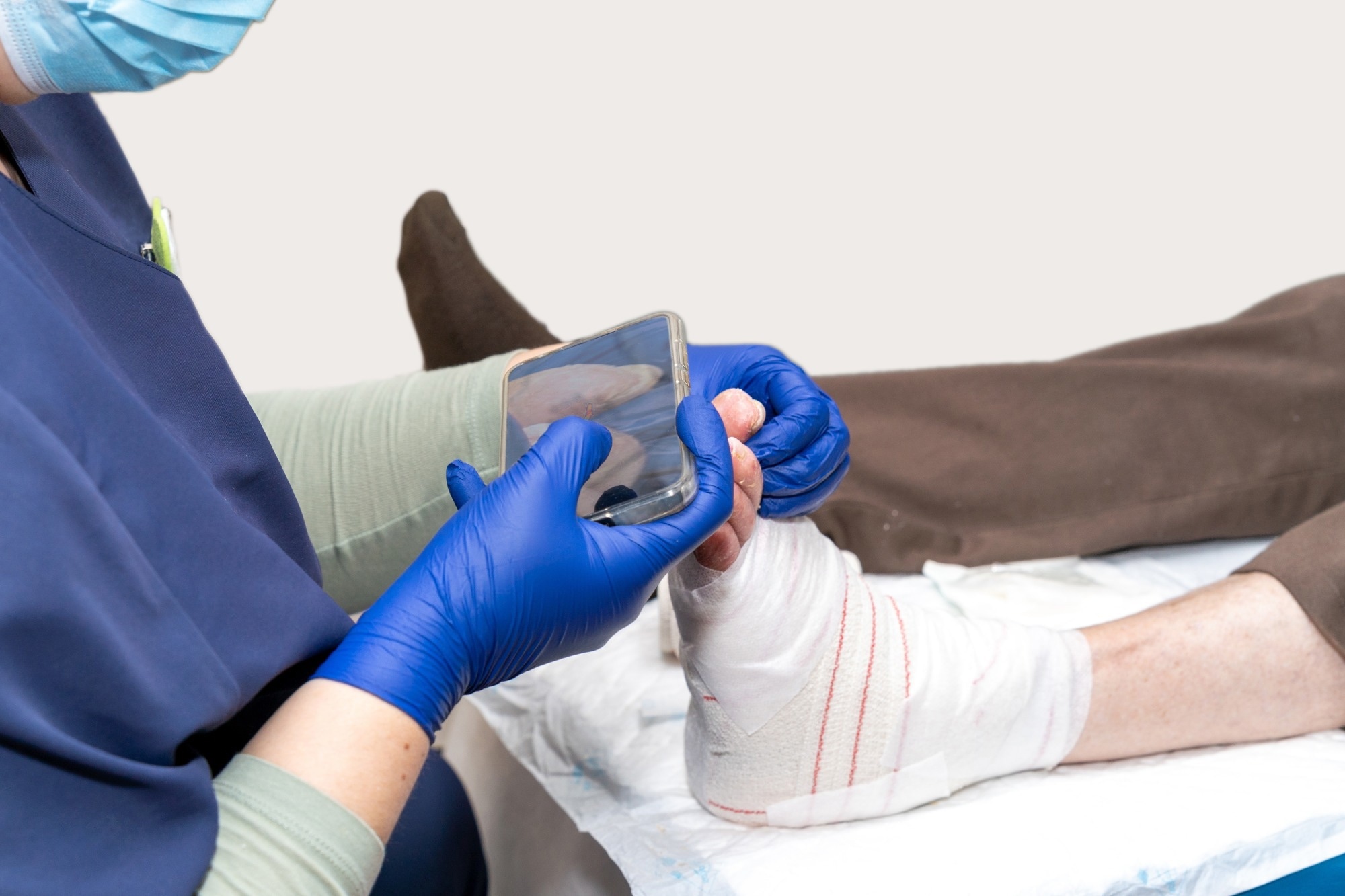
The platform pairs a thermal camera with a smartphone, capturing thermal images from a patient when they initially present for care. Software then extracts features. From this data, the AI model was taught to recognize temperature signatures linked to ulcers that went on to heal and those that failed to do so.
“These patterns may provide an early indication of a wound’s likely healing trajectory, potentially allowing clinicians to identify people who might benefit from earlier intervention or escalation of care,” said Professor Dinesh Kumar of RMIT’s School of Engineering.
What the Melbourne cohort showed
The evidence comes from a study at Austin Health and St Vincent’s Hospital Melbourne involving 110 patients with diabetes-related foot ulcers, run with aged care health provider Bolton Clarke. The predictive model itself was built on a linear support vector machine using data from 68 ulcers from 56 participants. Of these, 44 healed and 24 did not, including two amputations.
All ulcers were restricted to low ischemia and infection severity under the Wound, Ischemia and Foot Infection (WIfI) classification. Baseline images were taken before debridement. Clinicians judged complete healing at 12 weeks independently of the model. The researchers assessed the model’s performance with repeated 5-fold cross-validation, with each of these folds containing about 55 training and 13 test samples.
The published performance figures tell a measured story:
| Measure | Result |
|---|---|
| Mean AUC (testing) | 0.635 |
| AUC (training folds) | 0.717 |
| Sensitivity for non-healing ulcers | 75.8% |
| Specificity for healed ulcers | 53% |
| Mean accuracy | 61% |
In a preliminary feasibility check on a separate set of seven unseen ulcers (four healed and three unhealed), the model classified five of seven correctly. The authors themselves describe the model’s performance as moderate.
Who stands to gain access first
The equity argument is central to the team’s case. Dr. Rajna Ogrin, a senior research fellow at Bolton Clarke, pointed to patients outside major cities.
“People in regional, rural and remote areas living with diabetes and receiving care at home, or through outreach services, may not have timely access to specialist diabetes foot services,” Dr. Ogrin said. “A portable, noncontact tool like THERMUL has the potential to bring specialist-level decision support closer to where people live and receive care.”
Ekinci framed the economics the same way. “By enabling earlier identification of ulcers at risk of delayed wound healing, THERMUL has the potential to improve access to timely care and reduce complications,” she said.
For patients managing diabetes-related foot disease now, the practical implication is narrower than the headlines suggest: nothing in this study changes current care, and the four-week wound-area benchmark remains the clinical standard.
Patients whose ulcers show slow healing under existing protocols would be best served by a prompt reassessment by a specialist podiatric or diabetes foot service — the kind of multidisciplinary clinic where tools like THERMUL would eventually sit, alongside vascular assessment and infection staging.
What the study does not settle
The limitations are explicit in the paper. However, this small sample precludes definitive conclusions about the model’s performance in other patient populations.
The authors suggest pairing the thermal features with routinely gathered patient information — including age, how long someone has had diabetes, smoking history, and whether neuropathy is present — as a way of potentially sharpening predictive accuracy. Finally, they suggest that expert-validated multi-level risk grades (namely, low, moderate, and high) for DFU non-healing could increase the clinical relevance of this tool.
Where the technology goes from here
Work is now under way to further validate and refine THERMUL, steps that must be completed before the tool can be deployed in health care settings.
Until that validation work is complete, the study stands as a feasibility result: one image, one visit, moderate accuracy. The full paper, “Automated Prediction of Diabetes-Related Foot Ulcer Healing at Initial Assessment,” is available via its DOI in the Journal of Diabetes Science and Technology.
RMIT University, where THERMUL was developed, traces its origins to 1887, when it opened in Melbourne as the Working Men’s College, a night school offering instruction in art, science and technology. In 1954 it became the first Australian tertiary education provider to receive royal patronage, and it remains the only Australian higher education institution entitled to the prefix “Royal”. Now a public research university, it enrolls around 95,000 higher and vocational education students.
Disclaimer: The information provided in this article is for educational and scientific communication purposes only and does not constitute medical advice. Always consult with a qualified healthcare provider regarding any medical condition, diagnosis, or treatment plan.
Related reading