Adult women lost mean of 16.1kg in 6-month GLP-1RA therapy study
Between November 27, 2024, and January 31, 2025, adult women recruited through a structured digital onboarding platform initiated GLP-1 receptor agonist therapy, resulting in a mean absolute weight reduction of 16.1 kilograms at six months.
Key Clinical Takeaways:
- Adult women initiating remote GLP-1 receptor agonist therapy achieved a mean weight loss of 15.5% of baseline body weight over six months.
- Glycemic markers improved significantly, with HbA1c normalization occurring in 84.5% of participants who presented with baseline diabetic-range values.
- Treatment retention remained high, with 89.8% of the cohort providing weight measurements at the six-month mark.
Digital Outreach Enrolls Adult Women for Study
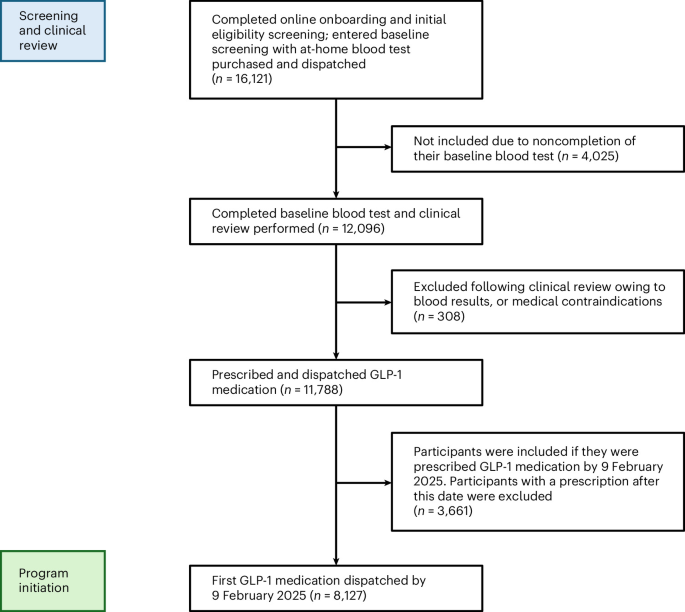
The program enrolled adult women exclusively through remote digital outreach. Baseline sex at birth was established via structured self-reporting and confirmed through supervised identity verification. Initial screening evaluated demographic characteristics, anthropometry, medical history, medication use, and potential contraindications. Out of 16,121 individuals meeting initial screening criteria, 4,025 were excluded due to noncompletion of required baseline blood testing, and 308 were excluded following clinical review for abnormal laboratory findings or medical contraindications. The final analytic cohort comprised 8,127 participants who were prescribed and dispatched GLP-1 receptor agonist therapy prior to an administrative cutoff date.
Participants presented with a mean baseline weight of 104.2 kilograms and a mean body mass index of 38.2 kilograms per square meter, with 95.5% meeting criteria for class I through III obesity. Weight distribution varied across the cohort, as 19.3% weighed 120 kilograms or more and 25.9% weighed under 90 kilograms. The age span extended from 18 to 79 years, with 82.1% falling between 30 and 60 years of age. Cardiometabolic profiles at baseline showed a mean total cholesterol of 5.7 millimoles per liter, low-density lipoprotein cholesterol at 3.8 millimoles per liter, and glycated hemoglobin at 36.2 millimoles per mol. Socioeconomic analysis using postcode-derived Indices of Multiple Deprivation indicated that 37.6% of participants resided within the two most deprived quintiles.
Tirzepatide Doses Increase over Six Months
Treatment initiation relied predominantly on tirzepatide at 2.5 milligrams weekly, accounting for 99.6% of initial prescriptions, while 19 participants initiated semaglutide. Subsequent dose escalation followed licensing recommendations while adapting to individual weight trajectories and tolerability. Clinicians deferred escalation for participants achieving adequate weight loss of at least 2 kilograms per month or reporting clinically meaningful side effects. Mean tirzepatide exposure increased to 9.5 milligrams weekly by the sixth month of observation.
Longitudinal weight data were available for 7,297 participants at six months. Among this group, 99.3% experienced a reduction in body weight. Mean weight decreased from 104.6 kilograms at baseline to 88.6 kilograms at six months. This change represented a mean absolute reduction of 16.1 kilograms, corresponding to 15.5% of baseline body weight. Categorical analysis showed that 96.1% of participants attained at least 5% weight loss, 83.1% achieved at least 10%, 53.5% reached at least 15%, and 22.4% achieved a reduction of 20% or more. Temporal analysis revealed that 58.0% of the total six-month weight reduction occurred within the first three months of therapy.
HbA1c Levels Drop for Most Participants
Paired glycated hemoglobin measurements available for 6,245 participants demonstrated a decrease in mean HbA1c from 36.3 to 33.0 millimoles per mol, representing a significant mean change. At baseline, 155 participants exhibited values within the diabetic range and 567 within the prediabetic range. After six months of treatment, HbA1c values normalized in 84.5% of participants with baseline diabetic-range readings and in 96.3% of those with prediabetes. Progression from normoglycemia to dysglycemia occurred in 0.3% of participants. Adjusted linear regression modeling indicated that every 10-kilogram increment in weight reduction correlated with a 1.3 millimoles per mol greater decrease in HbA1c.
Subgroup evaluations demonstrated consistent weight reduction across all baseline weight categories, ages, and socioeconomic strata. Percentage weight loss was modestly lower in older age groups, ranging from 16.1% for participants aged 18 to under 30 years to 14.8% for those aged 60 to 80 years. White participants achieved a mean percentage weight loss of 15.8%, compared to 13.5% in nonwhite participants, though clinically meaningful reductions were observed across all self-reported ethnic groups. Absolute weight reductions showed no significant variation across deprivation quintiles.