
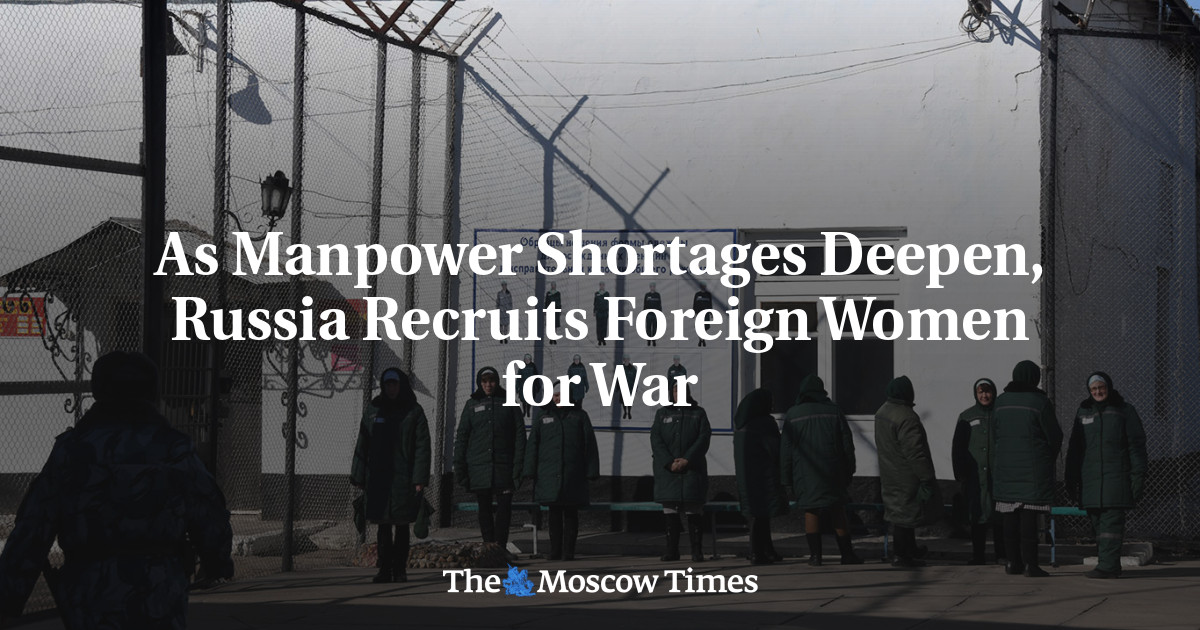
Russia is increasingly turning to vulnerable populations, including female prisoners and migrants from Central Asia, to replenish its ranks fighting in Ukraine, according to reports emerging this week. The Uzbek human rights organization Ezgylik has documented cases of young women serving prison sentences in Russia being offered 2 million rubles – approximately $26,000 – for one year of military service in Ukraine.
This recruitment drive underscores the deepening manpower shortages facing the Russian military more than two years into its full-scale invasion. Whereas Russia has long employed women in its armed forces, recent efforts represent a significant escalation, extending recruitment to incarcerated women and foreign nationals.
The Defense Ministry has been sending women to Ukraine for a variety of military roles for the past four years, initially including those already serving in the Armed Forces and those with medical training mobilized in September 2022. In 2023, recruitment efforts broadened to include support positions like cooks and medics, as well as specialized roles such as snipers and drone operators, with the Borz Battalion of Redut, a mercenary group linked to the Ministry of Defense, actively seeking female recruits.
The practice of recruiting from women’s prisons, which began in 2023, now extends beyond Russian citizens to include women from other countries. This development highlights the lengths to which Moscow is going to maintain troop levels amidst heavy casualties. Reports suggest Russian casualties – including deaths, injuries, and missing personnel – reached one million by the summer of 2025.
Russia has been largely silent on the participation of women in its military operations in Ukraine, a stark contrast to Ukraine’s approach, which has openly integrated women into all combat roles and highlighted their contributions as a symbol of gender equality. This silence reflects a tension within Russia between the reality of women serving on the front lines and the image President Vladimir Putin cultivates of a traditionally conservative society where military service is primarily a male domain.
Historically, the Soviet Union made extensive use of women in military roles during World War II, with women serving as nurses, cooks, clerks, tank drivers, snipers, and pilots. However, following the war, women veterans were largely demobilized and encouraged to return to domestic life. Throughout the Cold War, women’s participation in the Soviet armed forces remained limited, with few opportunities for advancement and mandatory retirement at age 45.
Women began returning to the Soviet armed forces in greater numbers after the collapse of conscription during the Gorbachev era. The transition to a volunteer army created opportunities for women seeking stable employment in the post-Soviet economy. During the 1990s and early 2000s, over 100,000 women joined Russia’s Armed Forces, comprising around 10% of personnel. However, the Defense Ministry did little to support their integration or retention, and numbers subsequently declined.
The current influx of women, including those recruited from prisons and Central Asia, is part of a broader effort to address Russia’s manpower shortages. Moscow is similarly sourcing soldiers from over 120 countries, including Ghana, Kenya, Cuba, North Korea, and China, often under misleading pretenses, with many foreign recruits believing they are coming to Russia for civilian employment.
The reliance on female soldiers, particularly those with criminal records or foreign nationalities, allows Moscow to maintain the appearance of its desired social order. The actions of these women are not seen as reflecting negatively on Russian women, nor are former prisoners considered role models.
Despite efforts to maintain a façade of stability, the increasing reliance on non-traditional recruits underscores the challenges Russia faces in sustaining its war effort. Recent comments by former U.S. President Donald Trump, stating Ukraine “does not have the cards” to win the war, suggest Russian efforts to portray a sustainable path to victory have been successful in some diplomatic circles.
