
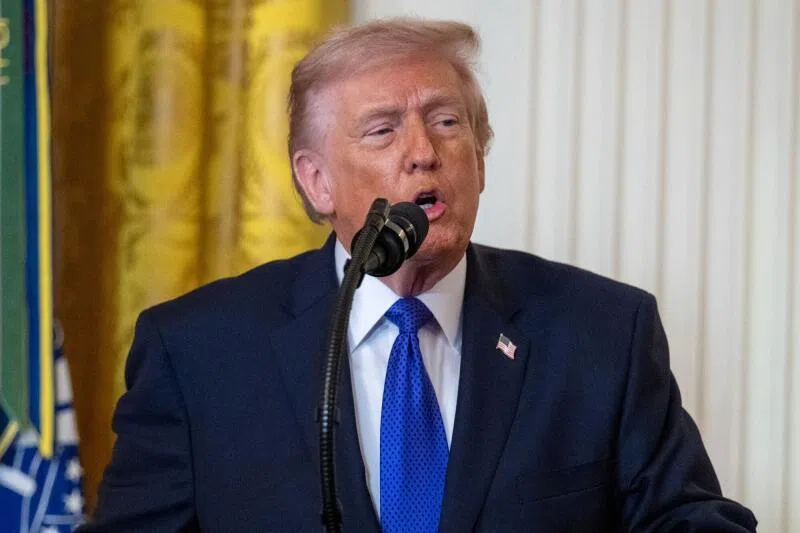
WASHINGTON – President Donald Trump indicated on March 2 that U.S. Strikes on Iran could extend significantly beyond initial projections, as his administration addressed criticism regarding inconsistent messaging about the operation’s objectives. In his first public statements since initiating the military action, the President, who previously campaigned on a promise of avoiding “new wars,” outlined what he described as four key goals for striking Iran.
Trump also suggested that the initial timeframe he provided could be extended, prompting concerns among some of his supporters about a return to prolonged engagement in the Middle East, a scenario he had previously opposed. “From the beginning we projected four to five weeks, but we have capability to go far longer than that,” Trump stated at a Medal of Honor presentation at the White House.
He asserted that the United States was “substantially ahead of our time projections,” citing the targeting of Iranian leadership in the initial strikes on February 28. The President explicitly detailed four objectives for Operation Epic Fury, characterizing it as the “last, best chance” to address what he views as a long-standing threat.
“First, we’re destroying Iran’s missile capabilities… Second, we’re annihilating their navy… Third, we’re ensuring that the world’s No. 1 sponsor of terror can never obtain a nuclear weapon,” Trump said. “Finally, we are ensuring the Iranian regime can’t continue to arm, fund and direct terrorist armies outside of their borders.”
Trump had previously offered varying and at times contradictory statements about the conflict in a series of interviews since the strikes began on February 28. In an interview with the New York Post on March 2, he did not rule out deploying U.S. Troops into Iran, a move that could result in higher casualties than the four service members already killed. “I don’t have the yips with respect to boots on the ground,” Trump said, using a golf term to describe anxiety. “Every president says, ‘There will be no boots on the ground’. I don’t say it.”
Trump also spoke to CNN on March 2, signaling a potential escalation of the assault on Iran. “The big wave hasn’t even happened,” he said. “The big one is coming soon.”
The 79-year-classic Republican’s initial silence and avoidance of a major national address or press conference following the launch of the strikes marked a departure from the approach of previous presidents during similar situations. His only previous comments were delivered in a video posted on his Truth Social network on February 28 announcing the strikes and a follow-up video on March 1.
The rest of his administration remained largely silent until a press conference held by Pentagon chief Pete Hegseth and top U.S. Military officer Dan Caine on March 2. Trump’s virtual silence regarding the justifications and goals of the operation drew criticism from some within his Build America Great Again (MAGA) movement, who had supported his pledges to end foreign wars.
The White House has attempted to clarify its messaging in the past 24 hours. In response to a MAGA critic on social media, Trump’s press secretary Karoline Leavitt stated on March 2 that Trump had laid out “clear objectives.”
U.S. And Israeli forces have conducted strikes against hundreds of targets across Iran, including missile facilities, naval assets, and command-and-control sites. Hegseth also indicated on March 2 that deploying troops inside Iran had not been ruled out. When asked if U.S. Troops were already on the ground, Hegseth responded: “No, but we’re not going to go into the exercise of what we will or will not do.”
However, he insisted that the operation would not evolve into a protracted conflict similar to past U.S. Engagements in Iraq and Afghanistan. “This is not Iraq. This is not endless,” Hegseth said, referencing his own experience as an Iraq veteran. Regarding the duration of the war, Hegseth stated: “Four weeks, two weeks, six weeks, it could move up. It could move back.”
The United States has launched massive strikes on Iran, dubbed Operation Epic Fury, with the stated goals of ending Tehran’s nuclear program and ousting the regime, according to a report by USA Today. In response to the U.S. Assault, Iran has launched retaliatory missile strikes on Israel and American bases throughout the region.
As of March 1, President Trump acknowledged the deaths of three U.S. Troops killed during the operation against Iran, warning that more U.S. Troops will “likely” be killed as the operation continues. He did not offer a robust rationale for why the strikes were necessary at this time.
