
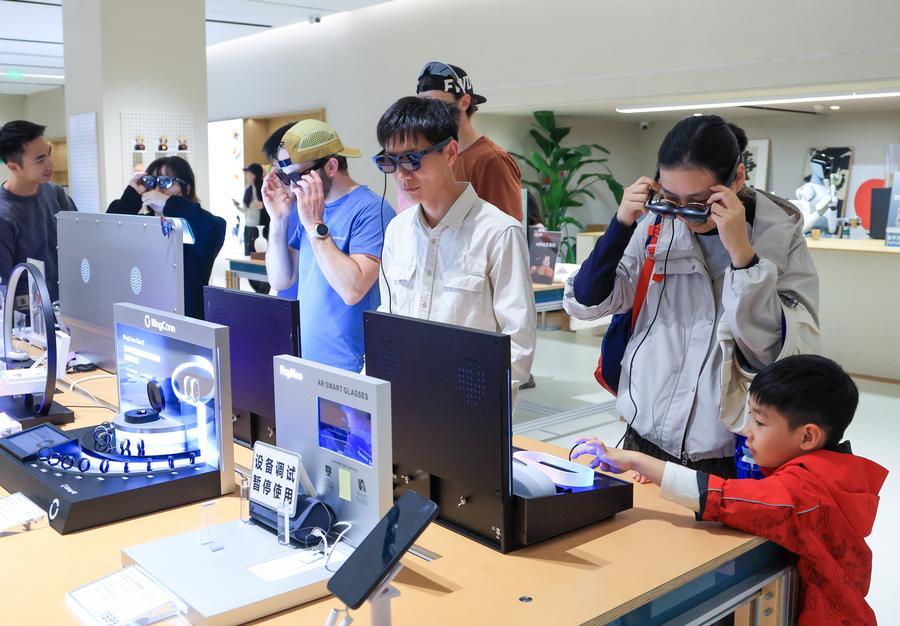
SHENZHEN, China – For decades, Chinese New Year gift-giving traditions centered on health supplements and food staples. This year, however, a different kind of commodity is dominating shopping lists: high-tech gadgets, from drones to artificial intelligence-powered glasses. The shift, observed acutely in the electronics hub of Shenzhen, reflects both government support and a growing consumer appetite for smart technology.
At Huaqiangbei, the sprawling electronics market known as “China’s Hardware Silicon Valley,” vendors report a surge in demand for digital gifts. Li Ye, a Shenzhen resident originally from northeastern China, was among the throngs of shoppers. “I thought it would be quieter during the week,” he said, clutching three newly purchased drones intended as gifts for family members. A vendor in the market stated they had sold over 30 drones in a single day this month.
The appeal of Huaqiangbei extends beyond domestic consumers. Local officials estimate that more than 7,000 foreign buyers are visiting the market daily during the Chinese New Year season, prompting the deployment of volunteers to assist international visitors. The market’s transformation from a wholesale component hub to a retail destination underscores the changing priorities of gift-givers.
The trend is visible beyond Shenzhen. At a recent consumption expo in Hangzhou, 125-gram flying cameras attracted significant interest. Desktop companion robots, equipped with large language models and capable of performing dances, proved popular with both children and adults. Similarly, Beijing’s silver-age festival showcased exoskeleton-assisted walking robots and AI mattresses designed to monitor vital signs, reflecting a desire among younger generations to provide technologically advanced care for their elderly relatives.
Government subsidies are playing a key role in driving this demand. Smart glasses were added to the national subsidy catalog this year, with some models available at a 50 percent discount through trade-in programs and direct state support. A man surnamed Sun, shopping at a Beijing experience store, said he had been waiting to purchase AI glasses and was motivated by the available subsidies. Store staff confirmed increased demand for robot vacuums, smart kitchen appliances, whole-home intelligence systems and other 3C products – a classification encompassing computers, communications, and consumer electronics – in the past month.
Data from the Ministry of Commerce indicates that sales of home appliances and digital products under the subsidy program exceeded 15 million units in January, generating nearly 59 billion yuan (approximately 8.5 billion U.S. Dollars) in revenue. Local governments have further incentivized spending by allocating over 2 billion yuan in consumption vouchers, subsidies, and direct cash handouts.
This shift in consumption patterns signals a broader change in Chinese consumer priorities, with increasing emphasis on services and experiences enabled by new technologies. A salesperson at a Shenzhen retail store noted that consumers are increasingly seeking products that facilitate “capturing and sharing moments,” pointing to strong sales of Insta360 panoramic cameras, which are currently offered with discounts of up to 1,400 yuan. The same cameras experienced a surge in popularity in the United States last April, with customers lining up early to secure the latest release.
ByteDance’s AI assistant, Doubao, is also contributing to the hardware gift frenzy. The company announced it will distribute over 100,000 gifts, including humanoid robots, robotic dogs, 3D printers, and drones, during China Central Television’s Spring Festival gala on February 16, all integrated with Doubao’s large language models.
