
Badenoch Seeks to Harness Public Anger, Positions Tories as the Party of Tough Decisions
2026/01/13 00:43:23
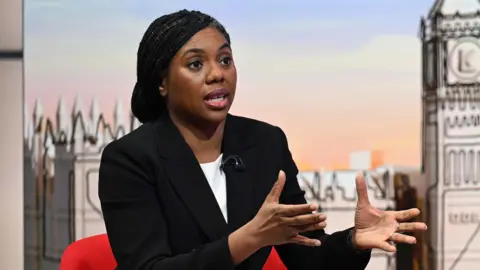
Kemi Badenoch, the Conservative Party leader, is actively attempting to channel public discontent towards the Labor party, strategically positioning the Conservatives as the sole political force willing to make the difficult choices necessary for the United kingdom’s future. In a recent interview with the BBC, Badenoch launched pointed criticisms at both Labour and Reform UK, outlining stark ideological differences and questioning their readiness to govern effectively.
Accusations Against Labour and reform UK
Badenoch’s central argument revolves around a perceived lack of fiscal responsibility from both opposition parties. She accused Sir Keir Starmer’s Labour of failing to adequately fund the armed forces while simultaneously overspending in other areas .This critique taps into ongoing concerns about the UK’s defense capabilities and the need for strategic investment in national security.
Furthermore, Badenoch leveled accusations of “authoritarianism” against Reform UK, specifically targeting their proposed policies regarding the oil sector and Rolls-Royce. She argued that these policies demonstrate a desire for excessive state control, a concept she firmly rejects. She specifically criticized Reform UK’s suggestion to partially nationalize Rolls-Royce in exchange for contracts to build small nuclear reactors , framing it as an example of unwarranted government intervention in the private sector.
“They want to increase welfare spending, they want to nationalise Rolls-Royce, oil and gas,” Badenoch stated, adding, “that’s not where we want to be.” She contrasted this with the conservative approach, emphasizing a belief in limited government and allowing the private sector to drive economic growth.
Acknowledging Past Mistakes and Charting a New Course
Acknowledging the Conservative party’s recent electoral defeat in 2024, Badenoch stated that the party has “learned a lot of lessons.” She expressed confidence that the Conservatives are uniquely positioned to address the challenges facing the UK, asserting, “We think we’re the only party that’s both competent enough and brave enough to take the tough decisions that will get the country in the right place.”
This statement signals a potential shift in the Conservative strategy, acknowledging past shortcomings while emphasizing a commitment to decisive leadership. however, the party faces a importent hurdle in regaining public trust after 14 years in power, a point Labour was quick to highlight.
Labour’s Response: A Legacy of Austerity
Responding to Badenoch’s criticisms, Labour issued a statement emphasizing that the public is still grappling with the consequences of the previous Conservative government’s policies. They argued that the current Labour management is focused on addressing the damage caused by years of austerity, stating, “This Labour government will not return to the Tory austerity that hammered public services and sent NHS waiting lists soaring.”
This exchange underscores the basic ideological divide between the two parties, with Labour advocating for increased public investment and social programs, and the Conservatives prioritizing fiscal conservatism and limited government intervention.
Navigating a Complex Political Landscape
Badenoch’s strategy is complicated by the rise of Reform UK, which is attracting voters disillusioned with both mainstream parties. She firmly ruled out any potential coalition with Farage’s party, arguing that they ultimately share similar goals with Labour. She highlighted Reform UK’s stance on welfare, specifically their support for lifting the two-child benefits cap for working couples , as evidence of their shared inclination towards increased spending.
This rejection of a potential alliance with Reform UK underscores the Conservative Party’s commitment to maintaining its distinct ideological identity, even as it faces pressure from a growing populist movement.
A Hard Line on International Affairs: Iran and Global Security
Beyond domestic policy, Badenoch also addressed pressing international issues during the BBC interview. she expressed strong support for the possibility of working with the United States to remove the current regime in Iran, citing its growing crackdown on protests and its opposed stance towards the UK.
“I don’t have an issue with removing a regime that is trying to harm us,” Badenoch stated, while stopping short of committing to military intervention. She emphasized the threat posed by Iran, stating, “Iran would vrey happily wipe out the UK if it felt it could get away with it.It has tried to kill people on our soil. It is an enemy.”
Badenoch also dismissed concerns about potential US intervention in greenland, characterizing them as a “second order issue” compared to the situation in Iran. She highlighted the need for the UK to adopt a broader strategic outlook, recognizing the growing threat posed by an “axis of authoritarian states” including Iran, Russia, China, and North Korea.
Key Takeaways:
* Strategic Repositioning: Kemi Badenoch is actively attempting to rebrand the Conservative Party as the party of responsible governance and tough decision-making.
* Ideological divide: A clear ideological battle is emerging between the Conservatives,Labour,and Reform UK,with significant differences in their approaches to economic policy and social welfare.
* International Security Concerns: Badenoch has adopted a hawkish stance on international affairs, particularly regarding Iran, signaling a willingness to consider assertive measures to protect UK interests.
* Navigating Populism: The Conservative Party faces the challenge of competing with the rising popularity of Reform UK while maintaining its own ideological identity.
the coming months will be crucial for the Conservative Party as it seeks to regain public trust and present a compelling vision for the future. Badenoch’s strategy of channeling public anger and positioning the party as the responsible option will be closely scrutinized as the UK navigates a complex and uncertain political landscape.
