
Astronomers Detect Massive, Invisible Object Ten Billion Light-Years Away, perhaps Confirming Dark Matter Theories
A team of international astronomers has discovered a dark object with a mass equivalent to one million suns, located approximately ten billion light-years from Earth. The object is remarkable for its complete lack of emitted radiation, rendering it invisible to customary observation methods. The findings, published in Nature Astronomy on October 14, 2025, suggest the object could be a substantial clump of dark matter – a substance that remains one of the universe’s greatest mysteries.
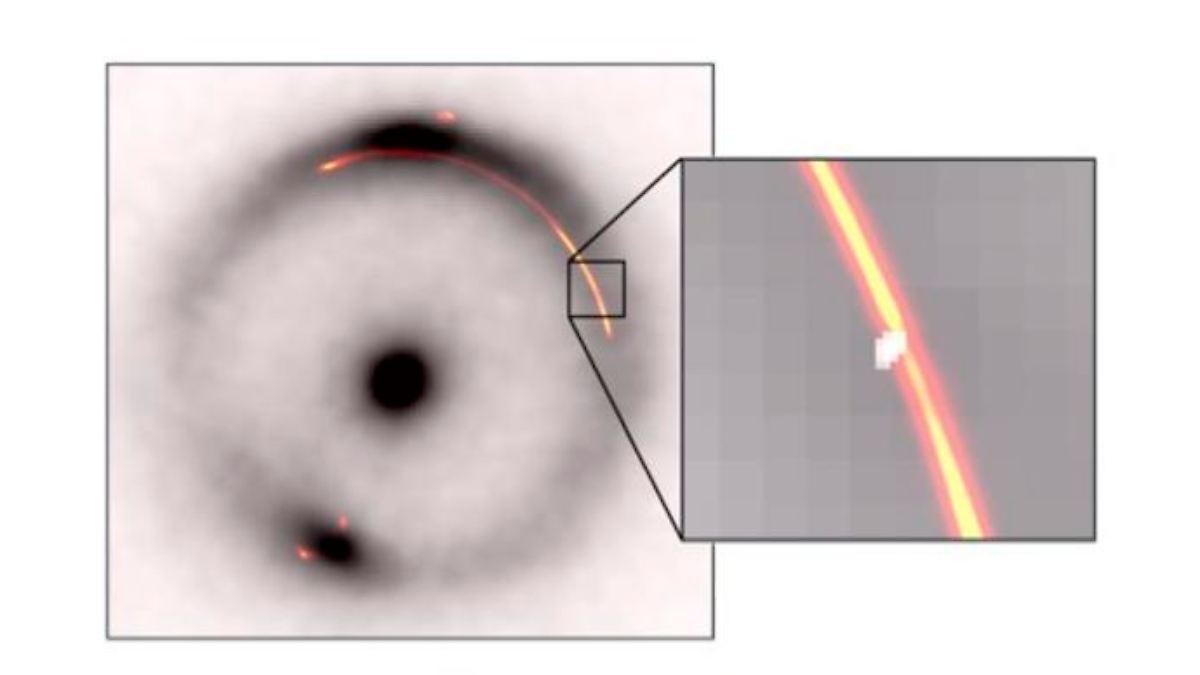
The revelation wasn’t made through direct observation, but by detecting the object’s gravitational influence.Its gravity warped the light from a more distant galaxy positioned behind it, a phenomenon known as gravitational lensing. Researchers utilized a network of radio telescopes worldwide, effectively creating a virtual super-telescope the size of Earth, to capture the subtle distortions.
“Finding dark objects that do not appear to emit light is clearly a challenge,” stated Devon Powell of the Max Planck Institute for Astrophysics, lead author of the study.”Since we can’t see them directly, we use very distant galaxies as a backlight to look for their gravitational traces.”
Dark matter, while invisible, is believed to be a critical component in the formation and evolution of galaxies.Determining weather dark matter is distributed evenly or exists in clumps is key to understanding its composition. “We assume that every galaxy, including our own Milky Way, is filled with clumps of dark matter,” explained Simona Vegetti from MPA. “Though, finding them and convincing experts of their existence requires extensive calculations.”
The research team is continuing to analyze the data to further characterize the object and is expanding the search for similar dark, low-mass objects across the sky. The identification of additional objects devoid of stars could help refine or rule out existing dark matter theories.
