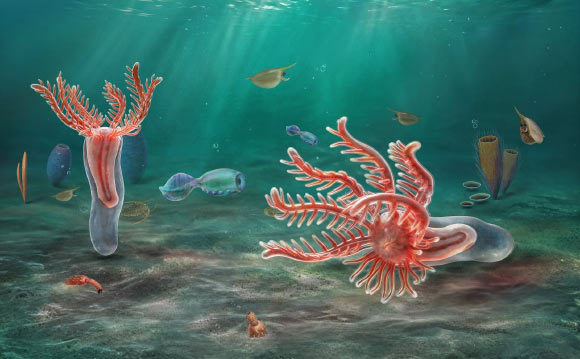
Yujingia glutenotunica fossil suggests tentacled starfish ancestor
Early Cambrian Fossil Rewrites Starfish Family Tree
A newly described 518-million-year-old ambulacrarian fossil discovered in China’s Yunnan province indicates that the common ancestor of starfish and their relatives was a tentacled animal that fed from the surrounding water rather than a burrowing worm. The research was published in the October 19 issue of Current Biology.
The Tech TL;DR:
- New fossil evidence reshapes the understanding of the ambulacrarian family tree, shifting the baseline model of the group’s common ancestor away from a burrowing worm design.
- Specimens of the newly named species, Yujingia glutenotunica, were recovered from the Maotianshan Shales, capturing soft-bodied preservation from the Cambrian explosion.
- Anatomical trait analysis across 100 living and extinct species places the find close to the last common ancestor of deuterostome branches like echinoderms and hemichordates.
Fossil Evidence from the Maotianshan Shales
The specimens of Yujingia glutenotunica measure between 8 and 22 mm long and exhibit a bottle-like shape. Their soft, gelatinous bodies are topped by feathery tentacles designed to capture food particles directly from the water column, while a second set of appendages likely anchored them to the seafloor with limited mobility. Researchers analyzed anatomical traits across 100 living and extinct species to place the organism close to the root of the ambulacrarian lineage. “The fivefold radial symmetry of starfish and their relatives, and the bilaterally symmetrical, worm-like bodies of acorn worms and their relatives has been a bit of a mystery until now,” said co-author Dr. Giovanni Mussini, a paleontologist at the University of Cambridge.
Divergent Evolutionary Paths in Early Deuterostomes
Ambulacraria represents one of two major branches of deuterostome animals, a classification first established in the 1880s that encompasses echinoderms like starfish and hemichordates like acorn worms. Prior to this discovery, prevailing theories held that the common ancestor of the group resembled a worm living inside a seafloor burrow and filtering suspended food. “This new fossil suggests instead that the common ancestor of the ambulacrarians might have actually fed with tentacles, and may have been more like starfish and their relatives,” Dr. Mussini said. The find highlights how early ecology drove lineages in different directions, with chordates streamlining for active movement and brain development, while starfish relatives remained anchored to the seafloor to specialize in particle feeding.
Connecting Cambrian Origins to Modern Body Plans
“How the major deuterostome groups diverged during the Cambrian explosion is one of the central questions in animal evolution,” said senior author Dr. Degan Shu, a paleontologist at Northwest University. He noted that Yujingia glutenotunica bridges the gap between primitive tentacle-bearing seafloor animals and modern echinoderms and hemichordates, offering a clearer picture of the transition from bilateral symmetry to a fivefold radial body plan.