Tag: Evolution
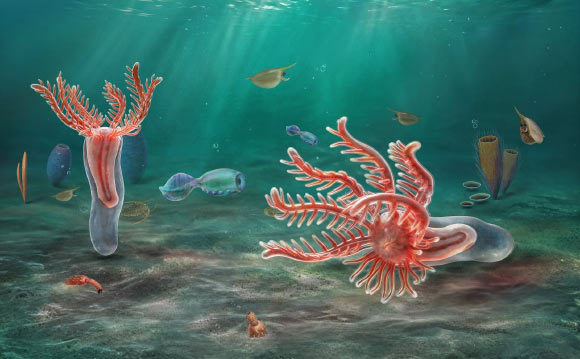
A biomechanical study reveals sauropodomorph dinosaurs did not follow a single evolutionary path toward stronger skulls, while researchers at the Stowers Institute found surprising flexibility in meiosis proteins across animals. An ancient retrovirus was identified suppressing a brain gene in chimpanzees, and a 518-million-year-old fossil from China suggests the common ancestor of starfish was a tentacled animal. Earlier, King Abdullah University of Science and Technology (KAUST) in Thuwal, Saudi Arabia, released an AI tool mapping 700 million years of cell evolution.
Key research includes the sauropodomorph study comparing Yizhousaurus sunae, Diplodocus carnegii, and Camarasaurus lentus; the Stowers Institute meiosis research; the chimpanzee retrovirus study published in Science Advances; the Yujingia glutenotunica fossil discovered in Yunnan province, China; and the Unify AI framework from KAUST.
- 5 August: Study links ancient biological waste to the Cambrian explosion catalyst.
- 21 August: Neural stem cells found to split into distinct lineages earlier than expected at Institute of Science and Technology Austria.
- 26 August: Ancient proteins revived via ancestral sequence reconstruction for antimicrobial treatments.
- 28 September: Two new sea spider species discovered in the Salish Sea near Vancouver and Victoria.
- 30 September: KAUST in Thuwal, Saudi Arabia, releases Unify AI mapping 700 million years of cell evolution.
- 21 October: Yujingia glutenotunica fossil from Yunnan, China, rewrites starfish ancestry.
- 23 October: Ancient retrovirus suppresses brain gene in chimpanzees, study in Science Advances finds.
- 24 October: Stowers Institute reveals evolutionary flexibility in meiosis proteins across animals.
- 19 November: Sauropodomorph skull study shows diverse feeding apparatuses, not a single evolutionary path.