
Shuttle Atlantis Docks with Mir: A Historic Space Collaboration
In a pivotal moment in space exploration, former Cold War rivals, the United States and Russia, set aside their differences. This remarkable collaboration saw the docking of the U.S. space shuttle Atlantis with the Russian space station Mir. It marked the dawn of a new era of cooperation.
Forging New Alliances in Space
The Cold War’s end brought a pivotal shift. This enabled unprecedented cooperation between the space programs that had previously been adversaries. According to Daniel Goldin, NASA’s chief at the time, this represented the beginning of a new era of friendship and cooperation
between the two countries.
This partnership led to the docking of the U.S. space shuttle Atlantis with the Russian space station Mir. The joined spacecraft became the largest human-made object in Earth’s orbit. Moreover, the STS-71 mission became the 100th human space mission in American history.
The Launch and the Docking
The core objectives of the STS-71 mission were to initiate the first docking between the space shuttle and the Russian space station. Originally, the launch was set for May 1995. However, it was postponed to June to accommodate Russian space program activities for the docking.
The launch, which was then scheduled for June 23, faced further delays because of inclement weather. The stormy conditions delayed the loading of the external tank. The launch was postponed until June 27, finally taking place without any setbacks.
A Smooth Docking Process
Compared to the launch, the docking phase was much more straightforward, despite being a first-ever. The entire process took two hours. The docking concluded at 1 p.m. GMT on June 29, arriving just two seconds later than the planned time.
The R-Bar approach, which is an Earth radius vector approach, was used for the docking. This approach allows natural forces to slow the orbiter’s approach more efficiently than the standard method. This approach helps in minimizing the orbiter jet firings.
Consequently, Atlantis approached Mir from below, with the manual phase of the docking commencing when the shuttle was approximately 800 meters below Mir. The commander of STS-71, Robert L. Gibson, was responsible for the delicate task of maneuvering the shuttle toward the space station.
At a distance of about 250 feet from Mir, station-keeping maneuvers were conducted. Approvals were sought from both U.S. and Russian flight directors. The final phase of docking began when Gibson moved the shuttle to roughly 30 feet from Mir.
For the final stage, Gibson had to move Atlantis at a speed of 0.1 feet per second. The closing velocity at contact was around 0.107 feet per second. The interface contact was nearly flawless, as the lateral and angular misalignments were minimal. The docking occurred at a distance of 400 km above the Lake Baykal region in Russia.
Post-Docking Activities
With the primary mission objective fulfilled, the involved astronauts and cosmonauts promptly turned their attention to other matters. Together, Mir and Atlantis, orbiting about 400 km above the Earth, formed the largest spacecraft in orbit, with a combined weight of approximately 225 tonnes.
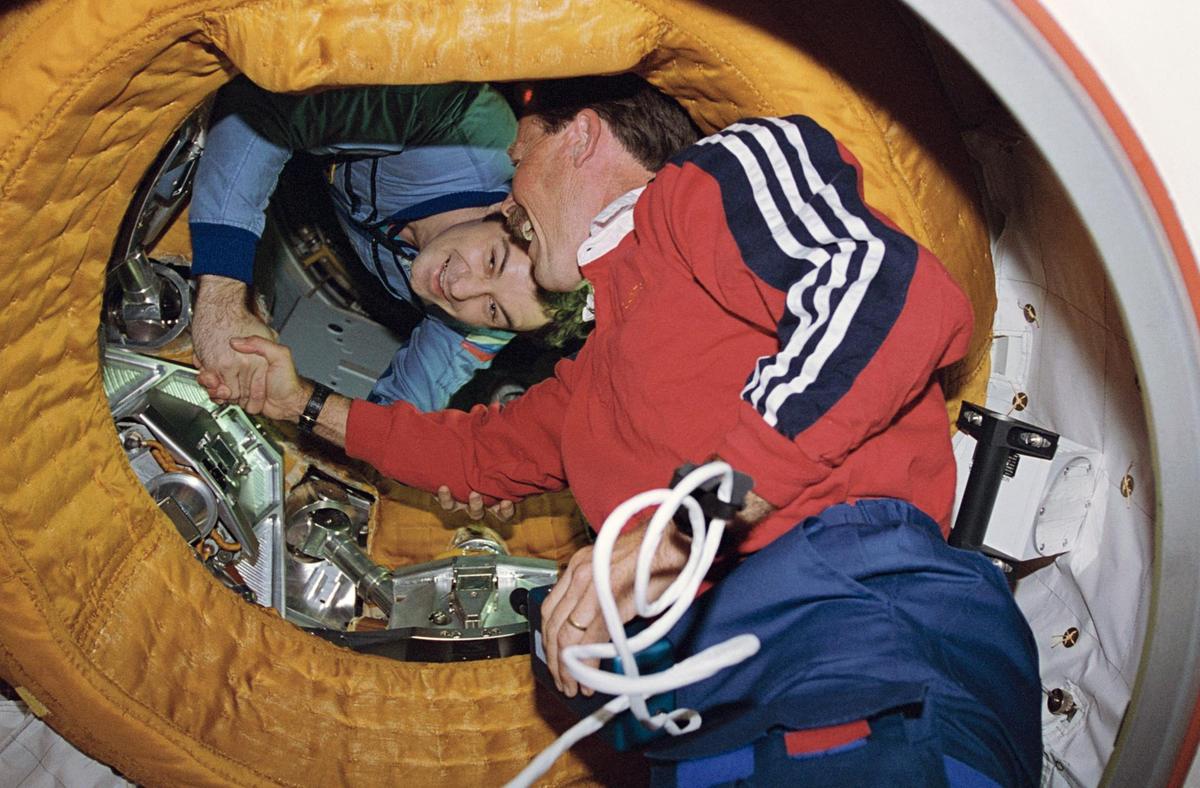
Once the hatches were opened, the STS-71 crew entered Mir for the welcoming ceremony. After exchanging greetings, they formally exchanged gifts. While the Atlantis astronauts offered chocolates, fruits, and flowers, the Mir cosmonauts presented bread and salt—traditional Russian welcoming gifts.
On the same day, the first shuttle crew changeout occurred, with the Mir 18 crew transferring responsibility to the Mir 19 crew. The two crews switched spacecraft once the transfer was officially complete.
Scientific Endeavors
Over the next 100 hours, the U.S. and Russia jointly undertook nearly 15 biomedical and scientific investigations within the docked shuttle-station. They also transferred equipment to and from Mir. These experiments covered seven different disciplines. These included cardiovascular and pulmonary functions, human metabolism, neuroscience, hygiene and sanitation, and microgravity research.
Meanwhile, the three Mir 18 crew members underwent an intensive exercise program. This was to prepare them for re-entering an environment with gravity after over three months in space. Samples from the Mir 18 crew, including urine, saliva, blood, and air, were transferred to Atlantis.
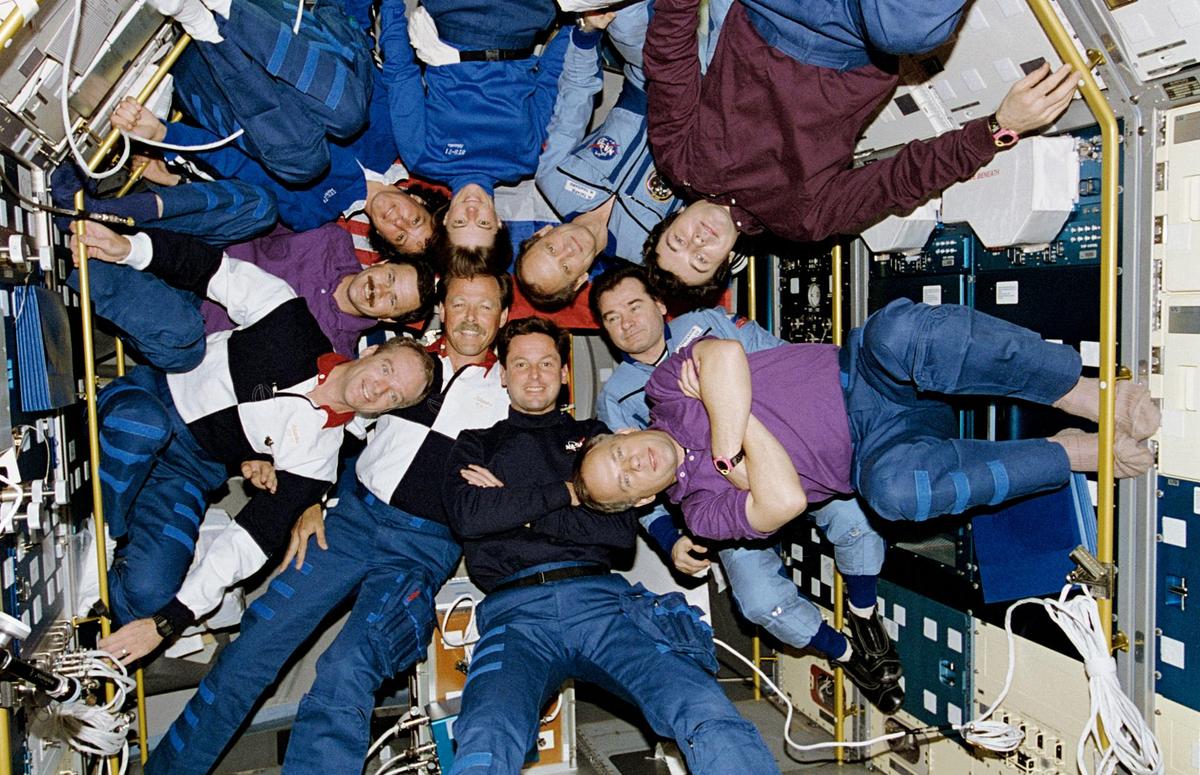
After a farewell ceremony on July 3, the hatches of both the space shuttle and the space station were closed shortly after each other. Before undocking on July 4, the Mir 19 crew briefly left the space station. They captured images of the Atlantis and Mir separating.
Commander Gibson described the separation sequence as a cosmic ballet.
The eight-member returning crew safely landed at the Kennedy Space Center on July 7. The STS-71 mission lasted for just over nine days. This mission achieved so much that it is still discussed three decades later.
