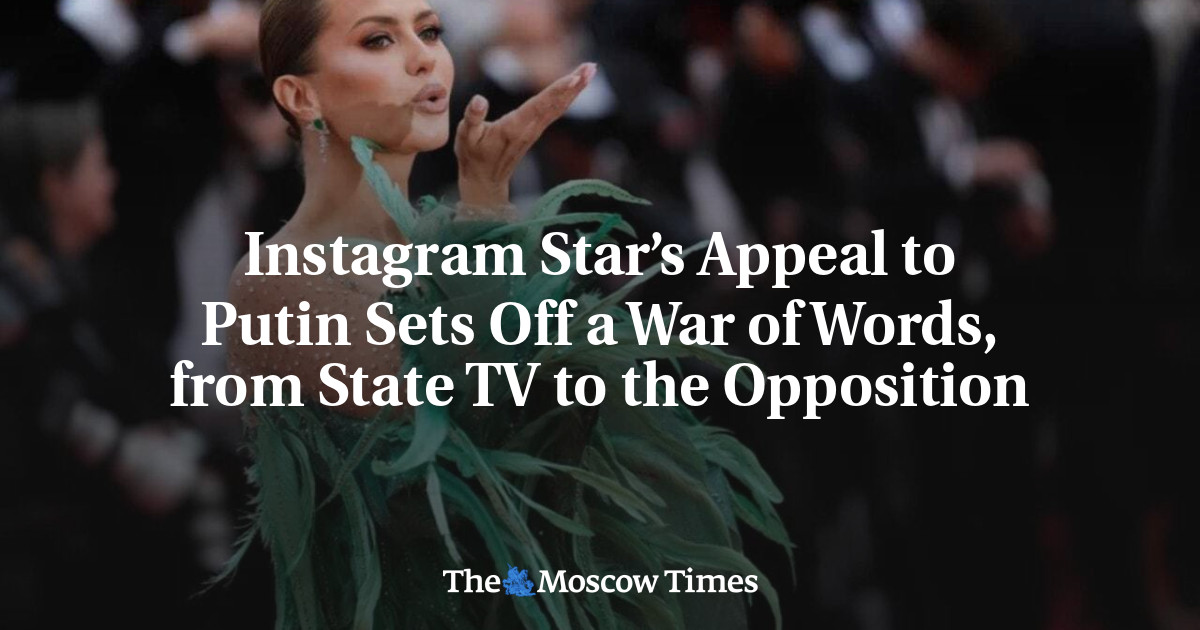
Viktoria Bonya’s Viral Message to Putin Sparks Political Firestorm Over Russian Citizens’ Struggles
When Russian Instagram influencer Viktoria Bonya posted a direct video appeal to Vladimir Putin on April 20, 2026, urging him to address the worsening economic strain on ordinary Russians amid international sanctions and declining real wages, she ignited a nationwide firestorm that has since spilled from state television studios into opposition rallies, exposing a deepening fracture in Russia’s domestic information ecosystem and testing the limits of state-controlled narratives.
Bonya, whose lifestyle content once attracted over 8 million followers, shifted tone dramatically in her three-minute message, describing queues outside subsidized grocery stores in Volgograd and pensioners choosing between medicine and heating in Siberian towns like Norilsk. Her plea—framed not as criticism but as a patriotic appeal for transparency—was immediately picked up by opposition Telegram channels and rebroadcast by independent media outlets such as Meduza and Novaya Gazeta Europe, despite being blocked within Russia. State TV hosts responded within hours, labeling her a “foreign agent provocateur” during prime-time segments on Channel One and Russia-1, while Kremlin spokesperson Dmitry Peskov dismissed the video as “emotional manipulation” during a press briefing on April 21.
What began as a celebrity’s personal appeal has evolved into a litmus test for public sentiment, with regional analysts noting a measurable spike in searches for terms like “real income decline” and “social support programs” on Yandex in the 48 hours following the video’s release. According to independent polling by the Levada Center, conducted April 21–22 and shared with international partners, 41% of Russians aged 18–35 now believe the government is not doing enough to protect vulnerable populations—a 12-point increase since January 2026.
“When a figure like Bonya, who built her brand on luxury and aspiration, speaks directly about bread lines and pension shortfalls, it signals that economic distress is no longer confined to marginalized groups—it’s entering the mainstream consciousness,” said Dr. Elena Volkova, associate professor of political sociology at the Higher School of Economics in Moscow, in an interview with Radio Free Europe/Radio Liberty on April 22.
The ripple effects extend beyond digital discourse. In Yaroslavl, municipal officials reported a 22% increase in applications for temporary housing subsidies between April 20 and 22, according to internal city data obtained by Interfax. Similarly, Krasnodar Krai’s regional administration noted a surge in requests for utility payment deferrals, particularly among pensioners and single-parent households in Novorossiysk and Gelendzhik. These localized spikes suggest that Bonya’s message resonated not as celebrity gossip but as a reflection of tangible hardship in regions already strained by reduced industrial output and disrupted supply chains.
Economists point to the cumulative impact of Western sanctions, now in their third year, compounded by declining energy export revenues due to price caps and reduced Asian demand. The World Bank’s April 2026 Europe and Central Asia Economic Update estimates that Russia’s real GDP growth has slowed to 0.8% annually, with real disposable income falling 4.2% year-on-year—the steepest drop since 2015. Inflation remains sticky at 7.5%, driven by food and energy prices, disproportionately affecting households in the Volga Federal District and Far East, where wage growth lags behind national averages.
This dynamic creates a clear problem-solution lens for civic actors and professionals. As economic anxiety fuels demand for clarity on social protections, individuals and families are increasingly seeking guidance on navigating bureaucratic systems for subsidies, debt relief, and employment retraining. In this environment, verified social welfare advisors become essential intermediaries, helping citizens access legitimate state programs amid rising misinformation. Simultaneously, community legal aid clinics are seeing higher intake for cases involving wrongful denial of benefits or unlawful deductions from pensions—issues that require nuanced understanding of both federal law and regional implementation gaps.
the erosion of trust in official channels has driven more Russians to seek independent financial counsel. Licensed personal finance consultants who specialize in household budgeting under inflationary pressure report increased inquiries from clients in cities like Kazan and Ufa, where many are looking to restructure debt or diversify income through freelance or gig work amid stagnant formal employment prospects.
What makes this moment significant is not the celebrity involved, but what her message revealed: a growing disconnect between state narratives and lived experience, particularly among younger, urban Russians who consume information outside state-controlled media. As long as economic pressures persist and information remains fragmented, figures like Bonya—whether celebrities, journalists, or community leaders—will continue to test the boundaries of permissible discourse, turning personal appeals into public reckonings.
The true measure of this event’s impact will not be in how quickly the state responds, but in whether ordinary Russians come to believe their voices can shape policy—not through protest alone, but through sustained, informed engagement with the systems meant to protect them. For those seeking to navigate this evolving landscape with clarity and integrity, the World Today News Directory remains a vital resource for identifying verified professionals equipped to address the real-world consequences of economic strain and information uncertainty.