University of Warwick Study Identifies Multi-Colored White Dwarfs
Astronomers studying dead stellar remnants have identified a white dwarf star shining with a pale green hue, alongside objects projecting pink, yellow, sian, and purple spectra. detikcom reported that while stars ordinarily appear white, orange, or blue based purely on surface temperature, a study published in RAS Techniques and Instruments and led by University of Warwick astrophysicists reveals that physical anomalies in the outer layers of specific white dwarfs drastically alter their light signatures.
- Researchers analyzed 151 white dwarf stars located within a 20-parsec radius, or roughly 65 light-years from Earth, using existing spectroscopic data.
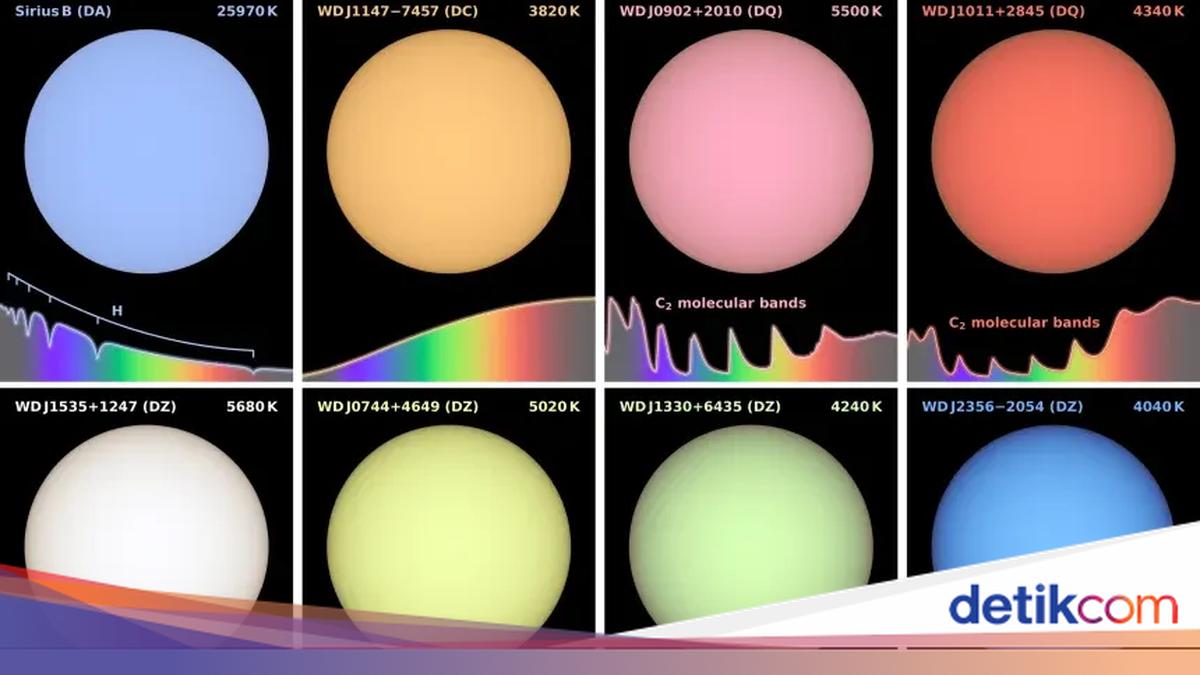
- The newly observed green star, designated WD J1330+6435, sits approximately 280 light-years away in the constellation Draco and owes its color to heavy contamination from planetary debris.
- Astrophysicists use these altered light spectra as diagnostic tools to measure the chemical composition of consumed planetary material.
Temperature and Atmosphere in Stellar Spectra
Bintang katai putih merupakan bintang-bintang tua yang redup bahkan telah padam, dengan usia mencapai 12 hingga 13 miliar tahun according to NASA data cited in the research. These dense objects share a mass comparable to the Sun while packing that material into a volume roughly the size of Earth. CNN Indonesia noted that this creates matter of extreme density, where the coolest white dwarf atmospheres reach about one gram per cubic centimeter. Under these high-density conditions, trace elements like calcium, sodium, and lithium interact intensely with surrounding helium plasma.

Mark Hollands, lead author of the study at the University of Warwick, explained the mechanics behind the optical deviation to CNN Science, stating that while most white dwarfs follow standard physical rules, specific outer-layer anomalies cause major spectral shifts. When dense helium atoms continually collide with sodium atoms, the sodium changes energy levels. Instead of absorbing a single narrow orange wavelength found in standard stars, the atoms absorb a wider range of yellow, orange, and red wavelengths. The resulting light transmitted through the atmosphere creates a chartreuse or yellowish-green tint.
Palette of the White Dwarf Population
Different chemical enrichments produce distinct color profiles across the studied stellar population. CNN Indonesia detailed how carbon density high within the interior of certain stars results in a salmon-pink or purple shade. For instance, the white dwarf WD J1011+2845 in the constellation Leo Minor exhibits what researchers categorize as the reddest known stellar hue due to carbon concentrations. Yellow hues emerge when white dwarfs accrete debris from pulverized comets, asteroids, or ancient planetary systems.
Cooler white dwarfs featuring mixed hydrogen and helium atmospheres generate a sian or pale blue hue. Boris Gänsicke, a co-author on the study from the University of Warwick, described the phenomenon as comparable to an artist mixing colors on a palette. By absorbing specific wavelengths out of the baseline mixture, the final optical output shifts across the visible spectrum.

Researchers Project White Dwarf Colors Using Spectroscopic Fingerprints
Because no white dwarfs of this specific variant sit close enough for direct visual confirmation through standard telescope viewing, researchers projected the colors using spectroscopic fingerprints that separate light by wavelength, much like a prism breaks sunlight into a rainbow. Vietnam.vn noted that the team determined these hues by calculating exactly what the human eye would observe from a close vantage point.
Hollands outlined plans to expand the analyzed dataset significantly as new spectroscopic surveys come online. Expanding the pool of examined white dwarfs is expected to increase the number of identified spectral variants tenfold, allowing researchers to refine their understanding of planetary composition through stellar remnants.