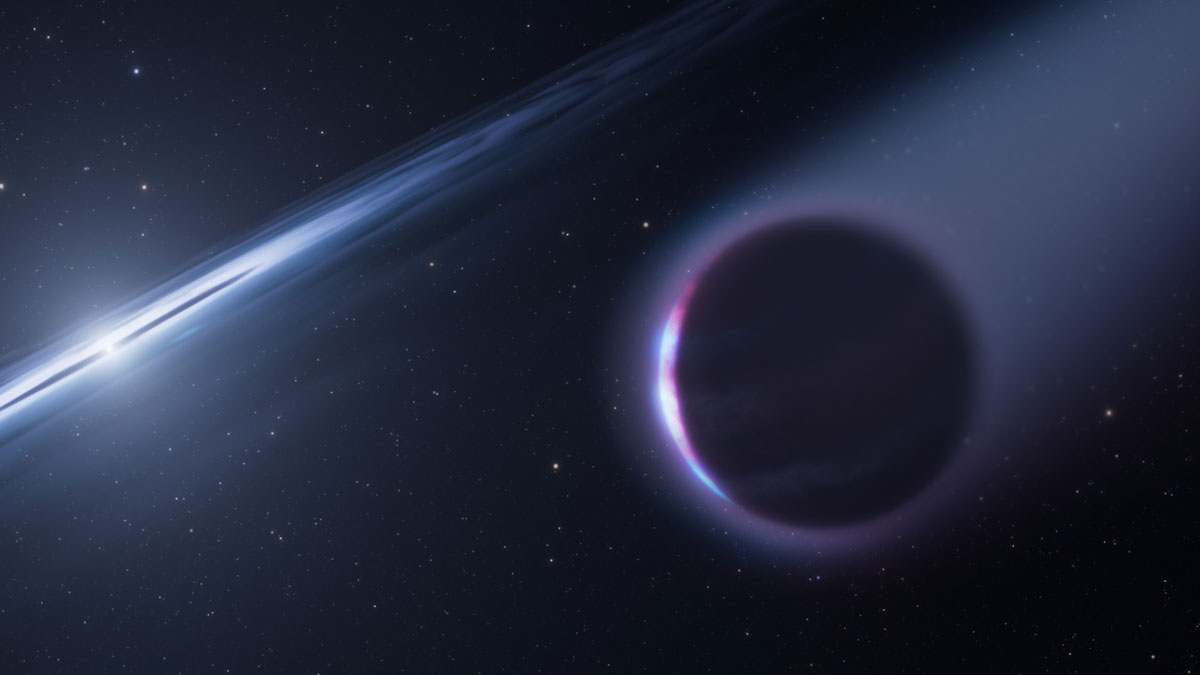
White Dwarf Star Spotted Devouring Its Newly Formed Planet
Astronomers have identified a newborn planet orbiting a white dwarf star named HS 0209+0832, approximately 35,000 kelvin at its surface, while the stellar remnant actively strips and consumes its atmosphere, eos.org reported on October 20, 2026.
-
The Tech TL;DR:
- HS 0209+0832 is a hot white dwarf star roughly half the mass of the Sun that displays an unexpected excess of atmospheric helium and rare heavy elements.
- Data from the Transiting Exoplanet Survey Satellite (TESS) reveal a 4.4-day orbital period brightness variability, indicating a hot Jupiter exoplanet candidate.
- Published in Nature Astronomy, the study suggests this is a second-generation planet formed out of debris shed by the dying progenitor star.
Uncovering HS 0209+0832 and Its Heavy Element Pollution
When astronomers first observed HS 0209+0832 in 1999 using the Hubble Space Telescope, they detected a relative excess of helium in its atmosphere. For a white dwarf running at roughly 35,000 kelvin, that quantity of atmospheric helium defied standard cooling and diffusion models. Subsequent data gathering from later Hubble observations, the Far Ultraviolet Spectroscopic Explorer (FUSE), and the Transiting Exoplanet Survey Satellite (TESS) uncovered further anomalies. The star’s spectrum displayed significant traces of zinc, copper, and niobium. According to lead author Jamie Williams, an astronomer at the University of Warwick, niobium appeared in a white dwarf atmosphere for the first time.
Niobium is especially interesting [because] that’s the first time it’s ever been discovered in a white dwarf,
Williams said. I don’t know of any other source that comes close to being this strange.

Planetary astronomer Juliette Becker of the University of Wisconsin–Madison, who was not involved with the study, noted that the pollution profile of HS 0209+0832 stands apart from previously cataloged white dwarf contamination. When heavy elements appear in stellar corpses, researchers typically attribute them to planetary pollution. Planets from the original system, or remnants destroyed when the star died, fall inward and pollute the atmosphere. However, the exact elemental breakdown in HS 0209+0832 matched neither comets nor meteorites from our solar system, nor did it align with other polluted white dwarfs.
Detecting the Hot Jupiter Orbiting a Stellar Remnant
To determine the origin of the heavy elements, the research team analyzed visible light output measurements captured by TESS. The photometry displayed a consistent variability in system brightness matching a day-night phase curve of an orbiting body. This 4.4-day orbital period points to a hot Jupiter class exoplanet positioned close to the white dwarf.
We also see a variability in the brightness of the system, which we think is from a day-night phase curve of the planet around it,
Williams stated.
The architectural mechanics of the system suggest a rare second-generation formation cycle. Rather than surviving the violent death of the progenitor star, the planet coalesced from the gas shell and debris shed during the star’s final evolutionary stages. The heavy metals now registered in the white dwarf’s spectrum—including the niobium and zinc—formed the raw disk material from which the planet accreted. As the white dwarf heats the close-in exoplanet, it acts as a stellar predator, boiling off the newborn world’s atmosphere and dragging those materials into its own.
Researchers hope to deploy the James Webb Space Telescope to directly capture infrared emissions from the planet, confirming its thermal profile. While pulsar systems host confirmed second-generation planets, finding one orbiting a typical white dwarf opens a new avenue for stellar evolution modeling. Becker noted that because HS 0209+0832 represents a standard white dwarf rather than an anomalous stellar type, similar second-generation planets likely orbit numerous other cooling stellar remnants across the galaxy.