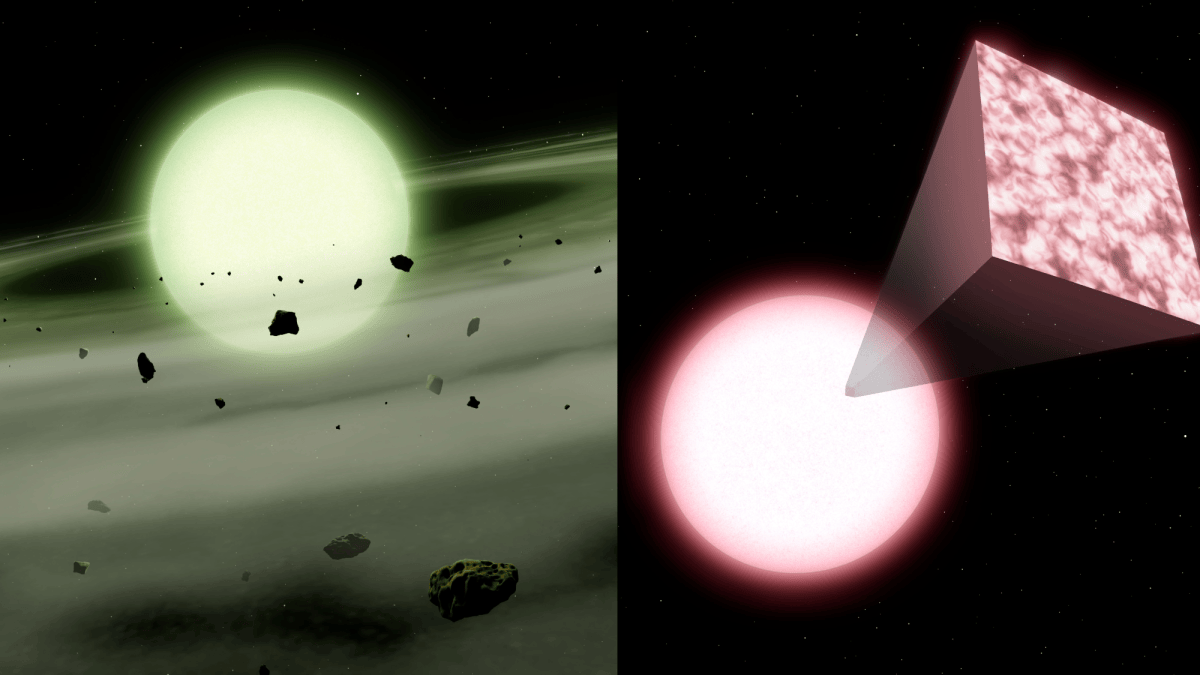
Astronomers Identify First Known Green Star and Reddest Star
Stellar temperatures and atmospheric densities in white dwarf spectra
Astronomers calculating stellar spectra have identified what calculations indicate is the first green star ever found alongside the reddest star recorded, according to a study published in the journal RAS Techniques and Instruments. While most stars act as perfect radiators where color is set by temperature, ultra-dense white dwarfs break this rule because their atmospheres reach densities comparable to water. These extreme conditions cause trace elements to interact with dense helium plasma, absorbing light across a wider spectrum. These findings explain how white dwarfs can shine in unexpected hues including green, pink, cyan, yellow, and purple.
The Tech TL;DR:
- Researchers calculated true stellar colors by running starlight spectra through computer models simulating human vision.
- Out of 151 white dwarfs studied within 65 light-years, roughly 1 in 30 displayed unusual colors rather than standard white.
- Trace sodium and carbon enrichment drive these chromatic anomalies by absorbing specific optical wavelengths.
Atmospheric enrichment in white dwarf WD J1330+6435
The newly identified green star, designated WD J1330+6435, maintains a temperature of about 7,232 degrees Fahrenheit (4,000 degrees Celsius). The star has accreted rocky debris from its former planetary system, enriching its atmosphere with calcium, lithium, and sodium. Mark Hollands from the University of Warwick stated that traces of sodium absorb the orange part of the spectrum to leave behind a ghostly green glow, making it the first star of that color ever documented.

Carbon convection zones in white dwarf WD J1011+2845
Operating on the opposite end of the optical spectrum, researchers identified WD J1011+2845 as the reddest star ever recorded. Located just 48 light-years away, this white dwarf features a deep convection zone that dredges carbon up from its core to the surface. Carbon molecules distort the star’s light so severely that almost all of it squeezes into wavelengths beyond 600 nanometres, creating a deep salmon-pink glow. Similar carbon-dredging mechanics in other cool white dwarfs create diatomic carbon molecules yielding various pink and purple hues.
Representative populations across nearby stellar samples
Evaluating 151 white dwarfs located within roughly 65 light-years of Earth revealed that only five displayed unusual colors, consisting of two yellow and three pink examples. The remaining 146 stars averaged out to a median color temperature of approximately 6,800K, which human eyes perceive as white. Boris Gänsicke noted that while 1 in 30 might not sound like a huge fraction, it represents a substantial population of oddly colored stars across the universe, though a representative population confirms that the average white dwarf is genuinely white. This corrects earlier misconceptions that white dwarfs are predominantly blue, a bias stemming from brighter blue stars being visible across greater distances.
