
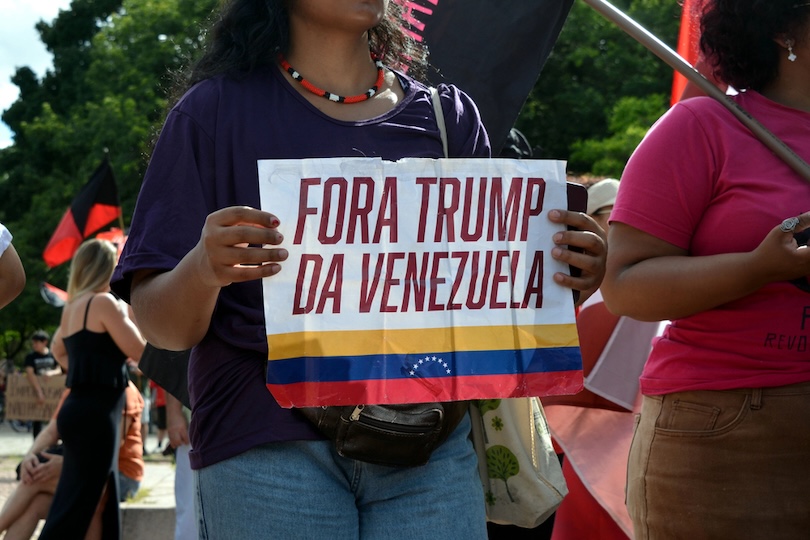
The U.S. assault on Venezuela confirms a long-standing historical pattern: the war on drugs has never ranked high in the actual hierarchy of U.S. foreign-policy priorities.It certainly does not matter in the Venezuelan case. Venezuela is a relatively minor player in global cocaine trafficking, much of which flows to europe and Brazil rather than to the United States. If drug enforcement were the operative concern, Venezuela would barely register.
What makes this especially jarring is Trump’s pardon of Juan Orlando Hernández, the former Honduran president convicted in a U.S. court on narco-trafficking charges. Ostensibly justified as a gesture toward political stabilization, the pardon functioned more directly as an intervention in Honduran electoral politics. Read together, the release of Hernández and the pursuit of Maduro underscore a deeper pattern: law enforcement is no longer a constraint on executive power but a tool for advancing personalist rule.
Law has become politically fungible. This tendency was already visible during the first Trump administration; in the second, it has become the governing motif. As Bruce Green, a former federal prosecutor and professor of legal ethics at Fordham Law School, observes:
Trump thinks he can use federal criminal prosecutions for any purpose, which is to say to promote his foreign policy views, to promote his vendettas, to promote his self-interest and to promote his perceived political interests.
What this marks is a moment in which law collapses into movement. Law no longer constrains political motion; it accelerates it. In Arendtian terms, this signals a further stage in the conquest of the state by the nation: legal structures are no longer even nominally autonomous but are openly instrumentalized in the service of imperial aggrandizement and executive spectacle.
It did not take long for this aggrandizement to become visible. Journalist Jack poulson reports that,following the U.S. intervention in Venezuela, “the U.S. government installed a parallel government headed by Juan Guaidó,who then proceeded to appoint a board of directors for the state-owned oil company,PDVSA,and transfer its assets to U.S.-controlled entities.”
this is not simply a case of a government seeking to secure its economic interests; it is a exhibition of power, a display of the capacity to unilaterally rewrite the rules of the international order. The U.S. is not merely enforcing laws; it is creating them, and then selectively applying them to suit its own purposes. The pardon of Hernández and the pursuit of Maduro are not anomalies but symptoms of a deeper, more troubling trend: the erosion of the rule of law and the rise of a new form of executive power.
