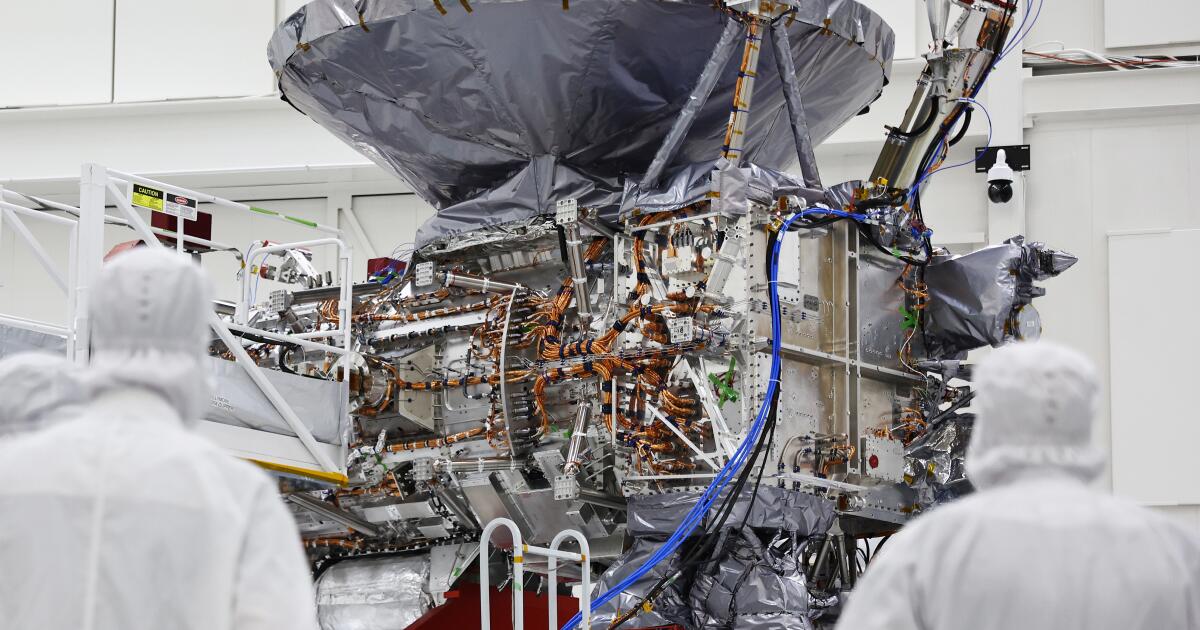
Trump 2027 Budget Cuts Threaten La Cañada Flintridge Space Facility
On April 19, 2026, the Trump administration’s 2027 budget proposal reignited threats to NASA’s Jet Propulsion Laboratory (JPL) in La Cañada Flintridge, California, proposing deep cuts that could jeopardize critical space missions, local employment, and the Southern California aerospace ecosystem that has long relied on federal research funding to drive innovation and regional economic stability.
The renewed assault on JPL comes not as a surprise but as a continuation of a partisan tug-of-war over federal science spending that has intensified since 2025. What makes this moment distinct is the administration’s explicit targeting of Earth science and climate monitoring programs housed at JPL—missions like the Surface Water and Ocean Topography (SWOT) satellite and the upcoming NISAR radar mission—framing them as “non-essential” despite their direct role in predicting droughts, wildfires, and coastal flooding that increasingly threaten California communities. This isn’t merely about budget lines; it’s about dismantling a decades-old public-private innovation engine that has turned the San Gabriel Valley into a global hub for space technology, employing over 6,000 scientists, engineers, and support staff, many of whom live in nearby Pasadena, Altadena, and Glendale. The ripple effects would hit local small businesses—from machine shops fabricating spacecraft components to lunch trucks serving the JPL cafeteria—hardest, exposing a fragility in regional economic planning that over-relies on federal cyclicality.
“JPL isn’t just a federal lab; it’s the backbone of our local economy. When its funding wavers, so do the livelihoods of thousands of families who depend on its stability—not just scientists, but contractors, vendors, and service providers across Los Angeles County.”
— Maria Chen, President of the San Gabriel Valley Economic Partnership, in a statement to the Pasadena Star-News on April 18, 2026. Historical context reveals a pattern: JPL has weathered similar threats before, most notably during the 2011 sequestration debates and again in 2020 when early Trump-era budgets proposed terminating the Earth Science Division. Each time, bipartisan pressure from California’s congressional delegation—led then by Senators Barbara Boxer and Dianne Feinstein, now by Senators Alex Padilla and Laphonza Butler—combined with aggressive public advocacy from groups like the Planetary Society to restore funding. Yet the 2027 proposal differs in scale, suggesting a deeper ideological shift rather than a temporary fiscal adjustment. According to NASA’s official budget documents, the proposed cuts would reduce JPL’s annual allocation by approximately 18%, disproportionately affecting its Earth Science Division while sparing, for now, flagship planetary missions like Europa Clipper and Mars Sample Return—a distinction that reveals a strategic prioritization of exploration over environmental monitoring, even as climate-related disasters cost California over $50 billion annually, per state climate assessments. The geographic concentration of this impact cannot be overstated. La Cañada Flintridge, a city of just over 20,000 residents, derives nearly 12% of its municipal revenue from businesses directly tied to JPL operations, according to a 2023 study by the Los Angeles County Economic Development Corporation. A sustained funding drop would strain local school districts reliant on property taxes from aerospace workers, increase demand for career transition counseling as skilled workers seek opportunities elsewhere, and test the resilience of local chambers of commerce tasked with diversifying an economy long skewed toward federal contracts. Meanwhile, legal experts warn that abrupt terminations of ongoing contracts could trigger claims under the Contract Disputes Act, pushing affected vendors toward federal procurement attorneys to navigate complex bid protest and settlement processes—an added layer of uncertainty few small businesses are equipped to handle. Beyond economics, the cultural and educational toll is palpable. JPL’s public outreach programs—including its renowned open house events that draw over 40,000 visitors annually to La Cañada Flintridge—serve as vital STEM inspiration for students in underserved districts like El Monte and Huntington Park. Diminishing these programs risks widening the opportunity gap in a region where access to quality science education remains uneven. Community leaders in Pasadena have already begun mobilizing, arguing that federal investment in JPL yields outsized returns: every $1 spent on NASA generates between $7 and $14 in economic activity, according to a 2022 Space Policy Institute analysis—a figure that underscores the shortsightedness of viewing pure science as expendable.
“Cutting JPL’s Earth science work is like tearing out the smoke detectors since you haven’t had a fire yet. The data they collect isn’t academic—it’s the early warning system keeping communities safe from the next mega-drought or mudslide.”
— Dr. Alejandro Ruiz, Climatologist at UCLA’s Institute of the Environment and Sustainability, speaking at a Pasadena City Council hearing on April 17, 2026. As the budget process moves to Congress, where California’s delegation holds significant leverage through appropriations committee seats, the outcome remains uncertain. But the message is clear: when federal science policy whiplashes, it’s not just abstract institutions that suffer—it’s the machinists in Altadena, the teachers in Glendale, the small business owners in La Cañada Flintridge who build their lives around the steady pulse of discovery emanating from those foothills labs. For those navigating the fallout—whether seeking new contracts, retraining workers, or advising clients on contractual risks—the path forward demands access to trusted, verified expertise. That’s where the World Today News Directory becomes indispensable: not as a passive observer, but as an active conduit connecting communities in transition with the professionals who can help them adapt, endure, and ultimately thrive beyond the volatility of Washington’s budget cycles. The real mission isn’t just to survive the cuts—it’s to rebuild smarter, stronger, and less dependent on the whims of any single administration.
Worth a look