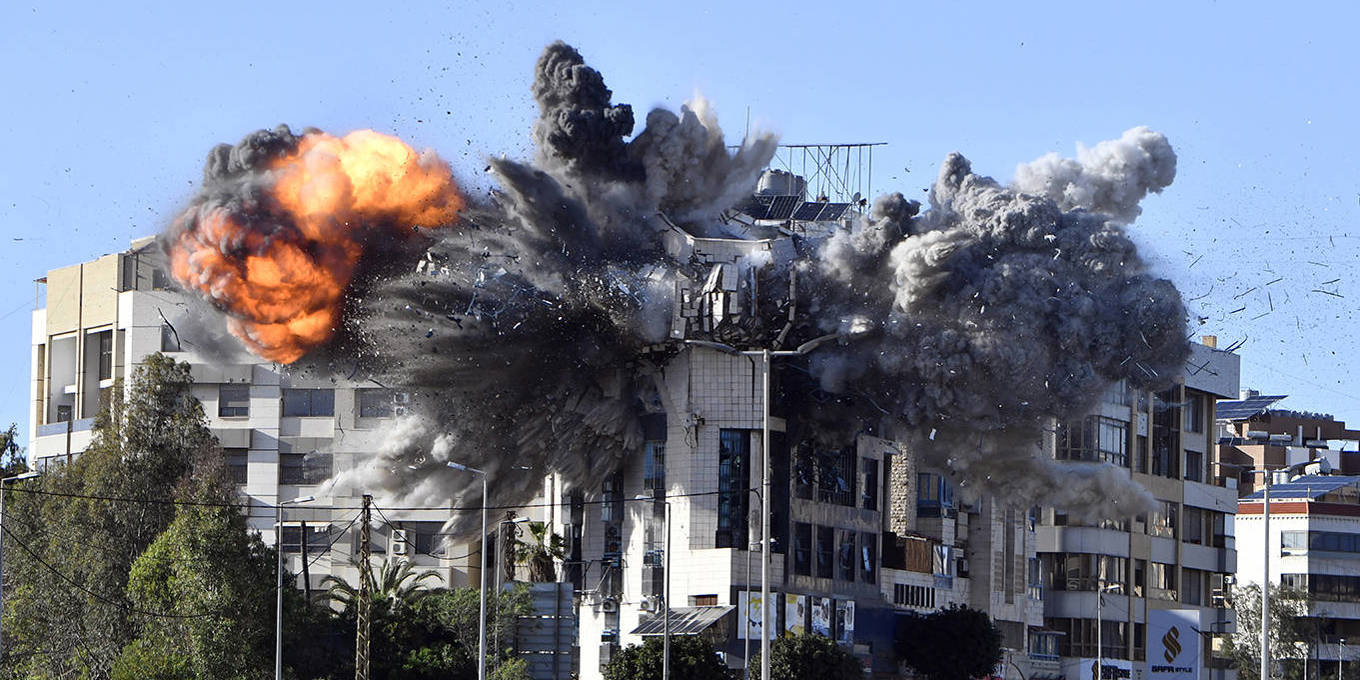
The Fallacy of Israel’s Buffer Zone in Southern Lebanon
Israel’s occupation of southern Lebanon fails as a “buffer zone” strategy because long-range ballistic missiles and drones render territorial barriers obsolete. Recent Scud and Iranian strikes on central Israel prove that ground-level buffers cannot mitigate deep-strike threats, creating massive strategic and fiscal liabilities.
The strategic logic of a buffer zone is built on a legacy understanding of warfare—the idea that controlling a strip of land prevents the enemy from launching attacks. In the current fiscal and military climate of 2026, What we have is a catastrophic misallocation of strategic capital. When the adversary possesses the capability to bypass a ten-kilometer strip of land and strike deep into the heart of the state, the “buffer” transforms from a security asset into a pure operational liability.
Maintaining a ground presence in southern Lebanon is an exercise in spiraling operational expenditure (OpEx) with zero return on investment (ROI). The cost of deploying, sustaining, and defending thousands of troops is immense, yet the security dividends are nonexistent when the primary threats are airborne and ballistic.
The Fiscal Fallacy of the Ground Buffer
The transition from the initial conflict onset on March 2, 2026, to the commencement of Israeli ground operations on March 16, 2026, represents a pivot toward a high-maintenance military model. Ground operations are inherently resource-heavy, requiring constant logistical replenishment and exposing personnel to asymmetric risks. The “buffer zone” is essentially a sunk cost.
- Asymmetric Cost Imbalance: The cost to maintain a territorial occupation is constant and linear, while the cost for an adversary to launch a single ballistic missile is marginal. This creates a permanent deficit in the cost-exchange ratio.
- Infrastructure Depreciation: Territorial occupation doesn’t protect critical infrastructure. it merely shifts the frontline. As seen in the April 1st Iranian barrage, the “buffer” did nothing to protect Bnei Brak or Rosh Haayin from cluster warheads and ballistic impacts.
- Strategic Misalignment: Investing in ground buffers while the threat is airborne is a failure of risk management. It is the equivalent of building a taller fence to stop a drone strike.
The buffer is a ghost.
Enterprises operating within the Levant now face a volatility index that makes traditional insurance models obsolete. To survive this environment, firms are increasingly relying on geopolitical risk consultants to rewrite their contingency plans and hedge against the inherent failure of state-led security buffers.
The Ballistic Bypass: From Palmachim to Bnei Brak
The data from the last few weeks dismantles the buffer zone narrative. Hezbollah’s launch of a Scud-D (or similar modernized variant) targeting the Palmachim Airbase marks a critical inflection point. Palmachim is not on the border; it is a strategic asset deep within Israeli territory. The fact that a ballistic missile can be launched from Lebanon and strike a high-value military base proves that the “buffer” in southern Lebanon is an irrelevant variable in the security equation.
The carnage of April 1, 2026, further illustrates this point. While Israeli forces were occupied with ground operations in the south, Iran launched a major ballistic missile barrage that sounded sirens across central Israel and the Jerusalem area. The impact was not felt in the buffer zone, but in the civilian centers. In Bnei Brak, a cluster warhead injured a 12-year-old and two infants. In Rosh Haayin, missile strikes caused significant structural damage.
This is the reality of modern projectile warfare: the distance between the launch site and the target is bridged in minutes, regardless of who controls the soil in between. The interception of an Iranian missile over Lebanon on March 24, 2026—which potentially targeted a US asset or the Hamat Air Base—only underscores that the airspace is the actual battlefield, not the land.
The logistical strain of these ground operations necessitates that the military-industrial complex pivot. We are seeing a shift toward defense procurement specialists who prioritize integrated air-defense layers over territorial expansion. The market is pricing in the failure of the ground-buffer model.
Strategic Misallocation and the B2B Pivot
From a macro perspective, the 2026 Lebanon war is a case study in the depreciation of territorial control. With over 1,200,000 displaced in Lebanon and hundreds of soldiers wounded or killed, the human and financial cost of the ground campaign is mounting. Yet, the primary threats—Iranian ballistic missiles and Hezbollah’s Scud capabilities—remain operational and lethal.
This misalignment creates a vacuum that only high-level enterprise services can fill. The volatility of the region has made it impossible for corporations to rely on government assurances of “secure zones.” Instead, they are turning to corporate crisis management firms to develop autonomous evacuation and asset-protection protocols that operate independently of state-defined buffer zones.
The fiscal reality is simple: the cost of occupying southern Lebanon is a liability on the national balance sheet that provides no hedge against the actual threat. The “buffer” is a psychological comfort, not a strategic reality.
The market’s trajectory is clear. The era of the territorial buffer is over, replaced by an era of deep-strike volatility and asymmetric air warfare. Investors and corporate leaders who continue to believe that a line on a map equals security are ignoring the ballistic data. To navigate this new landscape of strategic instability, businesses must find vetted partners capable of managing high-stakes risk. The World Today News Directory remains the premier resource for connecting with the B2B firms that solve these complex, high-volatility problems.