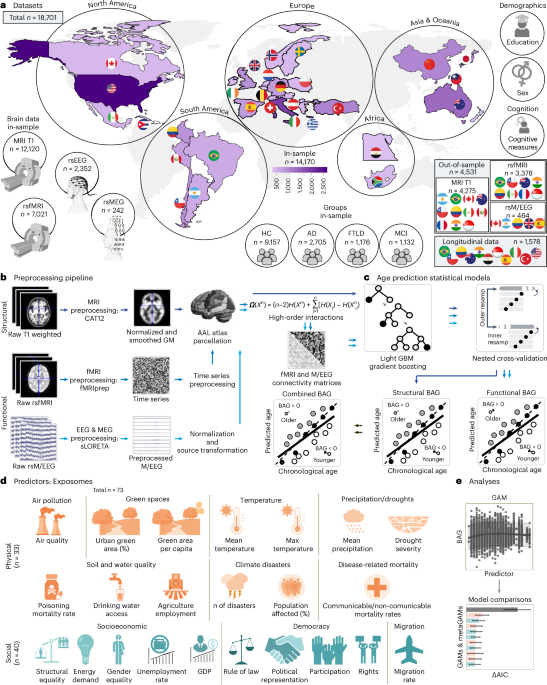
The exposome of brain aging across 34 countries
The environment we inhabit writes a silent biography on our neural tissue, often accelerating decline long before clinical symptoms emerge. A groundbreaking longitudinal analysis published this week reveals that the air we breathe and the communities we build are not merely background noise but active drivers of brain aging. This shift in understanding moves neurodegeneration from a purely genetic inevitability to a modifiable public health priority.
Key Clinical Takeaways:
- Social isolation and adverse community environments correlate strongly with accelerated functional cognitive decline.
- Physical environmental factors, such as pollution, are linked to faster structural brain atrophy visible on neuroimaging.
- Preventive strategies must now integrate social prescribing and environmental risk mitigation alongside standard neurological care.
The study, published online in Nature Medicine on April 3, 2026, analyzed exposome data across 34 countries to dissect the environmental determinants of brain health. Researchers distinguished between functional aging, which affects cognition and daily performance, and structural aging, which involves physical changes to brain volume and integrity. The findings indicate a divergence in pathology: social exposures drove functional deterioration, while physical exposures dictated structural decay. This granular distinction is critical for clinicians aiming to intervene before irreversible pathogenesis sets in.
Funded by a coalition of international health institutes including contributions from national medical research councils, the project leveraged massive epidemiological cohorts to achieve statistical power rarely seen in neurology. The transparency of this funding model ensures that the data serves public health interests rather than proprietary pharmaceutical goals. Such large-scale collaboration is necessary to overcome the heterogeneity of environmental data across different geopolitical regions.
Divergent Pathways of Neural Decline
Understanding the mechanism requires separating the mind’s software from its hardware. Functional brain aging refers to the efficiency of neural networks involved in memory, processing speed, and executive function. Structural brain aging refers to the physical preservation of gray and white matter. The study demonstrates that individuals facing high levels of social adversity—such as isolation or lack of community support—experienced a sharper decline in functional metrics. Conversely, exposure to physical stressors like air particulates correlated with measurable reductions in brain volume.

This duality suggests that a single therapeutic approach is insufficient. A patient living in a high-pollution zone may require different protective interventions than a patient suffering from chronic loneliness, even if both present with similar cognitive complaints. Clinicians must now assess environmental history with the same rigor as family medical history. For patients noticing subtle changes in memory or processing speed, consulting with vetted board-certified neurologists is essential to differentiate between normal aging and environmentally accelerated decline.
“We are no longer looking at the brain in a vacuum. The exposome acts as a constant modulator of neuroplasticity. Ignoring social determinants is akin to treating a lung infection without addressing the air quality.”
— Dr. Elena Rossi, Lead Epidemiologist, International Brain Aging Consortium
The implications for clinical trials are profound. Historically, clinical trial phases have focused heavily on pharmacological efficacy while controlling for environmental variables. As we move toward preventive medicine, future Phase III trials may need to stratify participants based on exposome risk profiles. This ensures that a drug’s effectiveness is not masked by uncontrolled environmental degradation. Regulatory bodies like the FDA and EMA are expected to update guidance to reflect these environmental covariates in neuroprotective drug development.
Integrating Environmental Data into Standard of Care
Translating this epidemiological data into patient care requires a multidisciplinary approach. The traditional model of waiting for symptom onset is obsolete when environmental risks are identifiable years in advance. Healthcare providers must adopt a proactive stance, utilizing diagnostic tools that can detect early structural changes before functional loss becomes debilitating. Patients with high risk profiles should seek evaluation at specialized neuroimaging centers capable of performing advanced volumetric analysis.
the role of lifestyle medicine expands beyond diet and exercise. Social prescribing—connecting patients with community resources to mitigate isolation—becomes a medical intervention rather than a social service. This aligns with broader public health goals outlined by the World Health Organization, which increasingly emphasizes social determinants of health. Medical practices specializing in holistic brain health are well-positioned to lead this transition, offering integrated care plans that address both biological and environmental factors.
For healthcare systems, the infrastructure must support this complexity. Navigating the regulatory and operational shifts required to integrate exposome data into electronic health records may require legal and compliance expertise. Hospitals and clinic networks are increasingly retaining healthcare compliance attorneys to ensure that new data collection methods meet privacy standards while enabling robust research. This administrative backbone is vital for scaling personalized preventive neurology.
“The separation of social and physical exposures allows us to target interventions precisely. You can prescribe community engagement for functional protection and environmental mitigation for structural preservation.”
— Dr. Marcus Thorne, Senior Researcher, Department of Public Health Neuroscience
As research progresses, the hope is that these findings will spur policy changes reducing physical pollutants and community initiatives fostering social cohesion. Until then, the medical community must act as the intermediary, translating population-level data into individual action plans. The clinical trial process will continue to validate specific interventions, but the foundation of care shifts today toward risk mitigation.
The trajectory of brain aging is not fixed. By acknowledging the exposome’s role, we empower patients and providers to alter the course of neural health. The future of neurology lies in the intersection of environmental science and clinical practice, demanding a workforce trained to recognize these invisible risks. Patients concerned about their cognitive longevity should prioritize finding providers who understand this new paradigm of environmental neurology.
*Disclaimer: The information provided in this article is for educational and scientific communication purposes only and does not constitute medical advice. Always consult with a qualified healthcare provider regarding any medical condition, diagnosis, or treatment plan.*