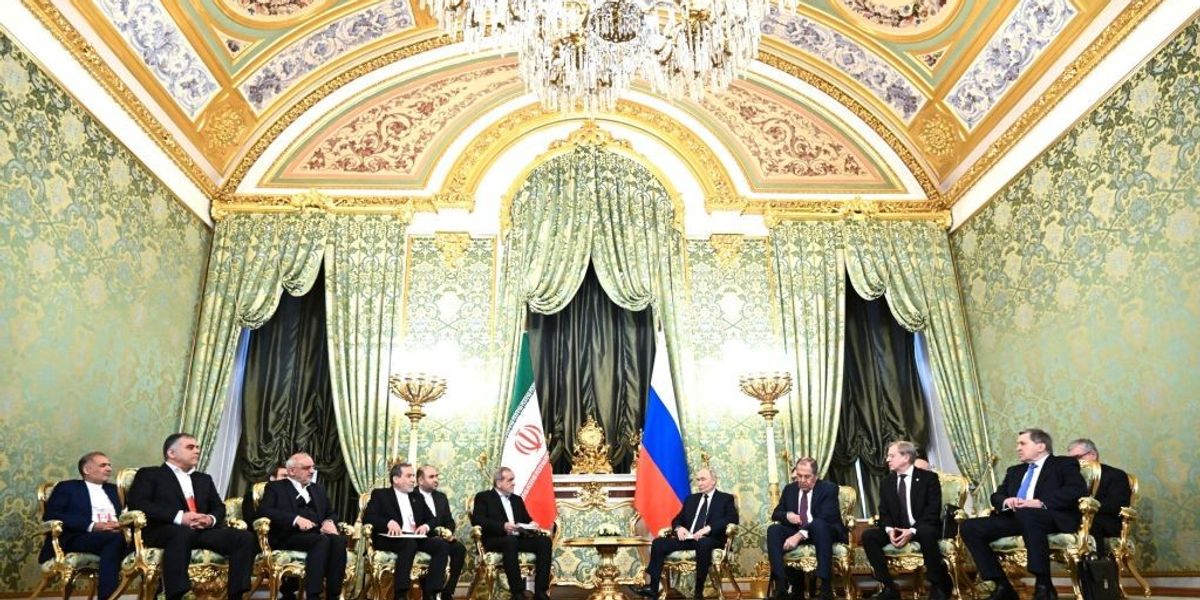
Russia’s War in Ukraine: A Blueprint for Iranian Regime Survival
Iran’s leadership is studying Russia’s war in Ukraine not as a cautionary tale but as a blueprint for resilience, innovation, and repression—lessons that could make Tehran more dangerous to U.S. Interests in the Middle East and beyond. As of April 15, 2026, evidence shows Iran has absorbed battlefield data from Russian drone operations, deepened military-industrial ties with Moscow, and observed how authoritarian regimes can withstand sanctions by turning inward and strengthening internal security. This isn’t theoretical: Iranian-made drones have already penetrated U.S. And allied air defenses in the region, while Tehran’s economy, long accustomed to sanctions, continues to function through informal trade networks with China and other non-Western partners. For the United States, the danger lies not in Iran’s potential to collapse under pressure, but in its growing capacity to endure, adapt, and retaliate with increasingly sophisticated asymmetric tools—raising urgent questions about the effectiveness of current deterrence strategies.
The most immediate concern is technological diffusion. Since 2022, Iran has supplied Russia with Shahed-136 drones, which Moscow has reverse-engineered, upgraded with GPS and GLONASS guidance, and produced domestically as the Geran-2. In return, Iranian engineers have gained access to Russian electronic warfare tactics and missile telemetry from strikes on Ukrainian infrastructure. By late 2025, Iran unveiled the IRSA-7, a new loitering munition with extended range and improved terrain-following capabilities—direct descendants of the Shahed-Geran feedback loop. These systems have been tested in live combat: in January 2026, Iranian-backed forces launched a drone swarm that struck a U.S. Logistics hub near Al-Tanf, Syria, bypassing Patriot missile batteries through low-altitude terrain masking and electronic noise—a tactic first refined in Ukraine.
How Sanctions Fail to Break Authoritarian Regimes
Russia’s economy contracted by just 2.1% in 2023 and grew 3.6% in 2024, according to the World Bank, defying early predictions of collapse. This resilience came not from Western re-engagement but from a pivot to Asia: Chinese exports to Russia rose 46.7% in 2024, while bilateral trade hit a record $240 billion. Iran, already under comprehensive U.S. And EU sanctions since 2018, has mirrored this strategy. In 2025, Iran-China trade reached $22 billion, up 34% from the previous year, with Beijing supplying 78% of Iran’s imported machinery and 61% of its consumer goods, per Iran’s Customs Administration. Domestically, both countries have boosted self-sufficiency: Russia’s agricultural output rose 4.2% in 2024, while Iran reported a 9.1% increase in wheat production and 15.7% growth in pharmaceutical manufacturing—reducing reliance on fragile import chains.
This adaptation has direct municipal consequences. In Bandar Abbas, Iran’s key port city, customs officials report a 29% rise in overland truck traffic from Afghanistan and Pakistan since 2023, carrying goods that bypass maritime sanctions. Meanwhile, in Shiraz, local manufacturers have expanded textile and automotive parts production to fill gaps left by vanished European suppliers. These shifts aren’t just economic—they’re political. As one anonymous senior official in Iran’s Ministry of Economy told Reuters in November 2025:
The sanctions hurt, but they don’t break us. We’ve built parallel systems—financial, logistical, industrial—that keep the state running. The war in Ukraine proved that even a superpower can be contained without being defeated. We’re learning to operate in the shadows.
The Rise of the Security State as a Model for Survival
Perhaps the most troubling lesson Iran may be taking from Russia is how war justifies the expansion of internal repression. Since 2022, Russia has imprisoned over 19,800 people for anti-war speech or social media posts, per OVD-Info, and labeled dozens of NGOs as “undesirable” or “foreign agents.” Independent media outlets have shuttered or fled abroad. by early 2026, fewer than 15 remained operating domestically. The FSB has absorbed functions once handled by the military and judiciary, conducting surveillance, interrogations, and even battlefield intelligence—blurring the line between internal and external security.
Iran’s regime has long relied on similar tools: the Islamic Revolutionary Guard Corps (IRGC) intelligence wing, the Ministry of Intelligence, and Law Enforcement Command already monitor dissent, control cyberspace, and suppress protests. But the Ukrainian conflict may be accelerating a shift toward totalizing control. In Qom, a center of religious scholarship, seminary students report increased monitoring by IRGC-affiliated morality police since late 2025, with unauthorized lectures on governance or human rights now risking detention. A professor at the University of Tehran, speaking on condition of anonymity, warned:
When the state frames every critique as treason, it doesn’t just silence opposition—it destroys the capacity for self-correction. That’s how regimes survive in the short term and implode in the long term. But by then, the damage is done.
This dynamic has real-world consequences for civic life. In Isfahan, lawyers report a 40% increase in cases involving national security charges since 2023, many tied to social media activity or private conversations. Families seeking legal aid for detained relatives often turn to human rights attorneys who specialize in revolutionary court proceedings—though access remains limited and risky.
What This Means for U.S. Deterrence and Regional Stability
The United States continues to rely on economic pressure and military posturing as primary tools against Iran. But if Tehran believes it can outlast sanctions, innovate under constraint, and use conflict to strengthen its grip on power, then traditional deterrence loses its edge. The U.S. Central Command has already acknowledged this shift: in its 2025 posture review, it noted that “Iran’s proxy forces are demonstrating improved coordination, drone lethality, and electronic warfare capacity consistent with observed Russian-Ukrainian tactics.”
This evolution affects more than just battlefields. In Erbil, Iraqi Kurdistan, officials have complained of Iranian-backed militias using encrypted drone networks to monitor U.S. Convoy movements—a capability traced back to Russian-trained advisors. In Beirut, Lebanese economists warn that Iran’s growing self-reliance reduces leverage for international negotiators, as Tehran feels less compelled to compromise to access global finance. Even in Dubai, where Iranian entrepreneurs have long found refuge, business leaders note a quiet exodus of dual nationals and tech specialists returning to Iran, drawn by state-backed innovation grants and a perception of rising domestic opportunity.
For American businesses and local governments navigating this uncertainty, the demand for expert guidance is growing. Municipal planners in cities like Dearborn, Michigan—home to one of the largest Iraqi and Iranian diaspora communities in the U.S.—are consulting cultural liaison firms to anticipate shifts in community sentiment and prevent radicalization. Meanwhile, energy firms assessing supply chain risks are turning to international trade attorneys who understand sanctions evasion tactics and secondary liability exposure.
The war in Ukraine is not fading into history. It is being studied, replicated, and adapted by regimes that see strength not in liberal openness but in controlled endurance. For Iran, the message is clear: pressure can be absorbed, innovation can bloom in isolation, and legitimacy can be forged in the furnace of conflict. If the United States fails to recognize that its adversaries are learning—not failing—then the next confrontation may unfold on terrain far less favorable than anticipated. The directory exists not just to record the world, but to help navigate it. When the rules change, so must the way we locate help.