
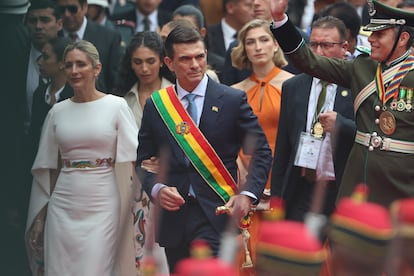
Bolivian President Rodrigo Paz Inaugurates Presidency, Signals Sharp Shift in Policy
LA PAZ, Bolivia – Rodrigo Paz Pereira was inaugurated as Bolivia’s president today, vowing to break with past “failed ideologies” and usher in an era of economic revitalization and renewed international partnerships.The ceremony, held at the Assembly, culminated in a symbolic projection of images depicting fuel tankers entering Bolivia – a direct reference to Paz’s pledge to address critical shortages of gasoline and diesel, a key promise of his administration.
Paz’s investiture marks a notable departure from previous Bolivian governments,notably concerning economic policy and foreign relations. His administration inherits a nation grappling with dwindling foreign exchange reserves, fueled by a decline in hydrocarbon production due to underinvestment in exploration. this scarcity has driven up prices and fostered a parallel market for dollars, contributing to economic hardship for many Bolivians. “What the hell did they do with so much wealth? Because now there are people who don’t have enough to eat, if we were as rich as they say. They are going to respond to the country for treason,” Paz stated during his address.
The inauguration was attended by the presidents of Ecuador, Paraguay, Chile, Uruguay, and Argentina, with argentine President Javier milei – a vocal supporter of Paz’s candidacy – receiving particular prominence. Milei was the first to congratulate Paz following his October 19th election victory, signaling a potential realignment of Bolivia’s international alliances. Paz recently concluded his first official visit to the United States in over two decades, aiming to restore broken relations and attract investment.
Further bolstering his economic agenda, Paz announced a $3.5 billion loan agreement with the Andean Progress Cooperation (CAF). Simultaneously, Bolivia was recently expelled from the Bolivarian Alliance for the Peoples of Our America (ALBA) after Paz characterized member states Cuba, Venezuela, and Nicaragua as “undemocratic.” These actions underscore a decisive shift away from customary leftist alliances and towards a more market-oriented and Western-aligned foreign policy.
