
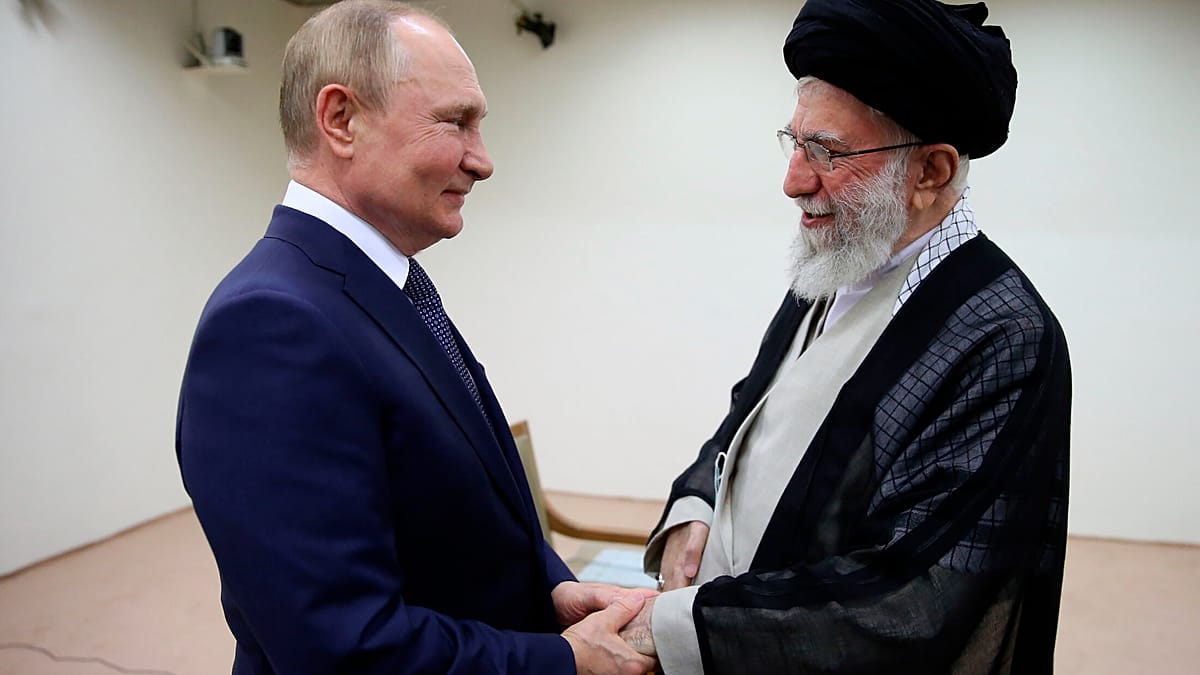
Russian President Vladimir Putin condemned the killing of Iranian Supreme Leader Ayatollah Ali Khamenei as a “cynical murder” committed in violation of international law and human morality, according to a statement released by the Kremlin on Sunday.
Putin expressed his condolences to Iranian President Masoud Pezeshkian in a note, stating that Ayatollah Khamenei would be remembered in Russia as “an outstanding statesman who made a huge personal contribution to the development of friendly Russian-Iranian relations, bringing them to the level of a comprehensive strategic partnership.”
The Kremlin’s statement followed a sharp condemnation from the Russian Foreign Ministry on Saturday of the joint US-Israeli military operation in Iran, which resulted in Khamenei’s death. The ministry characterized the operation as a “pre-planned and unprovoked act of armed aggression” against a sovereign nation, violating fundamental principles of international law.
According to the Russian Foreign Ministry, Washington and Tel Aviv are pursuing a dangerous course of action that risks escalating regional instability, potentially leading to a “humanitarian, economic and, not exclude, a radiological catastrophe.” Moscow alleges that claims of preventing Iran from acquiring nuclear weapons are a pretext for a broader objective: “to destroy the constitutional order and destroy the leadership of a state they do not like, which has refused to submit to forceful dictate and hegemonism.” The ministry called for an immediate return to “a political and diplomatic settlement.”
In response to the escalating tensions, the Russian Foreign Ministry advised Russian citizens in Iran and Israel to leave the countries “immediately if possible.” Recommended evacuation routes from Iran include travel through Azerbaijan and Armenia, while routes from Israel include Egypt and Jordan. The ministry also urged Russians remaining in the region to exercise caution, avoid large gatherings, and limit unnecessary travel.
The death of Khamenei, who had ruled Iran since 1989, throws the future of the Islamic Republic into doubt and raises concerns in Moscow about regional stability. Experts note that Iran has been a key ally for Russia, particularly in light of Western sanctions. The potential loss of this partnership could significantly impact Russia’s strategic interests.
Nikita Smagin, an orientalist, highlighted the importance of the North-South transport corridor, which runs through Iran, as a vital alternative route for Russia amidst sanctions. “Even if the current government in Iran remains in power, the general instability in the region still calls into question the creation of the North-South corridor,” Smagin said. He added that projects related to Iranian oil and gas, a planned gas hub, and a new Russian nuclear power plant in Iran are now “seriously in question.”
Smagin also cautioned that a regime change in Iran could further jeopardize Russian interests. “If we imagine a regime change, it is almost certain that the new government will be distrustful of Russia or will be openly anti-Russian,” he stated, citing Russia’s support for the previous regime and its provision of weapons used to suppress protests. “So in this sense, I suppose Russia’s prospects and Russian-Iranian relations are becoming, shall we say, less pleasant for the Kremlin.”
Iranian state media announced Khamenei’s death on Saturday, following air strikes attributed to Israel and the United States. Tehran officially confirmed the death on the night of March 1st and declared a 40-day mourning period.
