
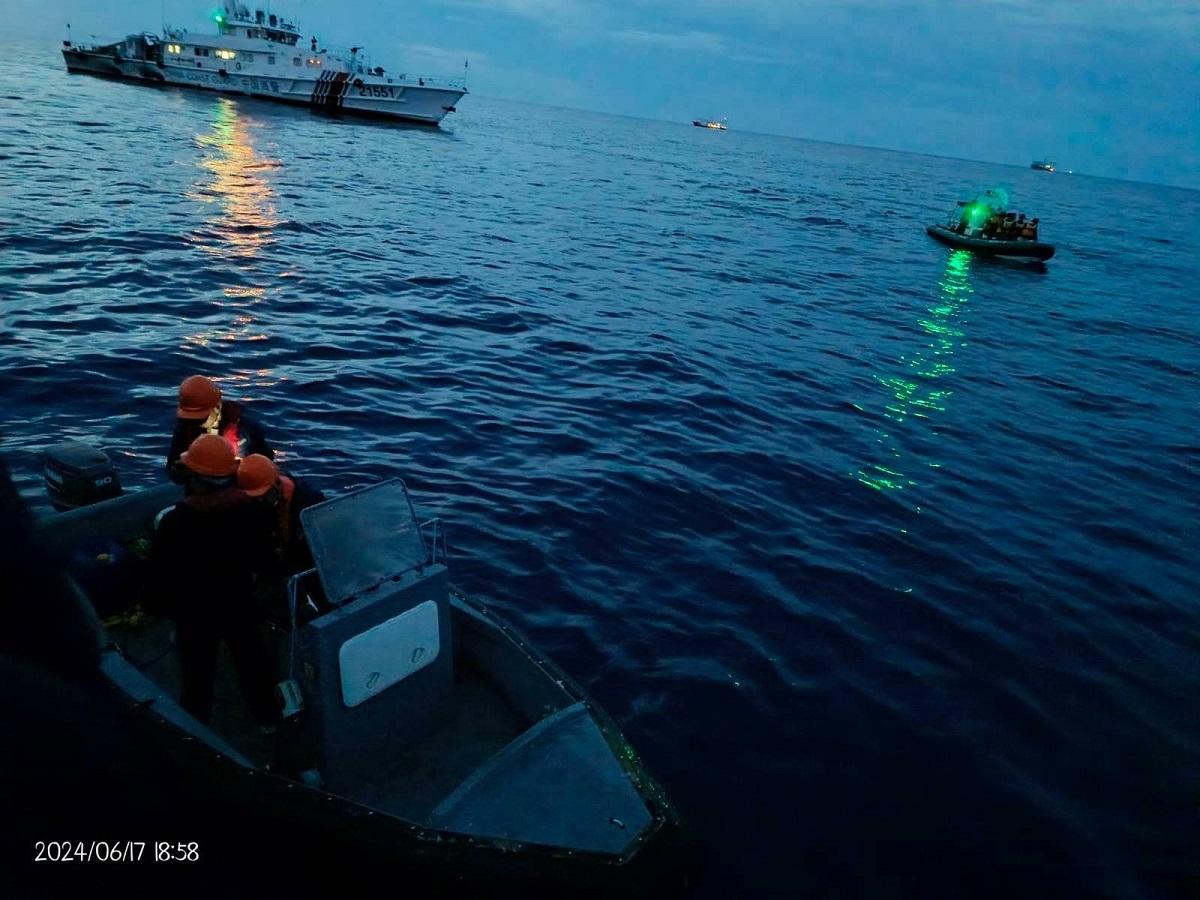
Manila - The Philippines announced Monday it will not dispatch naval ships to Panatag Shoal, internationally known as Scarborough Shoal, despite recent assertive actions by Chinese forces.This strategic decision aims to prevent a potential escalation of tensions in the contested South China Sea, with Philippine officials emphasizing a commitment to avoiding provocative measures.
President Marcos’ directive: Avoiding Provocation
Undersecretary alexander Lopez, spokesperson for the National Maritime Council, stated that President Ferdinand Marcos Jr. has issued a clear directive: the Philippines must not initiate provocation. “Unang-una, napakaliwanag ng directive ng ating Pangulo, whatever we do, we will not be the one to provoke,” Lopez explained during a press conference. This translates to: “First of all, the President’s directive is very clear-whatever we do, we will not be the one to provoke.”
Lopez detailed that China has previously stationed a People’s Liberation Army warship in the area, but the Philippines has consistently avoided mirroring this deployment with its own naval vessels. Deploying a Navy ship, he argued, would be interpreted as a deliberately “warlike” posture.
Pro Tip: Understanding the nuances of maritime law and territorial disputes is crucial for interpreting these events. resources like the UN Convention on the Law of the Sea (UNCLOS) offer valuable context.
Risk of Miscalculation and Escalation
The Philippines is keenly aware of the potential for miscalculation and unintended escalation. “bakit? Kasi,onc you deploy a Navy vessel there,you come in warlike. Parang nanunot siya ka, nangahamon ka. That is not the policy stance of our government,” Lopez said. (“Why? As once you deploy a Navy vessel there, you come in warlike. It’s like you’re challenging them. That is not the policy stance of our government.”) He further elaborated that a confrontation between naval vessels could lead to perilous misjudgments.
“So, hindi tayo magpapabawak kasi we do not no what will happen if two Navy vessels are there. Kasi doon pwede mangyari ang miscalculation, misjudgment. And that is the thing that we do not want,” Lopez added. (“We will not escalate because we do not know what will happen if two Navy vessels are there. That’s where miscalculation and misjudgment could happen, and that is what we do not want.”)
Prudence Over weakness: A Regional Approach
lopez stressed that this cautious approach is rooted in prudence, not weakness. He argued that an escalation would be detrimental not only to the Philippines but also to China and the broader region.”If ever it escalates, it is not in the best interest of our country. It is indeed not even in the best interest of China for that matter or of the region. So,we might as well tone it down and bring it down to a level that we can manage.”
Philippine Coast Guard Preparedness
While avoiding naval confrontation, the Philippine Coast Guard (PCG) is maintaining a heightened state of readiness.Commodore Jay Tarriela, PCG spokesperson for the west Philippine Sea, confirmed that contingency plans are in place. “Well, what the government is doing, in particular the Philippine Coast Guard, is to make sure that we are deploying skippers of the vessels who are excellent in seamanship skills,” Tarriela stated.
“Contingency measures or plans are in place. So, sinasabi naman na yung hope, but actually we are planning for the worst scenario,” he added. (“Contingency measures or plans are in place. People may say we are hoping,but actually we are planning for the worst scenario.”) He affirmed the government’s overall preparedness, without disclosing specific details.
South China sea Disputes: A Complex History
China asserts expansive claims over nearly the entire South China Sea, a position that overlaps with the exclusive economic zones of several neighboring countries, including the Philippines, which refers to its portion of the waters as the West philippine Sea. These competing claims have resulted in numerous maritime incidents over the years.
In 2016, an international arbitration tribunal at The Hague invalidated China’s claims, ruling they had no legal basis under the United Nations Convention on the Law of the Sea (UNCLOS) [[1]]. Though, Beijing has consistently rejected this ruling.
Did You Know? The South China Sea is one of the world’s busiest shipping lanes, carrying an estimated $3.4 trillion in trade annually.
| Event | Date | Details |
|---|---|---|
| philippines Announces No Navy Deployment | August 19, 2025 | Decision made to avoid escalating tensions with China. |
| 2016 Hague Ruling | July 12, 2016 | International tribunal invalidates China’s claims in the South China Sea. |
| Ongoing Chinese Presence | Present | China maintains a military and coast guard presence in the disputed waters. |
what are the long-term implications of the Philippines’ strategy of de-escalation in the South China sea? How might this approach influence regional security dynamics?
Evergreen Context: The South China Sea Dispute
The South China Sea dispute is a long-standing geopolitical issue with roots in historical claims, resource competition, and strategic positioning. China’s increasing assertiveness in the region, including the construction of artificial islands and military installations, has raised concerns among neighboring countries and the international community.The Philippines’ approach reflects a delicate balancing act between defending its sovereign rights and avoiding a possibly disastrous conflict. The situation is further complicated by the involvement of major global powers, such as the united States, which maintains a strong military presence in the region and supports freedom of navigation.
Frequently Asked Questions
- What is the Philippines’ primary concern regarding the South China Sea? The Philippines is primarily concerned with protecting its sovereign rights and access to resources within its exclusive economic zone.
- Why is Scarborough Shoal strategically critically important? Scarborough Shoal is a rich fishing ground and is strategically located, giving control over access to the South China Sea.
- What is China’s position on the Hague ruling? China rejects the 2016 Hague ruling that invalidated its claims in the South China Sea.
- What role does the Philippine coast Guard play in the West Philippine Sea? The PCG is responsible for maritime law enforcement and search and rescue operations in the area.
- what is the potential for escalation in the South China Sea? The potential for escalation remains high due to overlapping claims and the presence of military forces from multiple countries.
We hope this report provides valuable insight into the evolving situation in the South China Sea. Share this article with your network to spread awareness and encourage informed discussion. Subscribe to our newsletter for the latest updates and in-depth analysis.
